Successes mean combustible ice may be next big source of cleaner energy
Editor's note: In the run-up to the 19th Communist Party of China National Congress, China Daily will cover a series of key projects of national importance, showcasing the country's huge improvement and relentless efforts in manufacturing upgrade and innovation.
Though still 15 years from commercial use, so-called combustible ice and its successful mining in China is seen as a breakthrough toward a global energy revolution.
Chinese researchers have explored some 210,000 cubic meters of combustible ice trapped in frozen crystals in the South China Sea in the 30 days since a test drilling and production operation in early May. Daily production reached 6,800 cu m.
It will be another energy revolution, led by China following the US shale revolution, reshaping the global energy mix, said Li Jinfa, deputy director of China Geological Survey, which is under the Ministry of Land and Resources.
Reserves of gas hydrate, as combustible ice or flammable ice is known, in the South China Sea are estimated at 80 billion metric tons of oil equivalent, he added.
The ministry said it would formulate policies to encourage participation in the exploration of various types of combustible ice, while aspects including exploration block delineation, granting of licenses for mining, mining registration and development will be given priority to pave a path for commercialization of the frozen fuel.
According to a report on China's energy and mineral geology survey in 2016, China's gas hydrate could last the country for 100 years and could well be China's next big opportunity in energy.
China's choice of vigorous expansion of flammable ice mining at the moment is due to its urgency to replace conventional energy to optimize the energy structure and relieve problems caused by energy shortages, analysts said.
The nation now relies heavily on crude imports. Successfully mining flammable ice will substantially boost its energy security while lifting the country's clean energy production technologies to a new level, said Lu Hailong, a professor at the Institute of Ocean Research at Peking University.
Han Wenke, director of the Energy Research Institute at the National Development and Reform Commission, said environmental concerns had been pushing China to further upgrade its energy mix. Right now, China has a relatively high proportion of coal, which creates heavy pollution.
According to the International Energy Agency, China has been increasingly relying on imported oil as demand increases, and it is estimated that China's reliance on oil imports in 2020 could be even greater than the government's plan suggests.
All these are pushing China toward a cleaner fuel alternative.
Leader on global stage
China is not the first country to try mining flammable ice. Japan made headway in 2013 and again last month, while the U.S. government also been conducting research into the clean fuel for years.
However, no progress has been made mostly because of technological barriers.
The successful mining of gas hydrate has absolutely made China into a forerunner in the clean energy mining field, Han said, even though it has trailed behind international peers in the exploration of oil, gas, shale gas and coal mining. The lack of technology or experience to borrow or learn from makes China's success of even greater value, Han said.
The gas hydrate, which usually is located frozen deep in the Earth, requires advanced technologies and a comprehensive national strength, he said.
Once China comes up with a steady output of hydrate gas in the future, international cooperation would be needed, as much of the gas hydrate is frozen deep beneath international seas, he said.
According to Qiu Haijun, director of the trial mining headquarters, many countries along the 21st Century Maritime Silk Road have a demand for flammable ice mining.
With advanced technology, Qiu said, the gas hydrate could help resolve the problem of energy resources and boost economic development and exchanges between countries.
Deep-sea capabilities
The test drilling and production operation conducted by China International Marine Containers Group and China National Petroleum Corp created a solid foundation for commercial use of the resource before 2030 and the test-drilling will help facilitate China's deep-sea exploration capability, said Li, of the China Geological Survey.
According to Jin Qinghuan, an academician with the Chinese Academy of Engineering, China will complete the initial preparatory work for commercial production by 2020, including mining technologies and evaluation of seabed natural gas hydrate. By 2030, China will carry out commercial production.
Blue Whale 1, the ultra-deep-water semisubmersible drilling rig built by the nation's largest semisubmersible platform manufacturer, China Yantai CIMC Raffles Offshore Ltd, conducted the tests in the South China Sea.
Mai Boliang, president of CIMC, said Blue Whale 1 is the world's most advanced ocean drilling platform design and it was important practice for CIMC to further enhance China's high-end energy exploration equipment.
One step in long journey
Han, the Energy Research Institute's director, told China Daily that the success after 20 years of research and exploration is only a small step in a very long journey.
The potential risks for the environment and technological barriers soften all the optimistic outlooks, he said.
According to Han, collection so far is more of strategic concern with vast uncertainties, and whether the frozen fuel will replace regular oil and natural gas remains to be seen.
Gas hydrate also will face competition from other cleaner alternative fuels, including photovoltaic and wind power. And just like the early days of shale exploration in the United States, successful exploration depends on advanced technologies, reduced costs and environmental risks, he said.
The next step is more of research and trial exploration. Commercial production is unlikely in the next three years, considering storage and transportation costs, potential environmental concerns, the risk of marine pollution and technological barriers.
Being a strong contender to replace regular oil and natural gas, gas hydrate - like any fossil fuel - also raises significant environmental concerns.
According to the US Geological Survey, resources of flammable ice are located at sea bottom, making the collection challenging.
Li said an accident while exploring would lead to a massive leakage of methane gas and intensify the greenhouse effect.
Ye Jianliang, who heads the gas hydrate production field, said strict measures have been taken to protect the environment.
"We are monitoring the air, seawater, seabed and the exploration equipment. We also closely follow the amount of methane and carbon dioxide," he said.
"No pollution to the environment or geological hazards had happened so far."
zhengxin@chinadaily.com.cn
Combustible ice holds promise
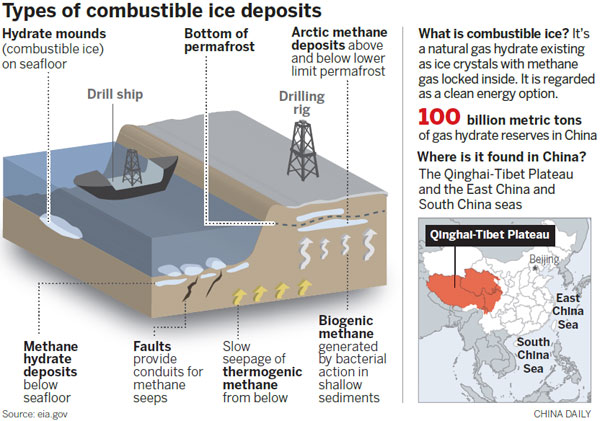
Combustible ice - a natural gas hydrate existing as ice crystals with methane gas locked inside - is usually formed under high pressure and low temperature in permafrost or under the sea.
When exposed to normal air pressure, the hydrate breaks down into water and methane, with 1 cubic meter of the compound releasing about 160 cubic meters of gas, making it a highly energy-intensive fuel.
It is regarded as a clean energy option with high energy density and huge amounts of reserves. It releases less than half the amount of carbon dioxide when burned as does oil or coal.
China's natural gas hydrate research started in the South China Sea, home of the biggest reserve in the country, with an estimated 80 billion metric tons of oil equivalent - the bulk of China's total 100 billion metric tons.
In China, the hydrate has been widely detected in permafrost in areas such as the Qinghai-Tibet Plateau, and below the South China and East China seas.
No country has been able to produce gas commercially, despite its promising potential, due to the challenging conditions of harvesting the hydrate, including worries about potential pollution.
China started research on the energy source in the late 1990s. Its first gas hydrate samples were collected in the South China Sea in 2007.




Copyright 1995 - . All rights reserved. The content (including but not limited to text, photo, multimedia information, etc) published in this site belongs to China Daily Information Co (CDIC). Without written authorization from CDIC, such content shall not be republished or used in any form. Note: Browsers with 1024*768 or higher resolution are suggested for this site.
License for publishing multimedia online 0108263 Registration Number: 130349