|
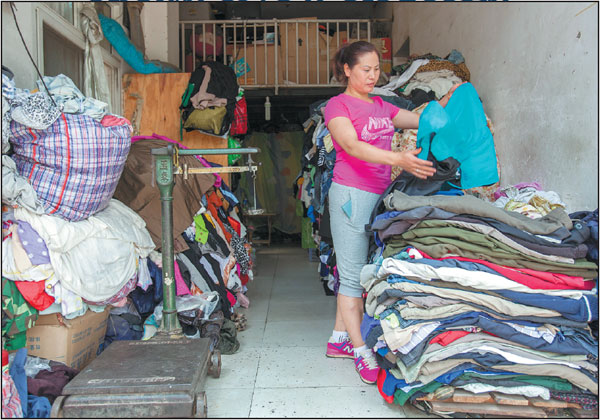
A woman buys secondhand clothes for distribution to homeless people in Kunming, Yunnan province.Xie Rui / For China Daily |
Experts are calling for greater recycling of unwanted clothing to prevent pollution and reduce the consumption of resources, as Zheng Jinran reports.
Though Chen Yang enjoys sorting through cupboards to throw away outdated clothes to make room for recently purchased items, she always feels guilty.
"The clothes are in good condition, but I have no easy way to sell them or donate to charity, so I leave them on a bench in my community," said the 29-year-old publishing house employee in Beijing.
In May, Chen left two bags of clothes on the bench. The next morning the clothes had disappeared, and the trash cans near the bench were empty.
"I hope people in need took the clothes, instead throwing them in the trash," she said.
Her fears were well-founded, because there's a strong possibility that discarded clothing will end up as household garbage, rather than being reused or recycled.
Higher living standards and better wages mean many people have become accustomed to chasing fashion and can buy as many clothes as they want. The problem is that there are few ways of disposing of unwanted items.
A survey conducted by the Beijing Institute of Fashion Technology and the China National Garment Association in 2015 showed that 40 percent of the 1,573 respondents owned 10 to 30 unwanted items of clothing, and 63 percent stored them in closets.
Research unveiled at an event headed by the Ministry of Civil Affairs in 2014 showed that every year less than 14 percent of waste textiles - generated during clothing production - and unwanted clothing were recycled. Moreover, the volume of waste textiles and unused garments was estimated to have reached 20 million metric tons a year.
The recycling of waste textiles and used clothing could provide 12 million tons of synthetic fibers and 6 million tons of natural fibers, meaning fewer textiles would need to be produced. The resultant decline in production would be equivalent to a reduction in crude oil consumption of 24 million tons a year, according to the report.
Meanwhile, polymer-based synthetic fibers, which originate from refined materials, such as petrochemicals, could also be a source of fibers.
"We can convert the plastic used in small water bottles into fibers for T-shirts because they use the same chemical ingredients," said Du Junqi, a professor of synthetic fiber technology at the Beijing University of Chemical Technology.
That could be significant, because random disposal of unwanted clothing and waste textiles can pollute the environment.
"It takes 100 years for cotton or woolen clothes to decompose if they are buried in landfill sites, but it's even longer for textiles made from synthetic fibers," said Zhao Guoliang, a professor of natural fiber recycling technology at the Beijing Institute of Fashion Technology.
"The best way to utilize used clothing is to sell it to people in need."
A promising market
Secondhand clothing stores are commonplace in developed countries, but few exist in China.
"Some of my Japanese friends have become used to buying secondhand clothes, even though some are more expensive than new ones," said Zhao Hua, 29, from Shijiazhuang, Hebei province, who has lived in Tokyo for five years.
Zhao recently bought a secondhand dress. It was cheaper than the items her friends bought, but she is satisfied: "It's stylish and clean."
Chen, the Beijing resident who chases every new fashion, refuses to buy used clothing. She used to sell unwanted garments online, but found the process frustrating: "Negotiating with online buyers is quite time-and-energy-consuming, and I made very little money."
She has doubts about the cleanliness of secondhand clothes: "I don't know where they have been, or if they are clean. Do they harbor bacteria? That thought would make me feel horrible if I wore secondhand clothes."
Despite the doubts, the market for secondhand clothing is promising, given the amount of unwanted garments in storage, and the soaring production and sales of new items.
Last year, sales of textile, clothes, hats and shoes exceeded 1.4 trillion yuan ($205 billion) in China, according to the National Bureau of Statistics, and the country has long been the world's largest textile producer and exporter.
Online platforms that focus on the sale of used clothes are becoming increasingly popular. For example, on Monday, Zhuanzhuan, an online platform that specializes in old clothing, carried information of about 380,000 items nationwide.
"Not all the used clothing sells, but big brand items sell for far more than regular brands," said Liu Chang, Zhuanzhuan's brand operations manager.
Noting that China has banned the importation and sale of used clothing, Zhao, from the fashion technology institute, said: "The used clothing business requires supervision because there are no laws or regulations to regulate collectors and vendors, or guarantee quality and the legality of supply."
Collections rising
While the institute's 2015 survey showed that 58.8 percent of respondents wanted to donate used clothing to people in need, there are few charities to receive their donations, and many branches of the Red Cross Society refuse to receive used clothing because of health concerns and storage costs.
While companies, including e-commerce giants such as JD.com and Taobao, and a number of express delivery outfits, have joined efforts to collect used clothing, voluntary groups shoulder the lion's share of the work.
"We conducted a weeklong collection project from April 10 to 17," Zhuanzhuan's Liu said, adding that the project was well supported, with more than 38,000 people from 28 cities donating more than 37.2 tons of discarded clothing. On average, each participant offered 96 items.
"We plan to organize more events in the future," Liu said.
Ma Yun, founder of Feimayi, a Shanghai NGO that started in 2014, is concerned about finances: "Our charity won't last long if we cannot cover basic costs, such as those for collection, storing and sorting."
Feimayi has developed a method of dealing with the items it collects: 15 percent is exported, 10 percent is donated and the remainder is taken to recycling plants. "The exported clothes mainly go to African countries," Ma said.
Data from the Bureau of International Recycling in Brussels show that in many African countries, 80 percent of the population dresses in secondhand clothing, mainly imported from the US, European countries and China.
Recycling
According to Zhao, from the fashion technology institute, the biggest problem is recycling discarded clothing to produce yarns and other products: "Sales and donations account for a relatively small proportion of the work."
Beijing Huanwei Group, a leading waste-disposal company, has built a large processing center in Handan, Hebei province. The center will become operational soon, according to Li Shurun, who oversees the recycling division. In time, the annual recycling capacity will be expanded to 50,000 tons.
"We use advanced recycling technology, and have imported new machines to sort clothing. The process is more efficient and accurate than manual sorting," he said.
Using existing technology widely adopted in China and new techniques pioneered by teams from the fashion technology institute and the Beijing University of Chemical Technology, unwanted clothing can be recycled as yarn for clothes, and in wider applications, such as loudspeaker cones, furniture padding, car insulation and even building materials.
"Many domestic companies are adopting advanced technologies, and we can dream big because of this promising recycling market," said Du, professor of synthetic fibers at the university.
Contact the writer at zhengjinran@chinadaily.com.cn




Copyright 1995 - . All rights reserved. The content (including but not limited to text, photo, multimedia information, etc) published in this site belongs to China Daily Information Co (CDIC). Without written authorization from CDIC, such content shall not be republished or used in any form. Note: Browsers with 1024*768 or higher resolution are suggested for this site.
License for publishing multimedia online 0108263 Registration Number: 130349