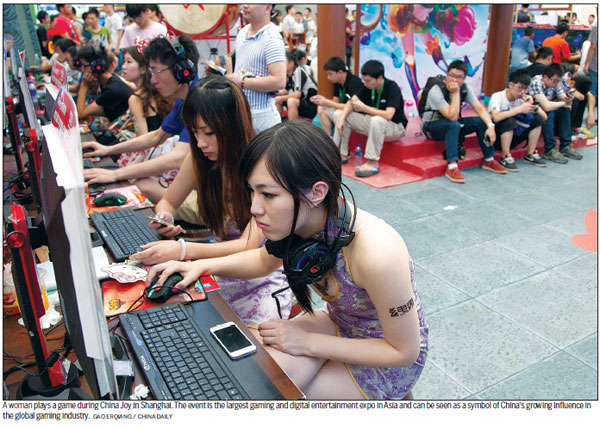
Wary of putting all their eggs into one basket, many Chinese gaming companies today are looking to expand beyond China's shores to gain a piece of the global market share
The influence of China's gaming industry is growing, as evidenced by the presence of Chinese developers at the Apple Worldwide Developers Conference (WWDC) which took place from June 5 to 9 in San Jose, California.
Getting into the prestigious event is not easy - companies are either selected by Apple or are picked through a lucky draw. This year, at least three Shanghai-based game companies were in attendance. The price of attending the event as an audience member is also indicative of how high-end WWDC is. Each ticket costs $1,599.
Lilith Technology, known for its action card game Xiaobingbing Legend, was among the Chinese companies at the WWDC. According to Du Yi, the company's game developer, Lilith Technology has managed to stand out from its peers because of its commitment to exporting Chinese culture to the world.
"Game developers should have a sense of mission for creating games that can showcase a country's values. While Xiaobingbing Legend has made it to Apple's game rankings in many countries, our new game Sword and Homeland is more valuable in our opinion because it embodies the ideals of our team, which is to help the world better understand Chinese values," he said.
Zhang Mingjing, chairman of Shanghai Kumora Information Technology, another Chinese company that was at the WWDC, said that it was a great privilege to be invited. He added that the conference is an important platform for Chinese gaming startups looking to break into the global market.
"The overseas game market is comparatively more mature as users know exactly what kind of games they like to play. But exploring other markets does not mean that we are not coming back in China. We believe the Chinese domestic market will become fully mature in the coming three years. As such, the teams with overseas experiences will be able to seize market share more easily," he said.
According to a report released during last year's China Digital Entertainment Expo and Conference, also known as China Joy, overseas sales of mobile games developed by Chinese companies hit $4.65 billion in 2016, up 76.8 percent year-on-year.
In addition, mobile market monitor Newzoo discovered that China accounted for 17.4 percent of the $26.7 billion overseas mobile games market. In June, a report published by London-based venture capital firm Atomico stated that China has already overtaken the US as the world's gaming capital in terms of market size.
The leading industry players in China have also highlighted their ambitions in overseas markets with a number of high-profile acquisitions. Shenzhen-based Tencent Holdings bought over Finnish mobile game company Supercell, which is best-known for its highly popular game Clash of Clans, for $8.6 billion in June 2016. Later that year in August, a consortium led by Giant Network and YF Capital acquired Israeli online game developer Playtika for $4.4 billion.
According to market consultancy IDC, Chinese companies will maintain this growth momentum in 2017, especially since global social network platforms such as Facebook are looking to cooperate with Chinese game companies.
Moreover, the Google Developers platform was made available to Chinese developers in December, providing them with a larger set of tools to drive innovation and growth in the industry.
"For Chinese gaming companies, there will be little chance left for them if they only eye the domestic market. Globalization is the only way out," said Wang Feng, chief executive of Beijing-based online game developer Linekong Interactive Group.
Zhang Hao, the co-founder of Lilith, said that being based in a city as cosmopolitan as Shanghai has its advantages as the city is home to all kinds of resources vital to the development of a gaming startup.
"The world's leading game companies usually choose Shanghai as the first stop when they come to study the Chinese market. The mature capital market here can address financing problems and the establishment of the China (Shanghai) Pilot Free Trade Zone has facilitated the outbound trade of games," he said.
"The localized review of games published in Shanghai, which took effect in 2014, has also shortened the review period by up to three months, which is the crunch time for most startups," he added.
Blizzard Entertainment, one of the world's largest gaming companies that developed the Warcraft, Diablo and StarCraft franchises, has an office in Shanghai. UbiSoft, the creators of the massively popular gaming series Assassin's Creed, has also set up shop in the city.
According to the Shanghai Game Publishing Industry Report released in July 2016, the turnover of online games across all platforms in Shanghai reached 49.93 billion yuan ($7.3 billion) in 2015.
Meanwhile, the income generated by games developed by Shanghai companies was 38.64 billion yuan. Game exports were on the rise as well - $695 million worth of games made in Shanghai games were sold in overseas markets, up 31.6 percent year-on-year.
Some of China's biggest gaming companies, including Shanda Group, Giant Network and Youzu Interactive, are based in Shanghai too.
Established in 1999, Shanda became the first Chinese gaming company to complete an overseas acquisition in 2004. The company went public on Nasdaq in 2009 and acquired the US flash game platform company Mochi Media for $80 million a year later.
In 2015, Shanda started to explore the overseas mobile games market by merging its three companies in South Korea. In the same year, income from the overseas market accounted for 20 percent of the company's total turnover. By the end of 2018, overseas income is expected to hit 40 percent of the company's total.
Giant Network went public on the New York Stock Exchange in 2007 due to the success of its games under the ZT Online Series. Early last year, the company announced its plan to set up a 770 million yuan overseas operation and distribution platform within the next four years.
Youzu Interactive started to reach out to the global market in 2008 with its game Goddess League, which was the first Western webpage game developed by a Chinese company. Last year, Youzu announced its acquisition of German game developer Big Point to strengthen its overseas expansion in the US and European markets.
shijing@chinadaily.com.cn




Copyright 1995 - . All rights reserved. The content (including but not limited to text, photo, multimedia information, etc) published in this site belongs to China Daily Information Co (CDIC). Without written authorization from CDIC, such content shall not be republished or used in any form. Note: Browsers with 1024*768 or higher resolution are suggested for this site.
License for publishing multimedia online 0108263 Registration Number: 130349