The unsung artist who inspired the Dutch master
In 1635, a talented Dutch teenager, with dreams of becoming an artist, arrived in London. Not yet 18 years old, he joined the studio of his uncle, Robert van Voerst, royal engraver to Charles I. Soon afterwards, the youth's father, also an artist, sent him a trunk filled with clothes and art supplies, including a mannequin.
With it was a letter, offering instructions: "Use the mannequin and do not let it stand idle," his father wrote. "Draw a lot: large, dynamic compositions."
Evidently, the youngster took this advice to heart because, in time, he became one of the most renowned artists of the Dutch Golden Age. His work was sought after by the aristocratic elite of Amsterdam. And monarchs and rulers across Europe - including William of Orange and Cosimo III de' Medici - desired his services.
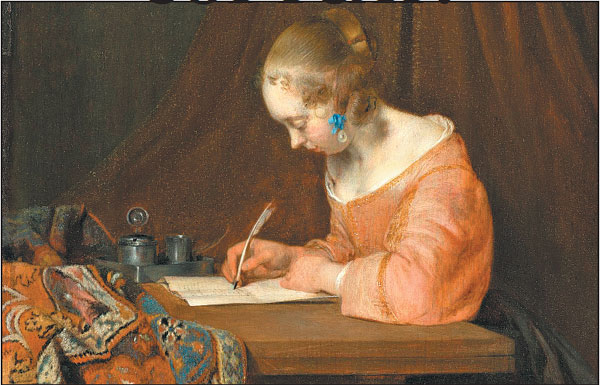
Yet, today, Gerard ter Borch, as he was called, is hardly a household name. This is, surely, one of the great injustices of art history, for Ter Borch (1617-81) was a suave and spellbinding artist, famous for his pictures of juffertjes (young ladies) that showcased his marvellous ability to capture the sheen and texture of sumptuous satin gowns.
Moreover, he was an essential influence upon his younger contemporary, Johannes Vermeer (1632-75). And while, today, Ter Borch is, if not forgotten, then recognised principally by specialists, Vermeer is, of course, universally celebrated.
"Without Ter Borch, there would be no Vermeer - that is clear," says Adriaan E Waiboer, the art historian responsible for Vermeer and the Masters of Genre Painting, a scintillating new exhibition of 60 paintings (including 10 by the master of Delft), which is about to open in Dublin, at the refurbished National Gallery of Ireland.
Unsung hero
Earlier this year, a version of the exhibition was staged at the Louvre, where it was visited by 325,000 people. Walking around, it was clear to me that the show's unsung hero - the great innovator who popularised many of the subjects and motifs later immortalised by Vermeer - was Ter Borch, an artist associated not with the dynamic metropolis of Amsterdam, or even Delft, but with a small Dutch trading town called Deventer, out in the sticks, in the eastern province of Overijssel.
Born in Zwolle, also in Overijssel, Ter Borch was taught to draw by his father, who proudly kept an early sketch of a horseman by his son, executed when he was just seven years old.
Following apprenticeships in Amsterdam, Haarlem and London, where he must have been dazzled by the elegance of the English court, Ter Borch Jr departed for southern Europe. During his travels, which occupied him for the next decade and a half, he visited Spain where, it was said, he painted Philip IV. If true, this was an astonishing coup: it beggars belief that an unknown young Dutchman would have been commissioned to make a portrait of the Spanish monarch.
Ten years later, though, Ter Borch was certainly moving in powerful circles: in 1648, he painted his early masterpiece, The Ratification of the Treaty of M??nster, which belongs to the National Gallery in London. This group portrait, featuring 77 men, depicts the ceremony that officially ended the Dutch Republic's 80-year struggle with Spain.
"Clearly, Ter Borch was comfortable dealing with people of elevated status," says Waiboer. "In that sense, he was a bit of a small Rubens, rather than this artist from the countryside who happened to be amazingly influential. He travelled an enormous amount, knew how to use a knife and fork, had connections. And that must have made a huge impression on Vermeer."
It was around this time that Ter Borch began his so-called genre paintings - intimate scenes of "daily life", typically featuring well-dressed men and women from the upper bourgeoisie. Much imitated by his peers, these are also the pictures upon which Ter Borch's fame rests today - for, among connoisseurs, his reputation has not dwindled. According to Waiboer, if a good genre painting by Ter Borch came on the market now, it would fetch &4.5 million.
In many of his genre pictures, Ter Borch used as a model his beautiful half-sister, Gesina, whom he sketched repeatedly in the late 1640s and early 1650s. She appears, for instance, in the Rijksmuseum's Woman at a Mirror (c1650) her face reflected in the looking glass. This ingenious composition, which simultaneously provides a front and back view of Gesina, features two quintessential "Ter Borchian" elements: a beautiful young lady, brightly lit against a dark background, and seen from behind; and expensive satin garments, in this case a shimmering white dress trimmed with gold braid.
Gesina pops up again, this time in profile, in A Young Woman at Her Toilet with a Maid (c1650), now in the Metropolitan Museum of Art in New York. This important panel, which presented a full-length figure in an elegant domestic interior for the very first time, initiated the vogue for "high-life" genre scenes that dominated Dutch painting in the second half of the 17th century.
In other words, without the inventions of Ter Borch, there would be no tranquil, enigmatic paintings of attractive young women by Vermeer. "The whole idea of women seen in a moment of contemplation, that stillness we like in Vermeer: they essentially come from Ter Borch," says Waiboer. "The idea of unresolved social interactions - that's also very Ter Borch. He invented that."
Inventive mind
Many of Ter Borch's works feature notes of narrative drama and psychological intrigue. For instance, in A Lady at her Toilet (c1660) the highborn protagonist - whose radiant white satin skirt is, incidentally, a tour de force - fiddles distractedly with a ring, while a perturbed expression flickers across her face.
Like many of the young ladies whom Ter Borch painted lost in their own thoughts, she is not a type but an individual - one, surely, troubled by love. This psychological component was arguably Ter Borch's chief innovation.
Even greater psychological complexity is evident in his best-known painting, Gallant Conversation, which Ter Borch painted in 1654, the same year he settled permanently in Deventer, having married his stepmother's sister. This ambiguous scene depicts either a father remonstrating with his daughter, or a military officer sizing up a courtesan in an upscale brothel. "He invents so much," says Waiboer. "All these women writing letters, reading letters, at their toilet: Ter Borch invents one subject after another."
By contrast, art historians have discovered compositional sources for almost all Vermeer's works. This is because Vermeer did not simply "paint reality", as is commonly assumed, but kept an eye on what his artist-peers were up to: time and again, he borrowed subjects and poses from people whom he admired.
"The big difference between Ter Borch and Vermeer," says Waiboer, "is that Vermeer isn't an innovator, in terms of subject matter. In fact, he's highly unoriginal." Of course, Waiboer continues: "In our own time, we are obsessed with who came up with something first, whereas these guys [17th-century Dutch artists] were interested in who painted something best. Vermeer was no innovator, but he was a synthesiser - and an improver.
"Vermeer was born at the right moment. Great artists had been there before him. He looked around, picked the best elements and ideas, and brought them to another level. Vermeer beats Ter Borch at, for instance, painting daylight and spatial illusion."
Even so, given Ter Borch's primacy and influence, why is he not a household name, while Vermeer is? Arguably, it is the apparent simplicity of Vermeer's paintings that appeals to contemporary taste. "We like simple, we like straightforward, we like Apple iPhones," says Waiboer, with a smile. "And Vermeer fits that very well."
If you go
Vermeer and the Masters of Genre Painting: Inspiration and Rivalry opened at the National Gallery of Ireland, Dublin, on June 17; nationalgallery.ie




Copyright 1995 - . All rights reserved. The content (including but not limited to text, photo, multimedia information, etc) published in this site belongs to China Daily Information Co (CDIC). Without written authorization from CDIC, such content shall not be republished or used in any form. Note: Browsers with 1024*768 or higher resolution are suggested for this site.
License for publishing multimedia online 0108263 Registration Number: 130349