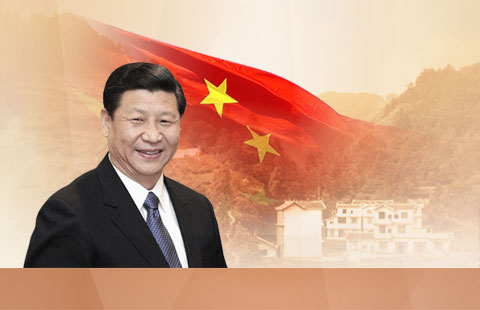
On his first trip outside Beijing in late 2012, after becoming general secretary of the Communist Party of China Central Committee, Xi Jinping laid flowers before a statue of Deng Xiaoping, China's former leader, on a hillside in Shenzhen, which neighbors Hong Kong.
Coming down the hill, a Hong Kong journalist asked Xi if he had anything to say to his Hong Kong compatriots.
Xi's answer was short but powerful: "Hong Kong will prosper."
Five years on, Xi's confidence has become a solid reality. It's been two decades since Hong Kong was handed back to China under the principle of "one country, two systems", and the region is doing better than ever.
Contrary to the predictions of various prophets of doom, the special administrative region has remained a center of international finance, shipping and trade and has been recognized as one of the world's freest and most competitive economies.
Mainland support
Aside from a business-friendly environment that encourages openness and productivity, the modern metropolis of more than 7 million people owes much of its economic success to closer links with the mainland.
Since 1997, the central government has made significant efforts to ensure the stability and prosperity of the Hong Kong SAR.
Basic necessities - 100 percent of the region's live cattle, 95 percent of its pigs, 90 percent of its vegetables and 70 percent of its flour, for example - are supplied by the mainland.
The Guangdong-based Daya Bay Nuclear Power Plant provides one-fourth of Hong Kong's annual electricity needs. And 70 to 80 percent of the SAR's fresh water comes from the mainland.
The central government also provided support during the Asian financial crisis in 1997, the international financial crisis in 2008 and the SARS outbreak.
"Hong Kong understands that its future and the mainland's are symbiotic and intertwined," 88-year-old Hong Kong tycoon Li Ka-shing told Xinhua in a recent interview. "The idea of 'one country, two systems' epitomizes the creativity and flexibility of Chinese leaders." He added that President Xi's unwavering commitment to the principle is "strong and comforting".
Xi has reaffirmed the "one country, two systems" principle on many occasions.
"Twenty years of practice shows that 'one country, two systems' is not only the best solution to the Hong Kong question left over from history, but also the best institutional arrangement for its long-term prosperity and stability since its return," Xi said on Monday during a visit to an exhibition in Beijing profiling Hong Kong's achievements over the past two decades.
"We will continue to comprehensively and precisely implement the 'one country, two systems' principle, handle affairs strictly in line with the Constitution and the Basic Law of the Hong Kong Special Administrative Region and further promote the overall development of Hong Kong," Xi said.
In his first meeting with Hong Kong SAR Chief Executive Leung Chun-ying in December 2012, after taking the helm of the Party, Xi promised "unchanged support" for the chief executives and governments of the Hong Kong and Macao SARs in carrying out their duties.
The central government's adherence to the "one country, two systems" principle and the Basic Law in the two SARs will not change, he said.
During a meeting with incoming Hong Kong SAR Chief Executive Carrie Lam Cheng Yuet-ngor in April, Xi said the "one country, two systems" principle in Hong Kong is unique and needs to be advanced through fresh explorations. The government's determination will not change or waver, Xi said.
Xi has backed up his words with action. In 2015, for example, the Chinese mainland and Hong Kong reached the Closer Economic Partnership Arrangement on the service trade. Plans for the Guangdong-Hong Kong-Macao Greater Bay Area are expected to link the SARs more closely to the Pearl River Delta's manufacturing and innovation heartland.
In addition, the Belt and Road Initiative is expected to boost Hong Kong's financial clout.
Land of optimism
Both the Belt and Road Initiative and the Greater Bay Area development plan are seen as drivers for Hong Kong's development. The central government's annual work report this year said China is planning to develop a city cluster in the Greater Bay Area that plays to the distinctive strengths of Hong Kong and Macao and elevates their roles in the mainland's development and opening-up. The plan includes the two SARs and nine cities in Guangdong province.
Hong Kong "can be very proud of itself" for its achievements during the past 20 years, said Eric Berti, consul general of France in the Hong Kong and Macao SARs. "For foreign companies, especially French companies, it is very important to be able to settle here for the wide Chinese market."
Kurt Tong, US consul general to the Hong Kong and Macao SARs, said the "one country, two systems" principle "allows Hong Kong to be special and different while still being part of China" - a posture that has brought prosperity.
Xinhua




Copyright 1995 - . All rights reserved. The content (including but not limited to text, photo, multimedia information, etc) published in this site belongs to China Daily Information Co (CDIC). Without written authorization from CDIC, such content shall not be republished or used in any form. Note: Browsers with 1024*768 or higher resolution are suggested for this site.
License for publishing multimedia online 0108263 Registration Number: 130349