Ancient China's most celebrated travel writer and geographer contributes to Jiangyin's appeal. Cang Wei and Erik Nilsson report in Jiangyin, Jiangsu province.
Jiangyin's status as the hometown of ancient China's most famous traveler has made it a modern destination for travelers from around the world.
Such contemporary attractions as China's richest village, a horse museum and traditional neighborhoods also lure explorers to the explorer's hometown.
But ancient adventurer and geographer Xu Xiake remains a main draw.
|
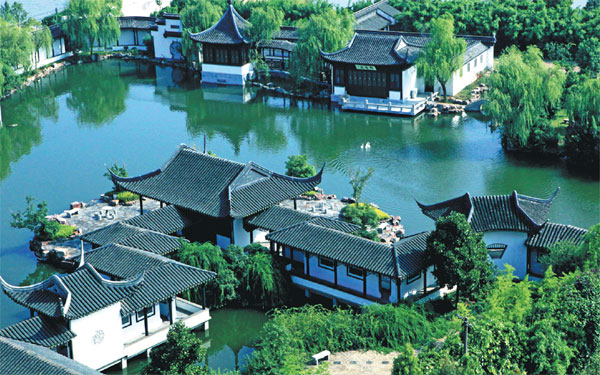
The former residence of the celebrated Ming Dynasty (1368-1644) traveler Xu Xiake, who spent over three decades roaming the country while chronicling his explorations in his 2.6 million-word treatise, The Travel Diaries of Xu Xiake. Photos Provided to China Daily |
The county-level city in Jiangsu province is celebrating the 430th birth anniversary of the Ming Dynasty (1368-1644) luminary, whose 2.6 million-word treatise, The Travel Diaries of Xu Xiake, is still widely read.
He spent over three decades roaming throughout 16 imperial provinces, chronicling his explorations in detail. His diaries belong to the ancient category of "travel literature" that's known not only for taking travel as its subject but also describing authors' experiences with narrative prose.
He was born to a wealthy father, who preferred nature to power - and particularly, landscapes over official positions.
Xu took after his dad. He enjoyed books on history, geography and adventure. He especially enjoyed reading about China's mountains and rivers. The child decided he'd see them himself when he grew up.
He took the imperial exam at age 15. He failed.
His father encouraged him to study out of interest rather than a desire for status.
Xu's dad died when he was 19. The son remained in Jiangyin out of filial piety until age 22, when he set off to discover the outside world - with his mother's blessings - in the spring of 1607.
He not only recorded his experiences but also documented such geographical and topical features as gorges and mineral beds with scientific accuracy.
Xu is credited with discovering the Yangtze River's headwater.
People often visit his former residence in Jiangyin. Celebrated calligraphers have inscribed stone tablets with passages from The Travel Diaries of Xu Xiake.
The Xu Xiake International Tourism Resort is scheduled to open in the city in 2020.
Tourism authorities say it received a total investment of about 30 billion yuan ($4.4 billion) and forecast it'll attract 3 million to 5 million visitors a year.
Planners will design islands with different motifs from Xu's writings, including a theme park, cultural experiences and a wetland area.
The city also hosted the 12th Xu Xiake International Traveling Festival in May.
But the celebrated traveler isn't the only reason people travel to Wuxi.
The county also contains Huaxi - China's wealthiest village. Residents live in posh villas and own cars. Grand statues line the street.
The Hailan Horse Culture Museum claims to be the world's only horse-culture museum. And its equine residents are well pampered - and "dressed" (many manes are braided by hairdressers).
It set a Guinness World Record as the club with the greatest diversity of horse breeds.
The 8,700-square-meter museum that opened last year hosts 48 horses of 47 breeds from around the world. It also contains artworks, interactive displays and a dressage-performance area. That's not to mention a shopping mall.
The museum and surrounding buildings are constructed according to European conventions. It has sparkling chandeliers, grand carpeted staircases and gold ceilings.
It's a far cry from the aesthetic of Changjing Road, where residents live in buildings that borrow architectural sensibilities from both the northern and southern Yangtze River Delta, since inhabitants are descendants of Anhui province and neighboring Wuxi city.
The homes that crowd against a kilometer-long canal hail to the Ming (1368-1644) and Qing (1644-1911) dynasties.
The area also hosts the Dafu Silk Worm Field, the Zhang Dalie Folk Museum and the childhood home of classic film star Shangguan Yunzhu, who appeared in 30 movies decades ago. (The house has been converted into a shrine to the celebrity.)
While modernity and urbanization reconfigure the world - with particular ferocity in China - Changjing isn't likely changing much any time soon.
But the city's history is perhaps best displayed at the Jiangyin Museum.
Exhibits include China's oldest excavated medical instruments, dating to about 1410 BC, a 5,000-year-old skeleton and witches' charms - plus a cannon used to defend Jiangyin from the invading Eight-Nation Alliance in 1900.
And, of course, there are sections devoted to Xu Xiake.
Contact the writers at cangwei@chinadaily.com.cn
Zhu Jingwen contributed to this story.




Copyright 1995 - . All rights reserved. The content (including but not limited to text, photo, multimedia information, etc) published in this site belongs to China Daily Information Co (CDIC). Without written authorization from CDIC, such content shall not be republished or used in any form. Note: Browsers with 1024*768 or higher resolution are suggested for this site.
License for publishing multimedia online 0108263 Registration Number: 130349