Three generations have documented the development of people-to-people ties between the two countries
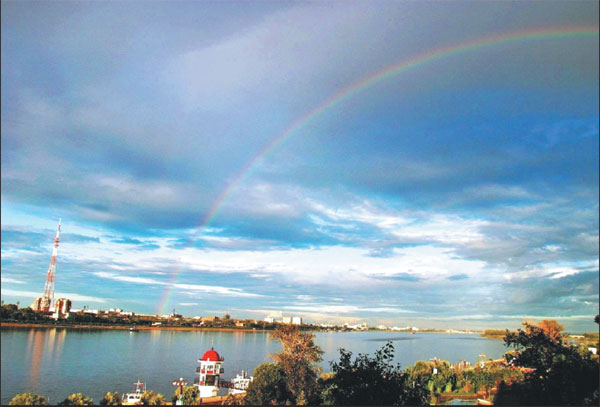
After a summer rain shower, Qiu Xianglin takes his camera and walks along the Heilongjiang River, which serves as a boundary between China and Russia, hoping to capture a rainbow stretching over the river between Heilongjiang province's Heihe city and the Russian city of Blagoveshchensk.
"It is the most beautiful image I can capture," said 74-year-old Qiu, former chief photojournalist for Heihe Daily. For 40 years, he recorded the changes in Sino-Russian economic and trade cooperation, taking more than 100,000 photos.
Watermelons in Exchange for Chemical Fertilizers is one of his most famous works. It was taken in September 1987, shortly after trade through Heihe Port was resumed. "Our side traded 208 metric tons of watermelons for more than 300 metric tons of much-needed fertilizers," Qiu said.
Over the years, trade has flourished between the two sides, and Qiu has witnessed a lot of it firsthand.
"Heihe's people-to-people trade with the former USSR was the most dynamic - a scene not seen in other Chinese cities," Qiu said. "The central street was filled with wheeler-dealers who traded sportswear with the Soviets for wool coats."
China's light industrial products such as clothing, shoes and hats were popular on the other side, while Soviet leather and metal products won the hearts of Chinese.
In order to satisfy the needs of both sides, the first economic and trade fair between China and the then-USSR, as well as eastern European countries, was held by the former ministry of foreign trade and economic cooperation - which is now the Ministry of Commerce - and the provincial government of Heilongjiang in the provincial capital of Harbin in 1990.
"Barter trade was basically the major mode of doing business, which was the precursor to the Harbin International Economic and Trade Fair," said Qiu, who took many pictures of the event.
Three Middle-Aged Men with Hands Clasped Behind Their Backs, Bending Over and Inspecting Crafts Made of Birch is a photo taken at the 23rd Harbin International Economic and Trade Fair in 2012 by Qiu's son, Qiu Qilong.
After the dissolution of the Soviet Union, the fair underwent several changes before taking its final form, focusing on Russia.
Qiu Qilong followed in his father's footsteps, continuing to photograph scenes from the fair every year.
In 2014, the 25th edition of the fair was upgraded to the China-Russia Expo. The same year, Qiu Guodong, 19, bid farewell to his hometown of Heihe, leaving to study at Heilongjiang Institute of Technology in Harbin.
Influenced by his father and grandfather, Qiu Guodong has been documenting China-Russia ties since he was a child. Fluent in Russian, he has a certain affection for the country.
"My father often talked to me about what the trade fair looked like, but what I saw in person was a lot different," Qiu Guodong said.
Stepping into the Harbin International Conference and Exhibition Center, where the fourth China-Russia Expo was held from June 14 to 18, left him shocked.
Cutting-edge exhibits, such as a model of China's manned deep-sea research submersible Jiaolong, an unmanned plane, nanotechnology and graphene, changed his thoughts about Sino-Russian cooperation.
It encouraged him to conduct research on cross-border e-commerce between China and Russia. "College students are encouraged to start their own business, and I think my hometown has some advantages," he said.
This year's expo also focused on further expanding common ground for the development of the Belt and Road Initiative and the Eurasian Economic Union, with merchants and government officials from 74 countries and regions participating in the event.
After another summer rain shower, Qui Xianglin once again walks along the Heilongjiang River, but there is no rainbow in sight. Instead, he raises his camera and takes a picture of a bridge being built. It will connect Heihe and Blagoveshchensk, bringing the twin cities even closer.
Xinhua
|
A rainbow connects Heihe in Heilongjiang province and the Russian city of Blagoveshchensk.Qiu Xianglin / For China Daily |




Copyright 1995 - . All rights reserved. The content (including but not limited to text, photo, multimedia information, etc) published in this site belongs to China Daily Information Co (CDIC). Without written authorization from CDIC, such content shall not be republished or used in any form. Note: Browsers with 1024*768 or higher resolution are suggested for this site.
License for publishing multimedia online 0108263 Registration Number: 130349