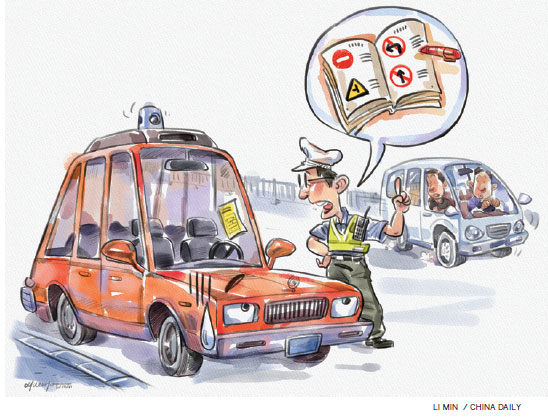
Editor's note: Robin Li, the chairman of China's largest search engine Baidu livestreamed himself riding in what he claimed was his company's first driverless car on Beijing's Fifth Ring Road on July 5, sparking a public debate on traffic regulations. There is no law or regulation on driverless cars, and traffic police said they are investigating the case. Three experts share their views on the subject with China Daily's Wu Zheyu. Excerpts follow:
Be prepared for the imminent auto storm
Although the United States National Highway Traffic Safety Administration has a broader definition for intelligent vehicles, which is accepted by many countries, cars as a whole can be classified into five grades. If a manually driven car is grade 0, a fully self-driving car will be grade 4.
A grade-4 car should have a perfect combination of environmental perception, decision-making and automatic control. For example, Google's driverless car, which many are familiar with, could self-drive only on special roads such as the Fourth and Fifth Ring Roads in Beijing, so it should be classified as grade 3. Theoretically, a self-driving car should not need a human driver.
Intelligent car technology is being developed to improve road safety. Studies show many accidents are caused by drivers' negligence, and intelligent vehicles can help achieve harmony among motorists, cars and road.
Grade 1 and 2 intelligent vehicles have already achieved industrialization. In fact, Google plans to launch its driverless car in 2018, with General Electric and BMW following in 2020. Chinese companies, on the other hand, plan to launch grade 3 vehicles between 2020 and 2025.
As the Institute of Electrical and Electronic Engineers estimates, self-driving cars will have about 75 percent of the automobile market by 2040 and thus change the current road transport mode.
Li Shengbo, an associate professor at the Department of Automotive Engineering, Tsinghua University
Specific rules needed for self-driving cars
That Robin Li, founder and CEO of Baidu, could livestream himself traveling in a driverless car reflects society as a whole welcomes the development of new technologies. But despite that, the authorities have to determine whether or not Li violated any traffic rules.
Although Li later explained that his fellow passenger was actually occupying the "driver's seat", conducting self-driving car tests in cities such as Beijing can be very risky - to those riding in the driverless cars as well as pedestrians and the drivers of other vehicles.
As members of the Chinese People's Political Consultative Conference, Robin Li, and Li Shufu have submitted proposals to the CPPCC National Committee seeking legislation on self-driving cars, which the authorities should consider seriously.
The good news is that the e-zone for self-driving cars in the National Intelligent Connected Vehicle Testing Demonstration Base in Shanghai has been open to public since July. Approved by the Ministry of Industry and Information Technology in June 2015, the e-zone will act as an incubator for innovative intelligent vehicles. Companies that want to launch their intelligent vehicles in the market can conduct different types of tests in the e-zone. More such facilities and specific regulations on intelligent vehicles are needed to boost the development of self-driving cars.
Wang Lin, director of litigation law faculty, Law School of Hainan University
How to ensure road and public safety?
Since Baidu did not seek prior permission to conduct a trial run of its driverless car, it should be held accountable for its action. Since there are no regulations on even the fundamental aspects of developing self-driving cars, the authorities should at least standardize one aspect of the process: only companies that obtain prior permits can conduct such tests. And for that, specific traffic lanes have to be designed and special road signs put up.
The biggest concern of allowing self-driving cars on the road is: How to rule out the systematic risks? An intelligent car may be absolutely problem free when it leaves the factory, but since it runs on telecom technology and GPS, a hacker can transform it into a potential threat. In such a case, who will be responsible for the consequences?
This might be a crucial challenge while drafting laws and rules on intelligent cars.
Gu Dasong, an associate professor of School of Law, Southeast University




Copyright 1995 - . All rights reserved. The content (including but not limited to text, photo, multimedia information, etc) published in this site belongs to China Daily Information Co (CDIC). Without written authorization from CDIC, such content shall not be republished or used in any form. Note: Browsers with 1024*768 or higher resolution are suggested for this site.
License for publishing multimedia online 0108263 Registration Number: 130349