Scientists blame humans for accelerating loss of biodiversity
PARIS - The sixth mass extinction of life on Earth is unfolding more quickly than feared, scientists have warned.
More than 30 percent of animals with a backbone - fish, birds, amphibians, reptiles and mammals - are declining in both range and population, according to the first comprehensive analysis of these trends.
"This is the case of a biological annihilation occurring globally," said Stanford professor Rodolfo Dirzo, co-author of a study published on Monday in the peer-reviewed US journal, Proceedings of the National Academy of Sciences.
Around a decade ago, experts feared that a new planetary wipeout of species was looming.
Today, most agree that it is underway - but the new study suggests that the die-out is already ratcheting up a gear.
It provides much-needed data about the threat to wildlife, mapping the dwindling ranges and populations of 27,600 species. For 177 mammals, researchers combed through data covering the period 1900 to 2015.
The mammal species that were monitored have lost at least a third of their original habitat, the researchers found.
Forty percent of them - including rhinos, orangutans, gorillas and many big cats - are surviving on 20 percent or less of the land they once roamed.
The loss of biodiversity has recently accelerated.
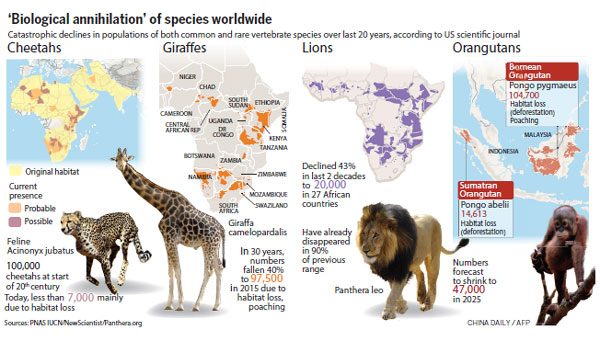
"Several species of mammals that were relatively safe one or two decades ago are now endangered," including cheetahs, lions and giraffes, the study showed.
Globally, the mass die-off - deemed to be the sixth in the last half-billion years - is the worst since three-quarters of life on Earth, including the non-avian dinosaurs, were wiped out 66 million years ago by a giant meteor impact.
There is no mystery as to why: our own ever-expanding species - which has more than doubled in number since 1960 to 7.4 billion - is eating, crowding and polluting its planetary cohabitants out of existence.
By comparison, there are as few as 20,000 lions left in the wild, less than 7,000 cheetahs, 500 to 1,000 giant pandas and about 250 Sumatran rhinoceros.
Main drivers
The main drivers of wildlife decline are habitat loss, overconsumption, pollution, invasive species, disease, as well as poaching in the case of tigers, elephants, rhinos and other large animals prized for their body parts.
Climate change is poised to become a major threat in the coming decades, with some animals - most famously polar bears - already in decline due to rising temperatures and changing weather patterns.
"The massive loss of populations and species reflects our lack of empathy to all the wild species that have been our companions since our origins," said lead author Gerardo Ceballos of the National Autonomous University of Mexico.
Beyond any moral imperative, there are practical reasons to rue the eclipse of animals, whether megafauna or smaller and less "charismatic" creatures, the researchers said.
The vanishing of a top-level carnivore or herbivore can have a cascading effect down the food chain, disrupting entire ecosystems.
Other species directly provide "services" to humans, such as honeybees that pollinate crops or birds that ensure pest control.
Previous studies show that ecosystems under stress, while resilient, have a breaking point - rapid change can lead to collapse.
Agence France-presse




Copyright 1995 - . All rights reserved. The content (including but not limited to text, photo, multimedia information, etc) published in this site belongs to China Daily Information Co (CDIC). Without written authorization from CDIC, such content shall not be republished or used in any form. Note: Browsers with 1024*768 or higher resolution are suggested for this site.
License for publishing multimedia online 0108263 Registration Number: 130349