Shandong government introduced 74 projects in three years to provide jobs and promote development of remote areas
Around 6 kilometers from the urban area of Shule county, Kashgar, one of the least-developed areas in Northwest China's Xinjiang Uygur autonomous region, is home to a textile industrial park.
With modern facilities such as spacious plants and solar powered street lamps, it stands out on an otherwise vacant expanse of land.
Inside a plant at the Shule Ruyi Hi-Tech Textile Industrial Park, a project invested in by Ruyi Group, which is based in Jining, Shandong province, dozens of workers fine-tune the automatic production line, preparing for the official start of production, which is scheduled for this month.
"I have spent two months learning how to manage the production line. It is totally automatic. What I need to do is to keep a close eye on an iPad, which shows whether the machines are working correctly," said Tuhangul Musa, a female worker at the park.
The 24-year-old worked in a local textile and garment company for two years before taking her current job.
"I am looking forward to working at such a spacious and clean plant," Tuhangul said.
After passing a three-month probationary period, she will sign a contract with the company, and get a salary of around 2,500 yuan ($370) a month. Her husband is also working at the textile park.
Long-term project
The head of Ruyi Group's Xinjiang Ruyi Textile Garment Co, Zhou Hongrun, who is responsible for the operation of the company's Shule project, said: "The equipment we use at the plant is considered state of the art in the textile sector. We bought most of it from Germany, Italy and Switzerland."
He said the industrial park involves a total investment of 1.5 billion yuan.
When the entire production line is put into use, it is expected to produce 250,000 spindles of high-quality yarn a year and provide jobs for 1,200 people, 80 percent of whom are from the Uygur ethnic group. The company enjoys preferential policies on tax, use of land and infrastructure from local governments.
Zhou is optimistic about the industrial park and views it as a long-term project.
"The yarn produced at Shule can be used at the textile base built by Ruyi Group in Pakistan," said Zhou, adding that the Pakistan base is scheduled to be completed by 2020.
"By investing in Xinjiang, Ruyi Group not only gains economic benefits, but it creates social benefits," he said.
The company has trained 150 Uygur people in modern textile skills in Shule, and in addition to building plants, the company extends its production line to villagers' homes.
Ruyi Group has provided 50 sock-making machines for 12 families in the fifth village of Baheqi town since June as part of a pilot project. The group plans to provide sock-making machines for 108 families in the village.
Aytuersun manages four machines that were installed in her two-story house in June.
"My job is monitoring whether the machines work well and checking if the socks the machines make have flaws," Aytuersun said.
The 22-year-old works on the first floor and lives with her parents on the second floor. The two-story house was built by the Shandong government as a pilot project to restore dilapidated houses.
Creating more jobs
Ruyi Group is responsible for teaching residents how to use the machines to make socks and collecting the socks to be sold.
The textile project developed by Ruyi Group is one of 74 projects that Shandong has introduced to Kashgar in the past three years in a bid to promote the development of the area and provide more jobs for local Uygur people.
Statistics provided by the Shandong government show the projects have created jobs formore than 60,000 people.
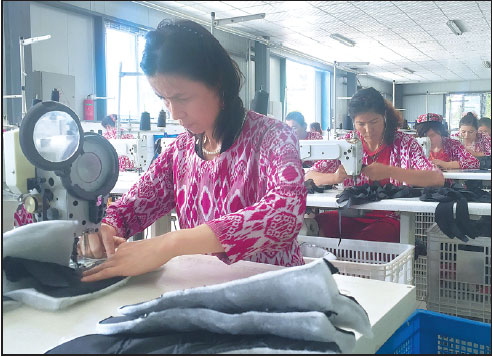
For example, a glove-making project invested in by Jining Zhongxing Garments has involved the development of 19 workshops in villages in Kashgar and has seen more than 2,700 women taught glove-making skills.
"We are developing town and village manufacturing bases to reach more people who are confined to their home, such as seniors and women who have to take care of their children," said Lian Gang, an official with Shandong government's department for assisting Xinjiang.
In the seventh village of Mangxin town in Yengisar county, a stage which was used by residents for dancing is now also used as a place to lock-stitch carpets.
Reziwangul Yiming, 33, works with more than 50 fellow villagers at the stage almost every day.
She earns 3 yuan by lock-stitching 1 meter of carpet for Kashgar New Yinhe Carpet, a company invested in by Shandong Yinhe, which is based in Shandong's Zibo.
Before, Reziwangul had to stay at home to look after her two children.
"I can earn over 1,000 yuan a month. With the money, I buy clothes and books for my children," she said.
"More than 140 women in the village have applied for the job of lock-stitching carpets, of which 70 percent are from impoverished families. They need to be trained before starting work," said Yin Junwei, an official in the village, adding that lock-stitching carpets will substantially improve their quality of life.
In a residential area of Yopurga county, Bilikezi Sayimu manages a cross-stitch cooperative.
"The cooperative has been expanded to cover 1,000 square meters from the original 20 sq m, thanks to 2 million yuan in funding from Taian city's department for assisting Xinjiang," Bilikezi said.
As a part of the 1,000-sq-m compound, there is a kindergarten where two teachers take care of children of workers at the cooperative.
To date, the kindergarten has 18 children.
Products from the cooperative are sold to cities including Beijing, and generated sales revenue of 330,000 yuan last year.
Shandong is working on introducing more projects to the four counties of Kashgar that fit local situations and can promote the area's development in the long run.
"By stretching production lines to villages and homes, we provide places where people can work close to home and make a better living with their own hands, rather than just relying on assistance. It's a sustainable strategy," Lian said.
Contact the writers at zhaoruixue@chinadaily.com.cn
|
Workers make gloves at a workshop invested in by Jining Zhongxing Garments in Kashgar, Xinjiang Uygur autonomous region. Zhao Ruixue / China Daily |




Copyright 1995 - . All rights reserved. The content (including but not limited to text, photo, multimedia information, etc) published in this site belongs to China Daily Information Co (CDIC). Without written authorization from CDIC, such content shall not be republished or used in any form. Note: Browsers with 1024*768 or higher resolution are suggested for this site.
License for publishing multimedia online 0108263 Registration Number: 130349