An exhibition of hundreds of paintings and sculptures shows how one province shaped Chinese art since the early 20th century. Lin Qi reports.
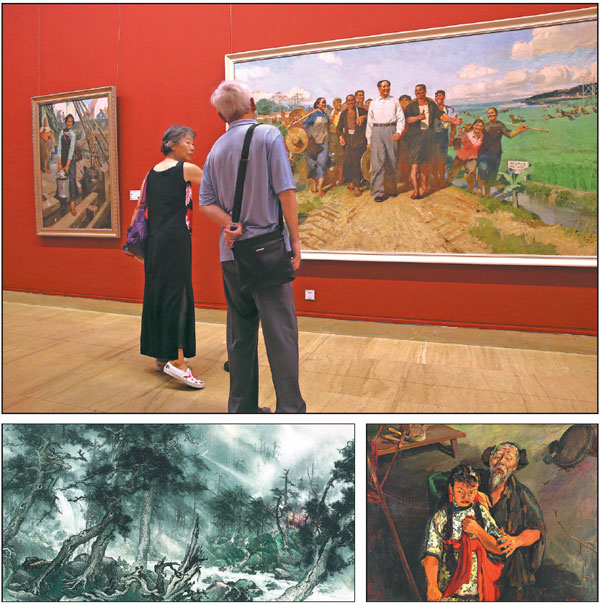
The National Art Museum of China is for the first time using its 17 exhibition halls to trace the artistic evolution and influence of a single province. The Destined to Reform exhibition, now on at the Beijing museum, shows how artists from Guangdong province shaped Chinese art since the early 20th century.
The show features more than 550 paintings and sculptures, which are on loan from public museums, cultural institutions and families of the artists.
The central chamber on the first floor, the most important space in the museum, has ground-to-ceiling photos of 21 prominent members of the Guangdong artist collective.
|
The ongoing Destined to Reform exhibition at the National Art Museum of China in Beijing features more than 550 paintings and sculptures by artists from Guangdong province since the early 20th century. Photos by Jiang Dong / China Daily |
Guangdong, which occupies nearly one-fourth of the mainland's coastline, was in the forefront of cultural exchanges and social transformations over the past century.
The southern province was known for producing leaders of the 1911 Xinhai Revolution, which led to the end of monarchy in China, and was the forerunner of the country's opening-up and reform.
It was also the birthplace of art reformers who modernized Chinese cultural traditions and was one of the places where contemporary Chinese art first began to flourish.
"For the last 100 years, Guangdong has been the cradle of art. The first-generation artists from the province studied art in Europe and Japan in the early 20th century, and were also among the earliest Chinese to be exposed to art movements across the world," says Xue Yongnian, a theorist from the Beijing-based China Artists Association.
He says that among them were pioneers like Gao Jianfu (1879-1951), who called for reforms in both society and art.
Gao, whose paintings are on show, co-founded the Lingnan School of Painting, an artists' group in Guangdong, which revived the dying ink-brush tradition by introducing oil painting techniques.
Gao graduated from the 130-year-old Tokyo Fine Arts School, now the Tokyo University of the Arts. And, with support from Sun Yat-sen, a renowned statesman who led the revolution that ended imperial rule in China, he was devoted to the dissemination of revolutionary ideas and art education.
The Tokyo school produced several modern Chinese artists, such as Li Xiongcai (1910-2001), a second-generation painter from the Lingnan school, whose works are also on show.
The exhibition features Li's Patrol in Forest, which demonstrates his skill in depicting natural scenery.
Chen Lyusheng, the former deputy head of the National Museum of China, says Guangdong's artists played a unique role in modern Chinese art, not only because they were open to foreign influences, such as oil painting, but because they cared about livelihoods.
"They explored styles that suited the times and the needs of the people.
"And as they traveled to other parts of the country, they influenced artists there. As a result they became models for Chinese modern art."
The exhibition also celebrates attempts to renew the face of Chinese art by featuring works of painters like Guan Shanyue (1912-2000).
A reproduction of his Jiangshan Ruci Duojiao (How Beautiful the Country Looks), is on show. Guan executed the 9-meter-long work with Fu Baoshi in 1959 on a State commission.
The ink-brush painting, which depicts a magnificent sunrise, was inspired by a poem by the late Chairman Mao Zedong.
Since its completion, it has adorned the entrance hall of the Great Hall of the People in Beijing.
Contemporary artists such as Liang Quan, 69, are also represented at the show.
Liang, who has exhibited at home and abroad, explores the idea of "emptiness" in Zen Buddhism.
The exhibition also pays tribute to female artists from the first half of the 20th century.
One of them is He Xiangning (1878-1972), who is known today more as a social activist and as the wife of senior statesman Liao Zhongkai. Her paintings depict lions.
Li Jingkun, the head of the Guangzhou Academy of Fine Arts, says: "Good artworks are records of history, and by seeing them, one can trace the evolution of thought.
"Viewers can see how artists felt obliged to participate in social transformations."
Contact the writer at linqi@chinadaily.com.cn




Copyright 1995 - . All rights reserved. The content (including but not limited to text, photo, multimedia information, etc) published in this site belongs to China Daily Information Co (CDIC). Without written authorization from CDIC, such content shall not be republished or used in any form. Note: Browsers with 1024*768 or higher resolution are suggested for this site.
License for publishing multimedia online 0108263 Registration Number: 130349