Nation should promote idea of 'cutting overcapacity, destocking, deleveraging and reducing corporate costs'
China should pay more attention to maintaining a balance between cutting leverage levels and stabilizing economic growth in the second half of this year after it achieved faster-than-expected GDP growth of 6.9 percent in the first half, said a former central bank adviser.
"So far, China has done a good job in striking such a balance," said Yu Yongding, an economist at the Institute of World Economics and Politics of the Chinese Academy of Social Sciences. "China's deleveraging move is in the right direction, but it is a long-term process and we should not carry it out too hastily so as to affect the normal financing activities of enterprises, especially small and medium-sized companies," Yu, a former member of monetary policy committee of the People's Bank of China, told China Daily.
China put forward the idea of "cutting overcapacity, destocking, deleveraging, reducing corporate costs and shoring up weak spots in the economy" in late 2015 to push forward its supply-side structural reform. In the latest development, President Xi Jinping said at the National Financial Work Conference, which ended on Saturday, that the country will further carry out "economic deleveraging" to contain financial risks.
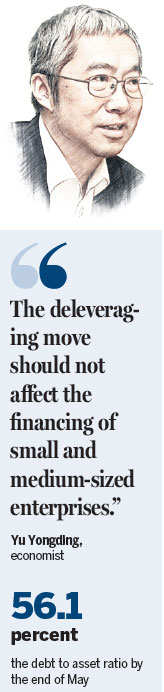
By the end of May, the debt to asset ratio (the measure of leverage levels) of China's major industrial enterprises was 56.1 percent, down by 0.7 percentage point from a year ago, according to the National Bureau of Statistics.
As China pushes deleveraging, banks may reduce loans to enterprises, including small and medium-sized firms, which are the main contributor to China's economic growth, jobs, taxes and exports.
"The deleveraging move should not affect the financing of small and medium-sized enterprises; without their brisk development, the vitality of the economy would suffer," Yu said. "A vibrant economic growth will in turn help resolve the country's debt problem."
China's GDP growth reached 6.9 percent in the second quarter of this year, and it may ease moderately in the second half, but there would not be any "hard landing", he said. "Economists generally agree that the Chinese economy has dropped to the lower band of the L-shaped trajectory; I think it is still possible that growth may continue to fluctuate and even further drop a little bit, but there would not be the danger of an economic hard landing."
Such relatively solid growth prospects mean China can have more room to deal with its debt problem, only that the tempo of deleveraging should be properly managed, Yu said.
In the short term, at least, the country should be more tolerant toward high-level leverage levels, he said, citing Japan's case.
In 1996, Japan's debt-to-GDP ratio exceeded 90 percent. Thinking the ratio may be too high and could incur a fiscal crisis, the panicked Japanese government tightened its fiscal policies, which led to an economic recession. Japan later gave up its tightening fiscal policy stance and now although its debt-GDP ratio has exceeded 250 percent, it is yet to encounter a fiscal crisis, Yu said.
xinzhiming@chinadaily.com.cn




Copyright 1995 - . All rights reserved. The content (including but not limited to text, photo, multimedia information, etc) published in this site belongs to China Daily Information Co (CDIC). Without written authorization from CDIC, such content shall not be republished or used in any form. Note: Browsers with 1024*768 or higher resolution are suggested for this site.
License for publishing multimedia online 0108263 Registration Number: 130349