Young entrepreneurs are fighting to find funding for newly developed techniques that could benefit the nation's agricultural sector, as Hu Yongqi reports from Yangling, Shaanxi province.
In 2006, Jiang Yiliang was a freshman at Northwest Agriculture and Forestry University in the Yangling Demonstration Zone, a city in Shaanxi province renowned for agricultural research and technology.
The only downside to his new life was that locally grown fruits lacked the vibrant taste and freshness of those from his hometown, Urumqi, the capital of the Xinjiang Uygur autonomous region.
"As a major in environmental sciences, I knew that damaged soil was one of the causes of the difference in taste. Soil remediation is a new way of improving the quality of local fruits, and can also be used in places where soil has been damaged by industrial contamination or excessive reclamation," he said. "I wanted to do something to improve the situation."
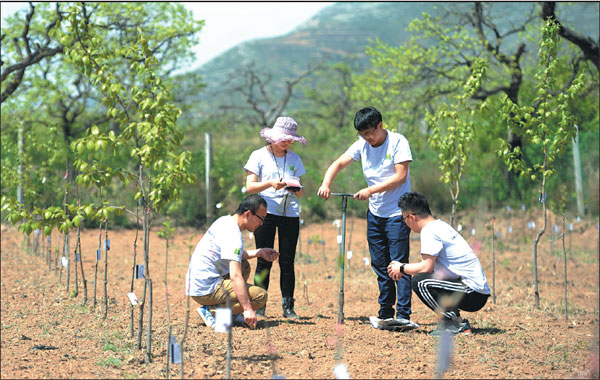
Nine years after he graduated, Jiang became the founder and CEO of Xi'an Jinhua Ecological Technology Co, one of a number of agriculture-related startups in Yangling.
In the demonstration zone, startups are working to produce a range of products and services, including equipment that monitors the mating seasons of dairy cattle to improve milk production, and drones to detect pests that harm plants.
Back to the land
In 2010, Jiang began working on soil technology when he started at graduate school and was taught by a professor who specialized in research into the "black soil" of Northeast China.
In the following five years, Jiang traveled nationwide to undertake detailed research to determine how soil becomes damaged and formulate a reclamation process that would benefit farmers.
Jiang was convinced that damaged soil was hampering the development of the nation's agricultural sector, reducing crop yields and undermining quality. He realized that remediation technologies could be used to help farmers and other players in the field.
In 2015, when they discovered that the market value of soil reclamation work was estimated to be as high as 900 billion yuan ($133 billion), Jiang and two other doctoral candidates established Jinhua, which now has 17 full-time employees.
Impressed by the company's prospects, an investor in Beijing provided 3 million yuan, while the company also generated revenue by providing soil tests and a range of other services.
Jinhua has developed technologies that restructure damaged or contaminated soil and help to retain water and organic matter. The techniques were used to cleanse more than 26,500 hectares of desert land used for potato cultivation in Shaanxi and the Inner Mongolia autonomous region.
The extra water and nutrients provided by the company's new technologies quickly helped to double crop yields to 52.5 metric tons per hectare.
Jiang represented the demonstration zone's young entrepreneurs and delivered a report about local conditions at a meeting with Premier Li Keqiang when he visited Yangling earlier this month. In response, the premier encouraged him to integrate his new technologies with deep cultivation farming techniques.
According to Li Guoxiang, who researches rural development at the Chinese Academy of Social Sciences, China is facing an agricultural dilemma; grain harvests have risen steadily in recent years, but most high-quality produce is imported. He believes that new technologies and business models can bridge the supply gap and improve the quality of produce.
Government support
Yangling, famous nationally for its agricultural and forestry technologies, was established as the country's first national demonstration zone for agricultural technologies about 20 years ago. It is also China's only pilot free trade area for agriculture.
As a result, the city attracts a large number of researchers and academics, which highlights the role of Northwest Agriculture and Forestry University. By the start of this month, its researchers had registered more than 1,200 patents related to agriculture, making the university a leader in the field.
The new technologies have prompted dramatic changes in the agricultural sector.
For example, last year, five farmers in Yangling pooled their resources to raise 105 million yuan, and used new drip and sprinkler irrigation techniques in 80 greenhouses where they grew watermelons and tropical fruits.
The new techniques saved water and the greenhouses provided a tropical environment that greatly improved the taste of the produce, which rapidly became popular with consumers.
Another local startup, Yangling Agricultural Cloud Co, is the country's largest data platform in new fields such as smart farming, providing accurate information about the use of nutrients and marketing techniques.
However, the integration of research and industry has proved problematic, and local officials concede that more than 90 percent of startups in Yangling fold before they can make a profit.
Northwest Agriculture and Forestry University provides startups with subsidies ranging from 10,000 to 50,000 yuan, while the local government subsidizes eligible companies to the tune of 50,000 to 200,000 yuan each.
So far, Jinhua has received 10,000 yuan from the university and 50,000 yuan from government funds, and was also granted 200,000 yuan by the Shaanxi Department of Science and Technology to rent equipment at the university.
"All the subsidies and assistance indicate the support the government has given to startups," said Gao Hailong, one of Jinhua's founders. "We can also apply to use other government-funded projects, such as a database for indigenous plants, which will help us to generate more revenue and improve our chances of survival."
A long journey
While Gao is optimistic, the reality is that survival is a tough business, irrespective of the quality of the new technologies being developed.
The demonstration zone is home to thousands of agrotechnology startups, but many will never make a profit in the short-term as a result of problems related to funding and marketing.
Zhu Junqiang, general manager of Shaanxi Zhongxin Technological Co, has registered 13 patents to cultivate eucommia ulmoides, commonly known as the hardy rubber tree, whose bark and leaves contain elements that are highly valued in traditional Chinese medicine.
Using the patents as a base for his business, Zhu decided to build a factory.
In 2014, he received funding from a real estate developer in Xi'an, which enabled him to hire workers to break down leaves and bark collected in the Qinling Mountains in Shaanxi. The resultant powder was exported to Japan as a food source.
Although Zhu made about 1.3 million yuan a month in his first year, the money didn't roll in fast enough for the developer. At the end of the year, he withdrew his funding, with the result that Zhu's first startup failed, even though his products were highly prized overseas.
The blow taught Zhu that in addition to a business plan, solid funding and a sophisticated industry chain are essential elements for startups.
Last year, when the State Forestry Administration announced that 2 million hectares nationwide would be sown with eucommia ulmoides by 2030, the business potential spurred Zhu and his older brother, Zhu Mingqiang, to keep their business in operation.
The announcement came at exactly the right time for the brothers because they had started a crowdfunding project late in 2015 that raised 65 million yuan.
In addition to financing Zhu Junqiang's factory, they rented 1,320 hectares of land in Xinjiang on which they planted eucommia ulmoides. The fledgling trees were easier to handle than those in the Qinling Mountains, which grow to a height of more than 2.5 meters, making it difficult to strip the leaves and bark.
The farm is easy to manage and the abundant sunlight in Xinjiang helps to produce higher yields, according to Zhu Junqiang.
Now, the brothers make a net profit by exporting eucommia tea, and they plan to develop a range of products, such as glues made from the plant.
Survival
"I failed once as a result of financial problems, so now we are very cautious about the capital chain," Zhu Mingqiang said.
Li Guoxiang, the CASS researcher, warned that agricultural startups and innovations take time to develop, and therefore early survival is the key to long-term success.
"Rural areas are less developed than cities because of a lack of infrastructure and talent," he said. "Many investors seem less interested in agricultural startups than other fields, such as the financial sector, because it's impossible to make quick profits. That lowers the chances of survival, so young people should be aware of this when they start businesses."
Contact the writer at huyongqi@chinadaily.com.cn
|
Employees of Xi'an Jinhua Ecological Technology Co take soil samples in Fuxian county, Shaanxi province.Photos Provided To China Daily |




Copyright 1995 - . All rights reserved. The content (including but not limited to text, photo, multimedia information, etc) published in this site belongs to China Daily Information Co (CDIC). Without written authorization from CDIC, such content shall not be republished or used in any form. Note: Browsers with 1024*768 or higher resolution are suggested for this site.
License for publishing multimedia online 0108263 Registration Number: 130349