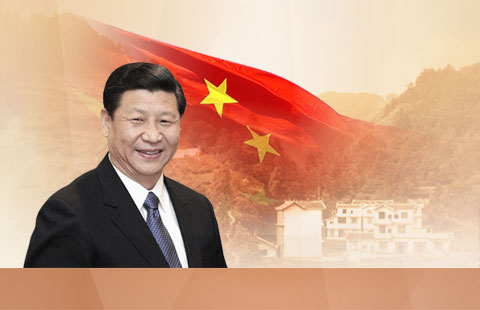
President cites advances, sees brighter economic and environmental future
Guo Yongcai, a retired forestry worker at Arshaan, Hinggan League, Inner Mongolia autonomous region, moved from his shanty hut to a newly built apartment last year as the local government presses forward with renovations to the community.
Before moving into the apartment, the 77-year-old man had worked at the local forestry bureau for over 3 decades. President Xi Jinping visited Guo's home, a hut measuring 38 square meters, on a cold day in January 2014, during which Xi urged local authorities to pay more attention to improving people's livelihoods.
"As long as there remains one family or even one person who has not resolved their basic livelihood problems, we will not take a rest," Xi told local officials.
The president also visited a herdsman's family in Xilingol League. After learning about the difficulties of electricity and transportation, Xi urged the local government to develop a plan to solve the problems.
Following the president's instructions, the local government sped up its work in areas like shantytown renovation, poverty reduction, pensions and medical services. In the past five years, the local government says 1.78 million people have been lifted out of poverty, with their average net incomes increasing over 15 percent a year.
These improvements come as 2017 marks the 70th anniversary of the establishment of the Inner Mongolia autonomous region, the country's first such region. With a population of 25 million, the northern region is home to a mix of ethnic minority groups, including Mongolian, Manchu, Hui, Ewenki and Korean.
Last year, Inner Mongolia's GDP hit 1.86 trillion yuan ($275 billion), an increase of 7.2 percent year-on-year, while per capita GDP was 74,000 yuan, up by 6.9 percent.
During his trip to the autonomous region, Xi reiterated promotion of an ecological civilization system to protect the region's prairies and environment.
"We should contribute more to building a beautiful China, and explore a green path in accordance with natural law and the country's situation," Xi said.
The autonomous region, which has large coal reserves and rare earth deposits, used to suffer from ecological degradation and desertification caused by over-exploitation of natural resources, including coal, in past decades. The president's order to protect environment has led to a series of measures taken by the local government to improve ecology.
For example, the Xilingol League government designated in 2015 about 75 percent of the league's area as the reserve, where exploitation of resources is strictly limited. The league has denied 24 major projects in the past two years that could have posed a threat to the environment.
The autonomous region has put forward 37 regulations to build an ecological civilization through such measures as protecting the grasslands, forests, lakes and wetlands. Government officials will be held accountable in 84 different types of instances for failing to fulfill their duties of protecting environment.
During his inspection tour, Xi told Inner Mongolian officials to streamline industrial chains and focus more on innovation-driven development, thus transforming the autonomous region's economic structure and cutting emissions at the same time.
The president's instructions had been put into action by the autonomous region - last year, the proportion of the coal industry among Inner Mongolia's overall industrial economy has dropped from 34 percent five years ago to 22 percent.
Last year, about 21 percent of Inner Mongolia's electricity was generated using new energies. About 90 percent of the autonomous region's new job vacancies were created by small and medium-sized enterprises last year.
Xi has paid attention to the country's ethnic groups, and he has expressed concern for ethnic people's livelihoods on numerous occasions.
In May 2016, when he visited a Hezhe village in Northeast China's Heilongjiang province, Xi said China's 56 ethnic groups are part of one family and none will be left behind on the road to prosperity. The Hezhe are one of China's smallest ethnic groups, with a population of only 5,000 people, mostly in Heilongjiang.
Xi, in a March panel discussion during the annual session of the National People's Congress, the top legislature, vowed to safeguard the harmony and stability of the Xinjiang Uygur autonomous region and improve the people's livelihoods in the northwestern region.
"We should love ethnic unity as loving our eyes, cherish ethnic unity like cherishing our lives, and hold together tightly like pomegranate seeds," Xi told lawmakers from Xinjiang.
Inner Mongolia has made significant progress in poverty alleviation and promoting prosperity during the past 70 years, Foreign Minister Wang Yi said in late July at an event in Beijing organized to showcase the progress of Inner Mongolia during the past seven decades.
"Today, under the leadership of President Xi Jinping, Inner Mongolia is presenting an unprecedented new look to the world," Wang told an audience that included ambassadors and other diplomats.
He praised the region for its resilience in tackling desertification and poverty, and its pivotal role in the Belt and Road Initiative and the historic China-Russia Tea Road, once a vital lifeline for trade.
Inner Mongolia is a major link between two key Belt and Road countries - Russia and Mongolia. The China-Europe Land-Sea Express Route extends from Inner Mongolia to Europe.
The president has attached great importance to the opening-up of Inner Mongolia, saying the autonomous region is a door for the country's northward opening-up, given its geographic advantage of bordering Mongolia and Russia. The autonomous region has 18 ports and 4,200 kilometers of border linking with Russia and Mongolia.
The Inner Mongolia should boost reform and development through its opening-up, Xi said, adding that the autonomous region should develop port economies, enhance infrastructure construction, improve the mechanism to cooperate with Mongolia and Russia and turn the region into an important hub for China's northward cooperation.
The autonomous region, which boasts lush green pastures, is also known as China's dairy center due to its quality milk products and is attracting investment interest from countries such as New Zealand, according to the region's government.
Li Jiheng, Party chief of Inner Mongolia, said the region has developed into an important window into China's opening-up and a significant part of the Belt and Road Initiative.
"We will pursue innovative and coordinated development, and adapt activity to the new normal (in China's economic development) ... to ensure strong growth for new types of industrialization," Li said.
anbaijie@chinadaily.com.cn




Copyright 1995 - . All rights reserved. The content (including but not limited to text, photo, multimedia information, etc) published in this site belongs to China Daily Information Co (CDIC). Without written authorization from CDIC, such content shall not be republished or used in any form. Note: Browsers with 1024*768 or higher resolution are suggested for this site.
License for publishing multimedia online 0108263 Registration Number: 130349