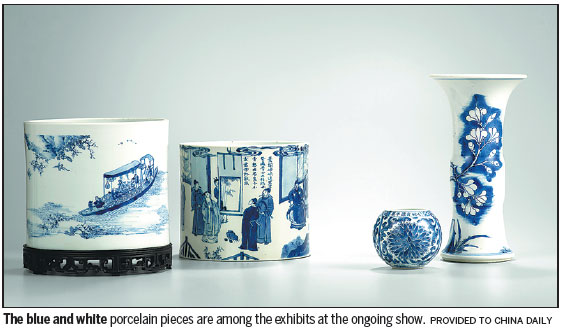
An ongoing porcelain exhibition featuring more than 100 vases, plates, brush pots and cups showcases different aspects of society in 17th century China.
The exhibition, Commissioned Landscapes: Blue and White Porcelains of the 17th Century, is the first of its kind to focus on porcelain produced by folk kilns during a period when royal kilns had stopped production.
The porcelains on display at the Guardian Art Center in Beijing were from Classy Society, a group of collectors concentrating on porcelain from the Ming (1368-1644) and Qing (1644-1911) dynasties. The group consists of more than 250 collectors, antique dealers, scholars and connoisseurs.
"The value of porcelain produced by folk kilns lies in their creativity and imagination. Many show the owners' personalities," says Leung Hiu Sun, curator of the show.
Unlike ceramics made for royal families that had restrictions on the patterns and pictures painted on them, the subjects and pictures on folk kiln-produced porcelain are diverse. Folk tales, legends and stories from novels and operas are all featured on the vases, plates and cups.
During the 17th century, society experienced ups and downs due to the change of dynasties. So, scholar-officials and the literati turned their attention to artistic things, such as gardens, paintings and ceramics.
Customized porcelain was particularly popular then.
As an example, Leung points to a blue and white vase featuring a Chinese painting by master ink painter Mi Fu (1051-1107).
Mi's ink paintings were regarded as hard to copy even on paper and silk, let alone on ceramics, says Leung. So the vase must have been ordered by a rich scholar.
Why did the client choose Mi's painting?
The then Emperor Kangxi was fond of painter Dong Qichang, a master painter whose skills were influenced by his idol Mi Fu, says Leung.
"It was a kind of following of the emperor's tastes," he adds.
Wang Gang, an antique collector and an actor, has loaned some of his porcelain for the show. One is his favorite vases features a legend about a Taoist representative Qiu Chuji and Genghis Khan.
Also, many pieces on display have pictures of women on them. These well-dressed women are seen playing along rivers, playing chess and appreciating art.
This, Leung says, shows that the social status of women was good during that period, as it was rare to see female images on porcelain before that period.
Another part of the show focuses on porcelain exported overseas, including to Asia and Europe.
According to historical documents, the Dutch East India Company exported nearly 12 million pieces of porcelain over 1602-82.
Leung says compared with domestic porcelain which stressed artistry, the exports were mainly for decorative purposes, and often had iconic Chinese elements on them.
In addition to the porcelain show, there is also an exhibition of furniture from the Ming Dynasty and an exhibition of bronzeware and stationery from the reign of Emperor Qianlong (1736-96).
All three exhibitions are being held by private collectors in conjunction with Guardian Art Center, which opened in October in Beijing.
If you go
10 am-6 pm, through Nov 19. 1 Wangfujing Avenue, Dongcheng district, Beijing. 010-6518-9968.
dengzhangyu@chinadaily.com.cn




Copyright 1995 - . All rights reserved. The content (including but not limited to text, photo, multimedia information, etc) published in this site belongs to China Daily Information Co (CDIC). Without written authorization from CDIC, such content shall not be republished or used in any form. Note: Browsers with 1024*768 or higher resolution are suggested for this site.
License for publishing multimedia online 0108263 Registration Number: 130349