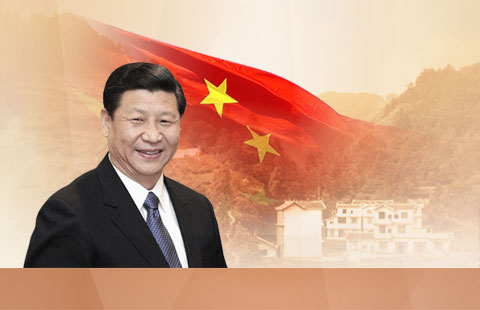
While President Xi Jinping is on a state visit to Laos after attending the APEC Economic Leaders' Meeting and visiting Vietnam, Premier Li Keqiang is in the Philippines to take part in a series of high-level meetings across five days starting Sunday, including the 20th China-ASEAN (10+1) leaders' meeting and the 20th ASEAN-China, Japan and the Republic of Korea (10+3) leaders' meeting, and the 12th East Asia Summit. The senior leaders' diplomatic moves, the first after the 19th National Congress of the Communist Party of China, highlight the great importance China attaches to its Southeast Asian neighbors.
As the first Chinese premier to visit Manila in a decade, Li will hold talks with Rodrigo Duterte, president of the Philippines, which holds the APEC chair this year.
That China and the Association of Southeast Asian Nations are expected to formulate a China-ASEAN 2030 vision and upgrade the existing free trade agreement will be watched closely. The protocol on upgrading the China-ASEAN Free Trade Area, which was agreed last July, has further boosted economic and trade development, and optimized the distribution of resources within the FTA framework.
China has been ASEAN's biggest trade partner for eight consecutive years, while ASEAN has been China's third-largest for six years. From January to July, two-way trade increased 14.5 percent year-on-year thanks to the tariff-free policies covering more than 90 percent of the goods traded and streamlined customs procedures.
While expediting service trade exchanges, tearing down investment barriers and funding cooperative projects, both sides also have to improve the policy environment and tap into cross-border e-commerce. A China-ASEAN e-commerce platform, established late last year, has attracted 135 ASEAN companies that received 646,000 orders in just three months.
Over the past four years, the Belt and Road Initiative, which now serves as an engine of China-ASEAN cooperation, has greatly improved infrastructure connectivity and boosted the construction of industrial clusters. But for deeper interaction with the ASEAN economies, Beijing should map out more detailed, targeted plans under the Belt and Road framework.
Trade remains high on the agenda, so does infrastructure. Given the differences in the economic development levels of ASEAN member states, China should accord priority to infrastructure and exploitation of agricultural resources in its cooperation programs, and deepen cooperation with countries such as Vietnam, Laos and Myanmar. And the focus of cooperation should be industrial capacity, service trade and cross-border investment.
Besides, to allay concerns over the China-proposed multinational economic arrangements, more attention should be paid to cultural exchanges, promotion of China's expertise in targeted poverty-reduction measures, and maritime cooperation pivoting on the 21st Century Maritime Silk Road.
Also at the center of China-ASEAN cooperation is infrastructure, through which China managed to export its quality products and labor resources, and Southeast Asian countries can have better public facilities and more stable electricity supply.
By the end of May, Chinese enterprises had signed infrastructure contracts worth more than $296.2 billion with ASEAN economies, and about $204 billion of the total amount has been put into business. China and ASEAN are also deliberating the possibility of a southward sea route connecting western China, Central and West Asia, and Southeast Asia. Also, in the long run, China and ASEAN should elevate their infrastructure cooperation, so that it centers on the engineering-procurement-construction mode, and widens financing channels by promoting public-private partnership.
Thirteen years into its permanent location in Nanning, capital of the Guangxi Zhuang autonomous region, China-ASEAN Expo, too, has great potential to rise above trade and investment. Now a key platform for upgrading the China-ASEAN FTA, it will play a bigger part in economic integration, internet-driven service trade and the transfer of technology in the region. The author is a researcher at the Policy Research Office of Chengdu Municipal Committee of the Communist Party of China, and a researcher at the China-ASEAN Collaborative Innovation Center for Regional Development, Guangxi University.





Copyright 1995 - . All rights reserved. The content (including but not limited to text, photo, multimedia information, etc) published in this site belongs to China Daily Information Co (CDIC). Without written authorization from CDIC, such content shall not be republished or used in any form. Note: Browsers with 1024*768 or higher resolution are suggested for this site.
License for publishing multimedia online 0108263 Registration Number: 130349