When young director Le Bojuan formed her troupe to attend the Daliangshan International Theater Festival in Xichang, Sichuan province, through Dec 1, she was surprised to find there were six "directors" on her team.
As five of her six actors make their livings as directors, the rehearsal process was extremely slow at first, with everyone having their own opinions about the opera production and often talking all at once.
Finally, the only non-directing actor joked that, according to the rest of the troupe, he could perform his first scene onstage in six totally different ways before wryly demonstrating each of them, one by one.
However, Le soon wrested back control of the production and started to discover the bright side of having such a glut of directorial experience.
"Having so many talented director-actors of course means a lot of pressure on my part, but it is also very gratifying. They made great suggestions and offered me a lot of inspiration and choices."
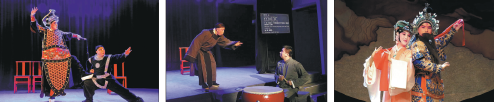
For the theater festival, she brought Who Is Macbeth, an experimental Chinese opera that juxtaposes Shakespeare's tragedy, Macbeth, with ancient Chinese figures, such as Zhao Guangyi and Gongsun Zidu.
The play, produced by Beijing Yongle Lifeng Culture company and Enjoy Troupe, was originally a student project Le wrote and directed in 2013.
It was initiated by the National Academy of Chinese Theatre Arts in conjunction with the Royal Academy of Dramatic Art of the United Kingdom to present Shakespeare's plays with Peking Opera.
Le, who founded Enjoy Troupe, was then working on her master's degree at the national academy, studying drama and TV directing. When she read Macbeth, she recognized the universal theme of human desire.
Commonalities between Macbeth and many tragic characters in ancient China started to emerge-many gave up their moral principles in the pursuit of power and then were tortured by their consciences.
Le, therefore, chose the stories of Zhao Guangyi, who murdered his brother and usurped the throne, and Gongsun Zidu, a legendarily handsome general, who killed a fellow general out of jealousy.
The present production is a version modified especially for a small audience. While the characters share similarities, the director chose to represent them in different types of Peking Opera roles, each requiring unique performance techniques.
Nearly all of the actors need to perform as several characters.
Chen Shengchao, for example, played all the three male protagonists-Macbeth, Zhao Guangyi and Gongsun Zidu-who are represented in four Peking Opera roles: laosheng (old male), xiaosheng (young male), wusheng (martial character) and hualian (painted-face character).
Chen says this is the biggest challenge he faced while doing this play.
"This arrangement presents difficulties for my performance, but it is also an innovative aspect of this production," Chen says. "I have never seen the method used in any traditional opera."
While presenting three tragedies, the play also included a male clown role (chou) and a drummer who provided both atmospheric percussion accompaniment and made impromptu remarks. Their banter and interactions often aroused bursts of laughter.
The innovative plays have been well-received by the mostly young audiences.
One of the audience members, Li Jianming, who is a theater practitioner herself, says: "I am amazed by the imagination and ingenuity of these young people.
"The play is very well executed, with excellent direction and acting. Daliangshan theater really does belong to the young people!"
Reviving Kunqu
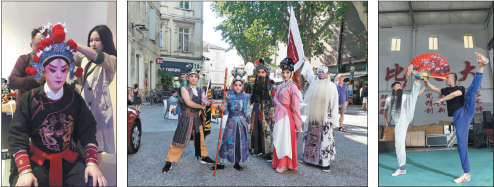
Also searching for ways to innovate upon traditional opera, another young director, Hu Hanchi, brought Fanqiuzhuji to Daliangshan under the English name, A Commander's Introspection. It was also staged at this year's Festival OFF d'Avignon in France.
Fanqiuzhuji is a Chinese idiom that literally means seeking the cause in oneself.
The play is a Kunqu Opera rendition of a story about an ancient commander, who has a self-reflective premonition of failure on the battlefield.
Those responsible for the play are particularly young. Most of the crew were born in the 1980s and 1990s.
"We want to explore the traditional Chinese story with the addition of a traditional Chinese way of expression in an experimental-theater scenario," Hu says.
Hu adds that they want to explore new ideas and approaches for traditional Chinese operas, particularly Kunqu Opera-one of the oldest opera genres in China. It boasts over 600 years of history and was listed among the first batch of UNESCO's Masterpieces of the Oral and Intangible Heritage of Humanity in 2001.
According to Hu, the performance during the Daliangshan festival is already its sixth revision since the play produced by the Northern Kunqu Opera Theatre premiered in France in July.
"We are constantly changing the performance to make it richer and more interesting, and injecting it with new elements, such as physical theater," says Hu.
While the production innovates upon traditional opera with modern dramaturgy, the director says the most modern element of it is, in fact, the theme.
While traditional Chinese operas value the "five virtues" of an intellectual according to Confucianism-benevolence, loyalty, decorum, wisdom and credibility-the production focuses more on illustrating the protagonist's introspection and inner struggle.
For this year's festival, Hu worked on five projects at the same time, including a physical-theater production entitled Shige (Hymn to Disappearance) and a performance for the grand ceremony.
He was, therefore, under a great deal of pressure, but his love of the work and of theater saw him through.
"Today's young people like to express themselves through art forms that suit their expertise," he says.
"I chose to express myself through Kunqu Opera. This is something I enjoy and will continue to work on."
Looking ahead
Legends passed down from ancient times have been endless sources of inspiration for Chinese dramas, and directors are seeking new ways to tell these stories.
Employing physical theater, Nanjing Drama Troupe from Jiangsu province staged the local legend of Mochou, a young woman who drowned herself for love-or, more accurately, because of the feudalistic oppression of the time.
The final production is entitled Free From Melancholy.
The experimental drama has been invited to attend and perform at theater festivals in countries from Germany to Singapore.
With a minimalistic mise en scene, almost all settings and props-such as a boat floating on water, tree branches and the stones along the protagonist's escape route, and even the candles flickering in a chamber-are presented by actors in black, tightfitting costumes.
The actor who performed the role of the male protagonist's mother, for example, also depicted a goose and formed half of a boat.
In fact, the seven performers altogether acted as more than 30 characters, roles and objects.
All three of these productions were shown under the festival's "lake" section, which sought to highlight experimental works, provide opportunities to young theater practitioners, and applaud diversity and innovation.




Copyright 1995 - . All rights reserved. The content (including but not limited to text, photo, multimedia information, etc) published in this site belongs to China Daily Information Co (CDIC). Without written authorization from CDIC, such content shall not be republished or used in any form. Note: Browsers with 1024*768 or higher resolution are suggested for this site.
License for publishing multimedia online 0108263 Registration Number: 130349