Three US-based scholars published a research paper last year dealing with the consequences of, and solutions to, a potential "misalignment" of human resources for the Beijing Olympics.
In layman's terms, they argue that Chinese migrant laborers are often underpaid, ill-treated and lacking in proper legal protection. Such practices may become an international concern if they continue at venue construction sites, the authors claim.
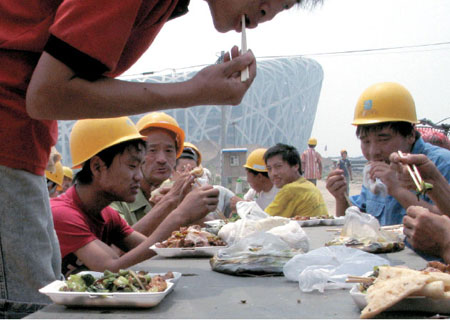 Construction workers tuck in at the Bird's Nest. [China Daily]
 |
Hence the scholars suggest that China "realign the human resources behavior of Olympic employers" by guaranteeing contracts between laborers and employers, setting Olympic pay rates, and punishing abusive contractors.
Failing this, the labor issue could lead to a "large-scale public relations disaster", thus damaging Beijing's goal of enhancing its national image through the staging of the Games. This is all contained in their paper: "An Application of a Human Resources Strategic Model to the 2008 Beijing Olympics: A Discussion of HR Goal Misalignment in Projects," as published in the Journal of Change Management.
You can imagine my relief, then, at having found no evidence to corroborate the claimed systematic abuse of Olympic construction workers after I did some research on the issue.
According to official Chinese figures, over the past few years, Olympic venues in Beijing including the Bird's Nest and Water Cube have employed about 30,000 migrant workers, most of whom were farmers drafted in from the provinces.
It is reported that Olympic construction workers are paid 50 to 80 yuan per day, higher than the rates suggested by the researchers. To make sure the laborers are paid on time, the government has required contractors to pay using "heart-warming cards," or debit cards issued by the local postal office, in order to keep tabs on late- or non-paying employers. Contractors who bend or break the rules will be blacklisted and prohibited from working on future city projects.
In addition, physical checks, and evening diversions including artistic performances and crash training courses are also provided for the laborers.
Following the researchers' model, Olympic labor practices might have already been realigned with Beijing's goal of creating a better international impression even before their paper came out. The "misalignment" issue was really a hypothetical situation in this case.
That being said, I do not dispute the human resource strategy per se, nor the intrinsic validity of their reasoning. The improved labor situation at the Olympic sites might be regarded as a theoretical replication of their logic.
The theory also makes sense as the country has been trying to improve its labor practices to help many of its 200 million migrant workers who face problems of low pay, poor safety conditions at work and inadequate social security, for sustainable social and economic development. Talk of "decent work" was on the lips of officials and trade unionists at a recent international labor forum in Beijing.
The migrant workers undertaking Olympic-related projects in Beijing are probably an exceptional case because their welfare has received attention from state and municipal leaders who have pledged to host a "People's Olympics".
Chinese Premier Wen Jiabao has been checking with migrant workers about their salaries and social security during inspection trips to Olympic building sites.
But what about workers at other sites? Will the Olympic laborers hold on to their envied status as unsung heroes after the Games? If employers have treated Olympic laborers decently because China's national image is at stake, what will motivate them to protect workers' rights when concerns like profit and cost take precedence?
It would be good to see the country and individual businesses set bigger goals for themselves and improve labor conditions with or without the Olympics.
Or, in academic jargon, they should strategically realign their human resources with the organizational goal of sustainability.
Email: guwen_2008@hotmail.com