On Saturday, the first competition day of the Beijing Olympic Games, composer Tan Dun was waiting anxiously in front of his TV. Seated in his temporary home in the suburb of Changping district, the composer was eagerly anticipating the broadcast of the first ceremony for awarding Olympic medals.
|
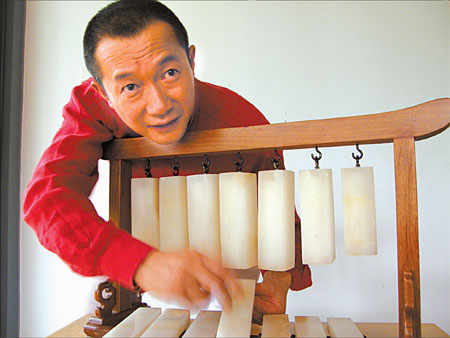
Composer Tan Dun demonstrates how to play his unique jade chimes. Courtesy of Tan Dun. [China Daily]
|
Like millions of other spectators, he was interested to know who would win the first gold medal, but he also had another reason for being excited. As the official composer of the award music for the Beijing Games, Tan was looking forward to hearing his musical handiwork in the background.
That morning, Tan was wearing a traditional red linen shirt paired with casual black Croc sandals. On a small table beside his sofa sits a jade percussion instrument of his own design, which he calls "Gold Rings, Jade Echoes". As he waited, the composer hit the jade pieces with his fingers to demonstrate how the instrument's unique sound is made.
Tan, an avid swimmer and sports fan, told China Daily that he found it to be a great challenge to compose music for a major athletic event. Yet in the end he enjoyed the journey. Though he struggled for nearly a year to find a suitable format, he finally found the process to be rewarding, even Zen-like.
"In the beginning you are a sports lover and a music lover. Then you put them together, and finally I have found it's quite interesting to see both as one. It's great fun," says the composer, who swims daily and plays golf once a week.
He explains that he took musical cues from history. "In Chinese culture, gold and jade are considered a perfect pair, symbolizing harmony, balance and a kind of bond between each other."
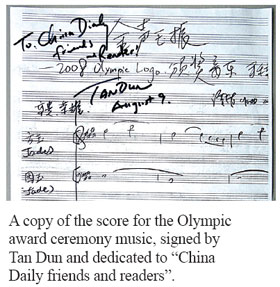
In December 2006, when Tan and director Zhang Yimou were collaborating on a production of the opera The First Emperor, Tan was approached by members of the Beijing Olympic committee about composing music for the Games.
At first he wasn't sure whether he would accept the offer. "Award music is quite different from commissions from concert halls or opera houses. It is functional, for a sport ceremony." In the end, he decided to take on the challenge. "I hope this piece that I created showcases my aspiration for heroes," says the Oscar and Grammy Award winner.
"And at the same time, it should be a key which lets people open the door to China," he notes. "China has such a rich and diverse musical heritage I wondered what I should include in a 25-second-long composition to let people know it is Chinese as soon as it plays."
In his search for a philosophical basis that could represent both the Olympic spirit and the Chinese culture, he studied all past Olympic music, toured Olympic cities and visited the American composer John Towner Williams, who has created theme music for four past Olympic Games. Yet Tan did not find inspiration until he returned to Shanghai, the hometown of his wife Jane Huang.
One day when he was drinking tea with Huang at Shanghai's Yuyuan garden, he saw an ancient board inscribed with four Chinese characters "jing sheng yu zheng", which literally means "gold sound and jade vibrations". After some research, he discovered the term originated in the writing of the revered Chinese philosopher Mencius.
"The term reminded me of the bronze chime bells I played to celebrate Hong Kong's return to China in 1997. An idea came across my mind immediately, that is to use the sound of the 2,000-year-old bronze bells, mixed with the lighter sound of jade instruments," Tan says.
He later learned that the medals of the Beijing Games would also feature the concept of jade and gold. "I was so excited about the coincidence and immediately started to work."
Now housed in the Hubei Museum, the ancient and fragile bronze chimes are not allowed to be played. In 1997, Tan got special permission from former President Jiang Zemin to play them for the celebration of Hong Kong's return to China. At that time he recorded the tunes. So this time, he used the recordings.
During his work with the Hubei Museum in 1997, he also made friends with Ma Yeping, a museum staffer who is also an expert on ancient music. Ma once told him that Xiangfan in Hubei province abounds with jade, which can produce beautiful sounds. So Tan visited Xiangfan with Ma and took out a big sum of money from his own pocket to quarry precious jade, from which he had made various chimes, bells and other instruments.
Tan is a perfectionist who wants the jade to be both pleasant to the eyes and the ears. "Not all the jade quarried produce good sound. Some looks beautiful, but does not sound nice," he explains.
It took 55 workers six months to carve more than 120 pieces of jade into different shapes and sizes, including a piece that covers the same scale as a piano.
The composer explains the final product. "This is the melding of ancient and modern, of tradition and innovation," he says. "The bells and jade represent the Chinese spirit, which must find a harmonious balance between ancient and modern. This music is my gift to the athletes - a gift of gold and jade - just like the medals they will be awarded for their triumphs."
In exchange for his hard work, Tan says the project has rewarded him with inspiration for future explorations.
"My next project should be a universal symphony, which mixes natural sounds from the earth and the universe," he says excitedly, with a twinkle in his eye.
