Once the best in the world, archers from China's Xibo ethnic minority are now making a comeback at the Olympics.
Xibo warriors began using the bow and arrow more than a thousand years ago, and their prowess was legendary. They helped the Yuan Dynasty armies sweep across the continent, and were said to be able to shoot their prey in the eye.
More recently, South Korean archers have dominated the Olympics, winning all major titles for more than a decade. Now, after winning two medals at the Beijing Games, the Xibo are back.
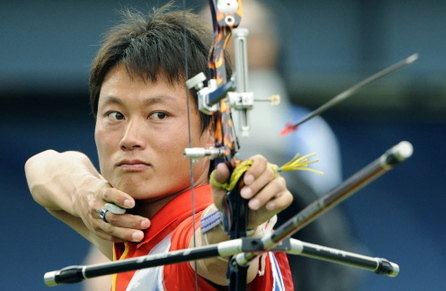
Archer Jiang Lin of China shoots an arrow during the men's team archery competition of the Beijing Olympic Games in Beijing on August 11, 2008. South Korea won gold, Italy won sliver and China got the bronze. China beat Ukraine by 222-219 in their bronze medal playoff. [Agencies] |
Leading the charge is Xue Haifeng, a modern Xibo archer who led China to a historic bronze on Monday.
"We used to be the best and now we're coming back to claim glory again," said Xue.
"Archery is an inherent part of Xibo people's lives. We grow up practicing archery and we are proud of our skills. Bows are almost parts of our bodies," he said.
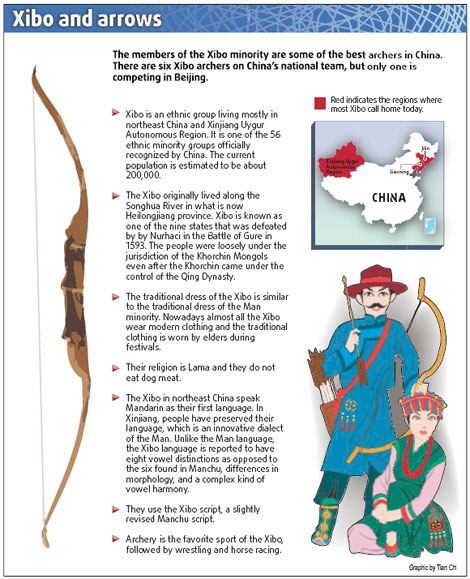
The Xibo are an ethnic minority living mostly in northeast China and in the Xinjiang Uygur Autonomous Region. They are one of 56 ethnic minority groups officially recognized by China. The current population of the Xibo is estimated at about 200,000.
The Xibo once wore traditional clothing similar to the Man minority, but today most wear modern clothes. Xibo elders sometimes wear traditional dress during ethnic festivals, however.
For Xibo children, archery has always been more than a sport; it is a part of their culture. Traditionally, babies were given bows on their first birthdays; those who grabbed the bows were considered to be future soldiers.
Even today, archery is an inherent part of Xibo culture.
"I remember when I was a baby there were always bows around," said Bai Yu, a 26-year-old Xibo who works in Beijing. "Archery has great significance for us. You don't just play with a bow and arrow; you have to be very careful when you have it in your hand."
Modern civilization has diminished the importance of archery to the Xibo, to be sure.
"Very few Xibo young people can actually shoot an arrow, though everyone is aware of the tradition," said Bai. "Most of the Xibo live in big cities like me, rather than living in the grassland like 1,000 years ago."
With Xibo culture on the wane, South Korea dominated international archery competition. Their women's team has won 11 world championships and six consecutive Olympic Games; the Korean men have taken the last three consecutive golds.
That is a situation Xue hopes to change.
"Winning two medals at the Games is huge for us," he said. "I hope our performance will increase the awareness of archery among the general public and get kids to compete at an early age. That's very important."
Xue, who has been practicing archery for 27 of his 28 years, was picked up by a local sports academy in Xinjiang when he was 15. He starred in several junior national championships before advancing to the national team in 2000.
As he is quick to point out, Xue was lucky to get the chance to go to the Olympics. Xinjiang sent only five athletes to the Games, while Guangdong province sent 73.
"Xibo has a lot of kids who really love archery and we have some real talent coming along," Xue said. "If we provide more coaches and better facilities, they are sure to succeed."
According to Zhou Yuan, director of China's archery program, half of the national team is from the Xibo ethnic minority and the other half is mostly from Shandong province.
"If you really want to win gold medals at the Olympics, you have to make archery a national sport, rather than just a minority thing," said Korean archer Park Kyung-mo.
"Millions of children play table tennis in China so you are very strong there. I think China has to do the same thing in archery to get more and more young people involved."
Korean coach Im Eun-taek, who coached a provincial team in China's Heilongjiang Province in 2007, agrees.
"South Korea has more than 100 primary schools with archery programs," he said. "So the coaches are able to select kids when they are 7, and by the time they are 12 or 13, they already have some very good basic skills.
"In China, children don't touch a bow until they are 12. That makes a big difference."
Chinese sports authorities have already started to correct that deficiency, in anticipation of the Beijing Games.
"The Chinese Archery Association has teamed up with 80 schools around the country to promote the sport," Zhou said. "We have more competitions than before and with our elite archers winning medals in Beijing, kids finally have some stars to look up. I'm sure archery will become popular in the near future. I am confident that we can beat South Korea some day."