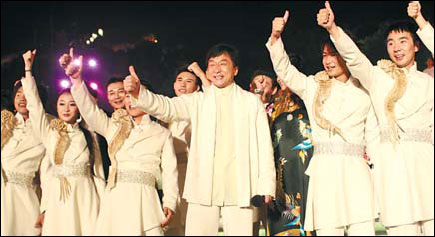
Jackie Chan and his "disciples" appear at the closing ceremony for the popular reality TV show The Disciple. File photo
Chinese reality TV show The Disciple had its closing ceremony at the Great Wall late last month, when Jackie Chan chose 24-year-old Jack Tu as his protg. Tu's reward is to die for: He will accompany the action star to learn everything about international filmmaking and even get to star in Chan-produced films.
Tu headed off more than 50,000 other hopefuls after a massive selection process, live kungfu contests and broadcast training with real stunt teams.
Like most Chinese reality shows, The Disciple bears all the hallmarks of Western TV shows. Even the name is reminiscent of Donald Trump's The Apprentice, in the United States, in which 16-18 businesspeople compete for a one-year, $250,000 starting contract to run one of Trump's companies.
Since Guangdong TV launched a remake of Survivor in 2000, reality shows have been a very popular genre on China's small screens. Most of them borrow ideas or formats from overseas shows, such as Super Girls, the singing contest show based on American Idol, and Shall We Dance, a version of Dancing with the Stars.
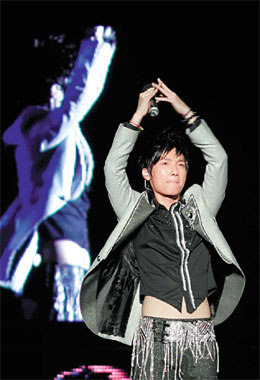
Happy Boy Chen Chusheng sings in Haikou, Hainan, during a nationwide tour. Yin Enbiao
The three most watched genres nowadays are talent contests, general knowledge quizzes and melodramatic talk shows, while adventure shows copying Survivor and Fear Factor are largely spurned.
Talent shows peaked in 2005, when Super Girls-mania hit the country. That year the show's finale drew one of the largest audiences in Chinese history, with an estimated 400 million viewers tuning in, dwarfing the 12 million for the final of Pop Idol. Chris Lee, the top winner of the 2005 Super Girls, is now an A-lister and idol of millions.

Like American Idol, viewers of Super Girls can vote by text messages for their favorite girl singer and their votes help to decide the contestants' fate, which is a totally new concept on Chinese TV. The voting segment is now widely believed to be one of the key factors in the show's popularity. The huge popularity of Super Girls soon prompted a slew of similar shows, such as My Hero and Super Boys, but most of the winners have not enjoyed the kind of fame Lee has.
General knowledge quizzes like Who Wants To Be A Millionaire? and The Weakest Link, have also been smash hits. CCTV's Quiz Show (Kaixin Cidian) and Luck 52 (Xingyun 52) are broadcast on weekend evenings, a golden time for variety shows.
Emotional talk shows strike a chord with viewers by focusing on people's minor tribulations, family disputes and lovers' tiffs. These shows' popularity, says Fang Yanming, dean of Nanjing University's Journalism and Communications School, reflects the fact that Chinese society is experiencing a great transformation, with new social problems emerging. People want to express their confusion over these problems, while at the same time peeping at others' problems and how they deal with them.
Despite the apparent similarities between the formats, Chinese reality shows are less dramatic and fierce, more harmonious and morality-oriented, compared to their counterparts on Western TV. No Jerry Springer here!
While scenes in which eliminated contestants swear and yell at the judges are quite common on American Idol, the contestants on Super Girls were always seen as saying thanks to the judges - some of them are as mean as Simon Cowell - for their precious advice, often in tears. When a contestant is eliminated, his or her competitors must be seen offering hugs, shedding tears and saying encouraging words.
Unlike America's Next Top Model or The Apprentice, you do not see contestants bad-mouthing each other behind each others' backs or plotting to get rid of a competitor. In Chinese talent shows, friendship among the contestants is highlighted and praised, while competitiveness is frowned upon.
Even so, Super Girls and similar shows were panned by critics for "amusing the public to death" and "lowering aesthetic standards", among other sins. "Confucius says articles are to convey values," Fang says. "The belief has been deep in Chinese culture that artistic works are destined to carry positive values and this even applies to entertainment programs."
This also explains why adventure game shows like Survivor do not succeed in China. Individualism and lonely heroes are not as encouraged as loving friendship and teamwork, at least not on TV, which broadcasts to a mainstream audience.
Emotional talk shows differ with their Western counterparts even more. "The focus of the Western melodramatic talk show is to share and show people's private lives while in China, the ultimate purpose of the show must be harmony," Fang says.
Moreover, Chinese are still somewhat shy about revealing their private experiences in public, especially the embarrassing ones - some guests wear masks. How many times have guests on Jerry Springer attacked each other, even breaking each other's bones in front of the cameras?
The good thing is, people do not take such shows that seriously; the bad thing is, Chinese versions of these shows are often drab affairs.
"I hope such shows can help people better understand and reflect on their state of living, rather than simply using the audience's anxiety, curiosity and privacy to make money," says Wu Jing from Peking University.