A brand new storm in an old coffee cup
By Debasish Roy Chowdhury (China Daily)Updated: 2007-08-01 07:04
"Made possible by the American Express Company", screams a signboard describing every hall at the Forbidden City. Yeah right, that explains how the Ming and the Qing emperors pulled off this stunning swathe of architecture. American Express credit, of course!
 So how does such rank profanity escape public wrath while a small coffee
shop, with two round tables and a few chairs, tucked away in the corner of a
souvenir shop suddenly finds itself in the eye of a storm?
So how does such rank profanity escape public wrath while a small coffee
shop, with two round tables and a few chairs, tucked away in the corner of a
souvenir shop suddenly finds itself in the eye of a storm?
The online petition that led to Starbucks' exit from the Forbidden City said its presence undermined the solemnity of the former imperial palace. The man who initiated the campaign, CCTV anchorman Rui Chenggang, has indicated that the American Express signs are also in his crosshairs, but how did Starbucks manage to fight off such fierce competition in the top eyesore contest?
A part of that answer lies in the power of symbols. Starbucks is a far bigger icon of the American way of life than American Express will ever be. Partly for their success and partly for the way they are packaged, certain brands evoke stronger national association than others. During bouts of mass fury, they thus find themselves the target more than others.
This is why French farmers trash McDonalds outlets to protest against US beef exports and Hindu nationalist peasants torch KFC outlets to vent their anger against the entry of US corporations in India's food market.
At times the strong national association is bad for business, at other times they help. In many Asian countries, the opening of a KFC or McDonalds outlet is a way of announcing to the world that it has arrived. But when political sands shift, the very factors that helped them expand in new lands become hindrances to further growth.
Even governments use these implied cultural signifiers to signal broader policy shifts. In 1977, when the Indian government wanted to tell the world that it was hardening its nationalist-socialist posture, it forced Coca-Cola to leave.
In 1993, when the country decided to reverse its decades-long autarkic policies, it welcomed back Coca-Cola. China similarly allowed Coca-Cola to re-enter in 1980 when the country began to actively pursue a policy of economic liberalization.
In a lot of ways, the outburst against the Forbidden
City Starbucks after seven years of operation is a reflection of the Chinese
people's growing awareness of this power of brands. A country where advertising
was reintroduced only in 1979, the protests symbolize a wider realization of
what the tiny coffee shop actually stands for. 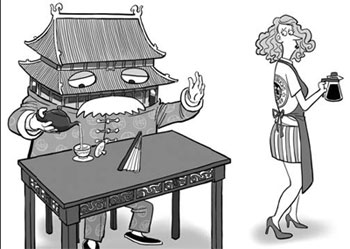
There is more evidence of this new brand consciousness. Apart from the mad rush of Chinese consumers for luxury brands, the Wahaha-Danone tussle over trademark, in which an international beverage giant has locked horns with a Chinese producer, is a case in point. Wahaha, which supposedly transferred the rights to its brand a decade ago, has suddenly woken up to the enormity of its mistake and will stop at nothing, from nationalistic spiels to a long-drawn-out legal tangle, to regain what it has realized was its most precious possession.
In the realm of business, this marks the progression of Chinese entrepreneurs up the value chain, a process which has brand-building at its very core.
But as in medicine, tackling the symptoms hardly cures the disease. Starbucks was told to sell its coffee under the brand name of "Forbidden City" or "Palace Museum". It is difficult to fathom how commodifying Chinese culture at a Chinese heritage site is less vulgar than hawking the American way of life there.
If the goal is to cleanse Chinese cultural sites of the crass consumerism, it is necessary to go beyond symbols and address the real problems, and there are many, starting with unscrupulous tour operators. Otherwise, whipping up mass hysteria over a coffee shop will result in nothing more than mere froth, just a brand new symbolic attack on the usual totems of consumerism.
The author is a senior editor with China Daily
(China Daily 08/01/2007 page11)
|
|
|
||

|
|