The world warms to China's peaceful rise
Updated: 2008-01-25 07:31
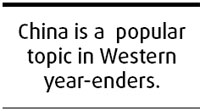
It is a media tradition to look back at what has happened in the past year and how things will go in the year ahead. For Western media in general, a popular topic in the recent year-ender and prediction season is China.
The Independent (daily newspaper) of Great Britain, for example, ran a series of articles about China on its online edition earlier this month. The authors described China as the world's newest superpower, the third largest economy in the world, the leading consumer society and an engine of economic growth. They said China's contribution to the world economy surpassed that of the US, that "Owned by China" will one day be as common as "Made in China" and that China's culture of innovation will spread to the rest of the world, and so on.
The US-based bi-monthly Foreign Affairs carried in its January-February issue an article titled "The Rise of China and the Future of the West", with a summary that begins by saying "China's rise will inevitably bring the United States' unipolar moment to an end". And the author (G John Ikenberry) lays out this view in the first paragraph: "The rise of China will undoubtedly be one of the great dramas of the twenty-first century. China's extraordinary economic growth and active diplomacy are already transforming East Asia, and future decades will see even greater increases in Chinese power and influence." The author holds that America's "unipolar" era is bound to expire, but the international system it heads is now more vital thanks to its "openness" and "freedom". He says conflicts and war can be avoided by embracing China.
There are others with somewhat different views, including those who describe China as "rich and poor" and "strong yet vulnerable superpower".
Taken in whole, the Western media's discussion of China this year really reflects a wide range of opinions, some which are not as sentimentalized and morally conceited as we are used to hearing. Instead, they are more focused on assessing China as it is in reality. Be it praise or sneer, people are better off not reading too much into such babbling anyway. And by saying so I include my fellow Chinese as well: just respond to comments by the foreign press by saying: "So what?"
China is a reality and that is that. We do not soar or fall according to what others say. As Chinese citizens we feel the progress our nation has made and the shortcomings it has, like a fish knows if the water is warm or cold, and we know only too well that we will never reach the top unless we keep climbing step by step.
In economics, the values of commodities are not always reflected by their prices because prices are determined by the ever-changing relationship between supply and demand, but in the end value matters. In a virtual economy the values and prices of commodities such as stocks tend to vary by bigger margins and are affected more strongly by psychological factors.
For a nation its real value lies in the all-round quality of its citizenry, the development of its society, the inherent vitality of its economy and its capability to make correct strategic decisions. And those are what our efforts should be focused on.
Outsider's assessments of a country are reminiscent of a market analysis, which can change in tone from ultra-high to super-low in a heartbeat. For those concerned it is best not to think too much about what others say.
History is full of bloody lessons about overblown prices, such as what Japan experienced in the 1980s, when the value of its currency rose to record highs and property prices sky-rocketed. The economic bubble back then was so enormous that when it burst and people realized the degree to which prices did not reflect values, the country's economy sank into a coma for more than a decade. The same "money game" has taken its toll on other Asian economies in the recent past.
People should think clearly when dealing with symbols, be they money or superlatives. China is under similar pressure these days and we need to remind ourselves of what would happen if we lost control.
China adopted the policy of reform and opening to the outside world 30 years ago. The move symbolized the nation's desire to participate in the international system on its own free will. It also means the suggestion by Western countries that "China should integrate itself into the international system" is really too late. To a certain extent such talk by some Western countries is a kind of self-psychotherapy.
In the past some Westerners refused to treat China as an equal member of the international community or a partner in international cooperation. They saw China as one of "the others". Now China's economy is growing more important to the world economy by the day, as it contributes more to global growth and becomes more closely linked with other economies. Some of the China-bashers have realized that their views about China no longer make sense and that it is time to ditch them. Late or not, it counts as progress.
And amid the contemporary enthusiastic assessments of China there are also voices of suspicion and even fear. It was a kind of law in the era of international power politics that the emergence of a major power always required a redistribution of power and interests, which inevitably led to war and drastic changes of the global status quo.
Today, against the backdrop of economic globalization, the game is played differently and the rules have changed. In the theater of history, one day's tragedy is another day's comedy.
It is China's policy to never seek hegemony. We desire a harmonious world. China's development contributes to world peace and stability.
The author is a council member of China Foundation of International Studies
(China Daily 01/25/2008 page8)
|
|
|
||

|
|
|
|