
Environment protection way forward for Asia
Updated: 2008-04-11 07:36

For much of the 20th century, Asia was dominated by the geopolitical tides of war. The 21st century is seemingly peaceful but no less marked by a desperate struggle - the battle to protect our livelihoods and future by halting the uneconomic war on the environment.
We see this struggle reflected in headlines from Bali and Bangkok and news of retreating glaciers and extreme weather. We know that the major challenge facing Asia is to deepen economic development to share its benefits more widely with the many people remaining in poverty.
However, we also know that this cannot be accomplished without radically reforming the strategy of development at all costs to development that includes protecting the environment, the basis for most people's livelihood and well-being. The pressure of population and politics demand this progress.
The situation that we have come to is quite understandable. Governments have been eager to have the benefits of economic development for their people. Companies have been eager to acquire profits for their owners.
In their eagerness, no one particularly stopped to ask whether this bargain could be sustained or whether the environmental price might be too high. Most often the costs were perceived to accrue in some distant future long after today's beneficiaries have left the scene.
But this process has been going on long enough that people are starting to see the environmental results. Those future damages have arrived in today's reality.
Based on this rising awareness of the damage of uncontrolled development, governments are now requiring more than just new factories and new jobs, they also are beginning to be serious about requiring companies to control pollution of all kinds.
What is emerging is a new legal regime both national and international, previously absent, which forces responsibility on enterprises to reduce their environmental impact or face serious financial consequences.
Shareholders are increasingly pressing companies to improve their environmental performance in order to improve competitiveness. They are also worried about potential environmental liabilities that could crush their profits.
Customers in this globalized world are also increasingly aware that unrealistically low prices may also come with unrealistically high environmental damage and low quality. We are witnessing a global convergence of consensus on the imperative of sustainability.
Almost everywhere you turn these days, there is a meeting, a conference, a magazine or newspaper article about the greening of business. Take Wal-Mart for example. The multinational giant has announced that it will slash its greenhouse gas emissions and yet still strive for pedal to the metal growth. Others have been at this business much longer.
Last year, a group of companies with instantly recognizable global logos representing more than $2 trillion in market capitalization banded together with several environmental NGOs to call on the Bush administration and Congress to enact sweeping climate legislation.
What gives here? More than $100 per barrel oil is one thing, another is the slow but inexorable crawl to national legislation curtailing such emissions by the United States.
Europe has reaffirmed that it will continue its leadership on green house gas (GHG) control and require deeper cuts from its industries. Scientists continue to warn of the dangers of a changing climate and reports of its effects pour in continually.
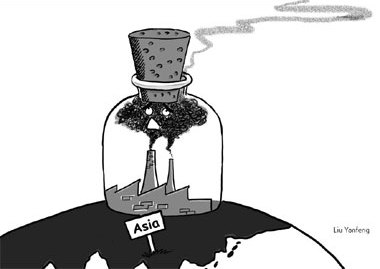
China has adopted a new and more activist stance at the international negotiations and at home reducing energy intensity is a serious new national priority. There is also change in the air from consumers who no longer think bigger is better. Right now, efficient is beautiful.
Building a green Asia will require more than the currently fashionable rhetoric. It will require a genuine shift in fundamentals. The tidal waves of foreign investment sweeping Asia have grown accustomed to current circumstances.
We all know about the "China price" and the market power wielded by large multinational corporations.
Changing the channel will require a concerted effort by governments to convince domestic and foreign partners that the rules and expectations have changed.
The first step is to rigorously enforce current environmental laws and regulations no matter who owns the offending facility. Killing a few chickens to scare the monkeys will go a long way to getting the message out.
The next step is to reward those who excel environmentally to accelerate the transformation from brown to green. Governments can use their own procurement policies to show multinational procurement officers how they expect them to do business in their country.
The race for global market share will be determined not by corporate officers repeating a green mantra but by showcasing green performance and innovative products. As in basketball, we need to watch their feet, not their mouth.
As the biggest player at the table, China needs to show the way. The nation has already begun construction of some of the foundation.
The recent reform of the water pollution control law includes heavy penalties for noncompliance. The national priority on environmental protection was given a further boost by the creation of the new Ministry of Environmental Protection (MEP). MEP already has a green company program. There are serious environmental targets in the 11th five-year plan.
However, these pieces still remain to be forged into an integrated strategy that aligns business and government interests at all levels in a search for environmental excellence. To grasp the markets of the future, China needs to get enterprises to lift their focus from the immediate path they are taking toward the direction of a market-driven green future.
Coordinating policies across ministries for a single unified powerful set of incentives will get their attention. These incentives need to be focused on both today's and tomorrow's environmental problems if they are to succeed in driving marketable innovations.
Companies need to recognize that the new environmentalism sweeping Asia is no less serious then its forerunners in Europe and North America where environmental values are now mainstream. Already we see previously revered global brands being taken to task for environmental missteps outside their home territories. This is no fad. It is here to stay.
When you take a close look at those companies that excel environmentally, it is usually a company that has learned the hard way from a serious environmental disaster in its past.
It need not take matriculation from the school of hard knocks to get the message. The vision starts from the top. CEOs need to dedicate their companies to excellence - especially environmental excellence.
They need to establish corporate incentives for environmental performance equal to those for financial performance. They need to create a culture of compliance and an expectation of constant improvement.
We are moving out of the era of fast easy profits into a more demanding competitive market place.
Buyers are going to ask more than just the price and delivery schedule. They are going to demand detailed information about how and where the products were produced. They are going to require environmental compliance and performance certifications backed by sanctions for false submissions.
There will be a movement to use purchasing power for environmental good by guiding contracts to suppliers that can demonstrate environmental excellence.
Governments will also act to reinforce these trends. In many developed nations, the globalization of the world economy has stirred real political discontent which is easily reflected in the speeches of presidential candidates.
The economic miracle created by the WTO is increasingly thought of as an environmental nightmare by some. Governments will respond to these perceptions and trade from nations viewed as pollution havens will be the target.
This need not be the case. Together we can harness the energy of this new green wave to protect the welfare of the people to create prospects for a healthy and secure life. But it will require serious effort to build and use effective environmental tools. The people of the region are ready to move beyond talk.
The author is chief economist of the Environmental Defense, a US-based non-governmental organization
(China Daily 04/11/2008 page9)
|
||

|
|
|
|