
How the English language borrows from others
Updated: 2008-04-22 07:29
Over its 1,500-year existence, English has borrowed words from more than 350 other languages. Anxiety about such imports - usually called loanwords, although this is a misnomer, since no borrowed term is ever going to be given back - has tended to be niggling, before turning sulphurous.
Typically, loans have been seen as symptoms of intellectual and moral laxity. In the age of Shakespeare, for instance, authors' verbal innovations were widely regarded as an affront to national dignity.
Patriots condemned the adoption of "oversea language" and the "harsh collision" of exotic polysyllables, which laid them open to the depravity of "back-door Italians" and reputedly syphilitic Frenchmen.
More recently, words learnt from German have been expunged in time of war, and, on an altogether more mundane level, consumers hostile to globalization have sniped at the Italian locutions favored by certain coffee chains - barista, venti and the especially hokey frappuccino.
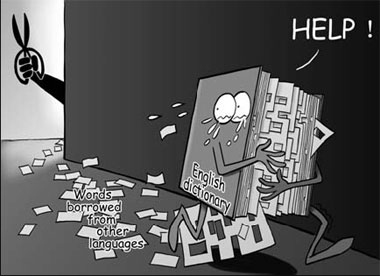
Sometimes purist resistance has sounded endearingly whimsical. The Victorian poet, William Barnes, proposed wheelsaddle as an alternative to bicycle, and in the same vein suggested painlore, folkwain and nipperlings in lieu of pathology, omnibus and forceps.
But arguments about language are always political, and purism is ideologically charged. It is not hard to see what the composer, Percy Grainge had in mind when he called his reversion to Anglo-Saxon - in which, for instance, a piano became a keyed-hammer-string - "blue-eyed English".
English has no equivalent of the Academie Francaise to deliver rulings on proper usage. The creation of such a body has often been mooted, notably by Jonathan Swift.
Samuel Johnson's celebrated Dictionary was originally envisioned as an attempt to "fix" the language, but as he worked on it Johnson moved away from a narrowly prescriptive approach, and modern dictionaries, such as the OED, are conspicuously tolerant - some would say indulgent - of modish usage and spicy imports.
Today a large measure of purists' hostility is aimed at Americanisms, another little quirk I discovered while researching linguistic borrowings.
Among those often reviled are math, heads-up and diapers. Yet many words that once met with similar objections are now not recognized as American coinages: examples are mileage, slapstick, curvaceous and squatter.
In a strict sense, these are not borrowings, but their acceptability - once contested - is a reminder that the majority of loans to English are seldom, in their daily use, recognized as such.
While many people will instantly think of zeitgeist as German and smorgasbord as Swedish, there are far more words in this class whose origins will not be readily identified.
Who makes any connection between marmalade and Portuguese, robot and Czech, flummery and Welsh, or toboggan and the Micmac language of Newfoundland?
Links of this type are worth digging up. Loans bear witness to history. Additions to a language signal changes - political, social, technological, aesthetic. Borrowed words are evidence of contact with other cultures.
The Norse element in English (which includes words such as husband, muck and window) is the result of the Viking invasions that began in the eighth century; a much larger element, from French, started to come in with the Norman conquest.
This is hardly a revelation, and neither is it surprising that English assimilated so many words from Indian languages - bungalow, pyjamas, guru, pariah - given the two centuries of British rule in India. But other connections are less easily spotted.
Take, for instance, Dutch. Words that English has assimilated from this source include wiggle, landscape, coleslaw, snack, shamble, gin and mesh. In her recent book Going Dutch, Lisa Jardine claims that when William of Orange invaded in 1688 he succeeded thanks to generations of cultural exchange.
This is borne out linguistically; over the preceding hundred years, Dutch practices and the Dutch words that denoted them had permeated both England and Scotland.
Jardine claims that William's Glorious Revolution was "the slickest feat of naval planning and execution ever to have been witnessed in Europe".
Naval excellence was a quality then often associated with the Dutch, and many of the words English took from them had to do with seamanship: skipper, cruise, deck, yacht and landlubber are just a handful.
Aloof is another term with a maritime background, deriving from the Dutch phrase "on loof", literally meaning "on rudder" and spoken by a captain when he wanted to steer a course away from a hazard such as a reef. (Reef is also Dutch in origin.) From the Dutch in North America, meanwhile, English-speaking settlers learnt boss, cookie, waffle and snoop.
However, English-speakers are afflicted with a peculiar myopia about the extent to which their language is borrowed. In part, this is a denial of an imperial past: in part, a jingoistic contempt for the "alien" words and ideas that boost the vitality of both the English language and the civilization it embodies.
The Guardian
(China Daily 04/22/2008 page9)
|
||

|
|
|
|