
Panic no answer to price rise
Updated: 2008-05-13 08:01
High energy prices pose a monumental challenge to economic growth. Everyone knows this. But high food prices stir more visceral fears. The concern today is that the world faces a serious crisis as a result of accelerating prices of food staples.
The conventional thinking is that we face runaway prices because of a crisis of shortage. This is partly true. The diversion to non-food use, like biofuels, of agricultural produce like soya beans has lowered supply for food processing. Drought and pestilence have lowered yield.
Wheat, soya and maize prices have all spiked because of one or a combination of these factors. But with rice, conventional thinking is off the mark; supply may not be as tight as prices suggest.
Rice is perhaps the world's most important crop. It is the staple of more poor people than any other food. The doubling of rice prices over the past year affects them more directly than the rise in the price of wheat, for example, for other poor consumers.
This is because rice is consumed with little processing, almost off the field. Once it's dehusked and graded, it's ready for final sale. Thus, there is an almost direct connection between the soaring warehouse price of rice and that of end-consumer rice.
Wheat, on the other hand, is consumed after a long series of processing, from milling into flour to baking into bread, to being turned into breakfast cereal, and so on.
This chain of processing means the final wheat-based product includes other inputs that may not have risen in cost as much as the grain itself. Also, a succession of processing and packaging premiums can absorb some of the price rise. So while wheat might double in price, bread won't cost twice as much. Not so for rice in the pot.
No question, there's been a drop in rice output growth over the past several years. Higher oil prices mean more expensive fertilizer; and poor farmers using less fertilizer get lower yield. Water shortages lead to less cultivation. Pests too are a problem. Rice-growing plots have been converted to plant other crops and to non-agricultural use. Flooding in some areas and cold weather in other parts of the world's rice belt spell less production. Clearly, availability is down, and this influences prices.
Then, because warehouse prices so directly affect rice consumption costs, governments have tried to guarantee supply and affordability. The reason is clear: 600 million of Asia's very poorest spend 40 percent to 50 percent of their income on food. Indeed, Rajat Nag, the Asian Development Bank (ADB)'s managing director-general, says food spending now accounts for 80 percent of income for some of the poor in South Asia.
Nevertheless, government intervention only exacerbates price pressures. As producers in some countries tighten export limits to ensure domestic supply, they take rice out of the open market.
Next, attempts by other governments to further boost stocks through imports threaten to distort the market some more. The Philippines, for instance, plans to import 2.7 million tons of rice this year - it imported 1.9 million tons last year. Its tender recently set a new benchmark, with auction prices mostly exceeding US$1,100 a ton. A month ago they were around $700.
Of course, demand at the back-end hasn't risen by a corresponding half in a month. The reason for the price jump is that traders, anticipating more large tenders, are holding back offers in anticipation of even steeper rises going forward, which in turn causes prices to rise immediately.
They also have concerns that their own domestic prices might rise quickly, squeezing them between the price they buy stock and the price at which they commit to sell abroad. Either way, prices rise, rise, rise.
So how bad is the food crisis? As the ADB's Nag puts it, rice demand last year rose 0.9 per cent while production increased 0.7 percent. This cuts into stock.
Now, just how low stocks have become should be a key factor for prices. But in truth, we don't know. Stock levels - for anything - are a guesstimate. And because grains can be stored almost anywhere - from under the bed to bags in the barn to warehouses - a big waffle factor must be added in. Dire warnings of shortage should thus be taken with a big dose of salt. Indeed, Nag agrees there isn't yet a supply crunch.
Of course, the production-demand gap is a factor in prices, and so has rice's "participation" in the general commodities boom - economists' way of describing how rice has jumped on the bull-led bandwagon.
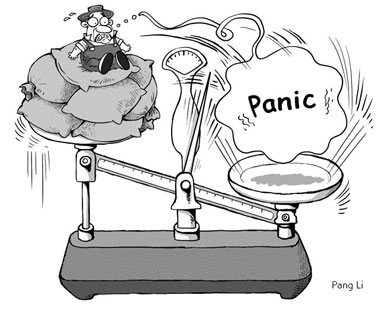
But a very significant portion of the run-up in prices might ultimately be attributed to panic among governments as they see the immediate knock-on effect of warehouse prices on supermarket prices. Increased stockpiling and export caps send all the wrong signals that sweep up prices in a whirlwind.
But this doesn't mean there isn't a problem. The poor must eat, and in slums and shantytowns it's increasingly difficult to scrape together enough rice to cook. Yet the best way to address this is to offer targeted income support so people can afford shop prices.
Eventually, as economists like to put it, the remedy for high prices is high prices, which provide an incentive to farmers to produce more rice. Couple this with a willingness over the longer horizon to invest in irrigation, to use genetic engineering to produce higher-yielding rice varieties and to be willing to plant these, and there needn't be a food crisis within the foreseeable future.
Right now, we have a price crisis, not a supply crisis. And straightening out market signals is the most prudent way of addressing it.
The writer is currently a Bernard Schwartz Fellow at the Asia Society in Washington The Straits Times/Asia News Network
(China Daily 05/13/2008 page9)
|
||

|
|
|
|