
Maintaining growth hard, but only, option
Updated: 2008-05-14 07:29
For quite some time, "overheating" has been taken as one of the biggest potential threats to China's economic soundness. And the figures about the investment in fixed assets in the first three months of the year were taken as a solid proof for that.
From January to March, investments in fixed assets totalled 2.18 trillion yuan ($312 billion), 24.6 percent higher than in the same period of 2007. And the growth rate is 0.9 percentage points higher than the growth achieved during that time.
However, these figures may no longer be used as a valid proof of economic overheating when compared with another group of data.
On April 22, the National Bureau of Statistics announced that the prices of investment in fixed assets rose by 8.6 percent in the first quarter of 2008. This is the highest growth for a quarter since 1996.
After the mounting prices of investment in fixed assets are considered, the actual growth in the investments in fixed assets becomes 14.73 percent, which is 6.19 percentage points lower year-on-year.
When the investment growth turns from positive to negative, it is really worthwhile to take a closer look into the economy. The economic outlook might be more severe than expected.
On the one hand, the economic performance is subject to several complicated uncertainties. While the inflation level remains high, the elements pushing the price high, like the inadequate supply of agricultural produce and sky-high prices of crude oil, are unlikely to be controlled in the short term simply with the efforts from the policymakers of the country.
On the other hand, the three engines for economic growth - investment, consumption and trade - have all slowed down their forward pace.
The actual investment growth is already negative and the actual consumption growth in the first quarter was 12.29 percent, 0.25 percentage points lower than in the same time last year. It is needless to specify the difficulty for further trade growth given the upcoming global economic slowdown and the swift appreciation of renminbi.
When the two aspects are combined together, it becomes a real challenge for the policymakers. To curb the inflation, the policy should be tightened, but it also runs a big risk of weakening the growth momentum of investment, consumption and trade.
When the decision-makers resort to hiking the interest rate in order to tighten the money supply, it instantly raises manufacturers' financing costs, which, in turn, would push up the prices of consumer goods.
When manufacturers make lesser profits because of higher costs, they are sure to pay less to their employees. The lower disposable income of individuals certainly weakens consumption, which, coupled with the high inflation, causes more trouble in social terms.
In short, the Chinese economy is seeing an overheating and a slowdown in different parts simultaneously, making it much more difficult to choose specific policy tools.
Thus, it is advisable that the policymakers prepare themselves for the worst scenario in future when they fix economic policies.
The "worst scenario" mentioned above is stagflation, when inflation is combined with stagnation.
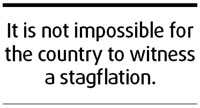
The high inflation level is primarily caused by the elevated prices on the international market sneaking into China through its huge import volume. Since the domestic economic slowdown is also possible, it is hence not impossible for the country to witness a stagflation.
Dubbed a "cancer" in the economy, it has no effective treatment in any textbook at this time. Usually, policymakers could only choose between stimulating economic growth and curbing price rise and take relatively mild policy remedies to get the economy back to its normal condition.
In China's case, stimulating the economic growth should be the choice for decision-makers if they face the dilemma some day because it is an easier target to strike than bringing down the inflation.
The current round of inflation is driven by the imbalance between the demand and supply for agricultural produce in and out of the country. And such imbalance would definitely carry on while the current shortage of grain across the world continues.
In the foreseeable future, the price of agricultural produce is not going to drop, but will keep going up till it stops at some unpredictable, high point, if it ever stops rising.
So, maintaining the economic growth remains the only choice after curbing inflation becomes a mission impossible. Otherwise, the country may be more vulnerable to external risks.
All in all, the policymakers should decide on their priority as early as possible to keep the country's economy better prepared for the increasingly sharp contradiction posed by price rise and economic growth.
The author is an anchorman with China Business Network, a TV network based in Shanghai
(China Daily 05/14/2008 page8)
|
||

|
|
|
|