
Protecting small firms from big poachers
Updated: 2008-05-14 07:30
This year's white paper on small and medium-sized companies focuses on how such firms, which are unable to match their larger rivals in capital or manufacturing capacity, can overcome their competitive disadvantages.
The report, compiled by the Ministry of Economy, Trade and Industry, urges small and medium-sized firms to make strategic use of information technology, expand their exports and overseas operations and complement each other through networks involving players from industry, government and academia.
But there are many problems confronting these companies that are not referred to in the white paper but which still need to be tackled immediately. One of them concerns intellectual property-the patents, trade secrets and other proprietary information that give a competitor the edge.
Many small and midsized companies in this nation have developed highly sophisticated technologies and techniques that even their much larger competitors cannot match-products of many years of focused efforts. Such small but hot-shot high-tech companies receive orders from all over the world, well beyond the boundaries of corporate grouping.
Their competitive edge, however, is often threatened by technology theft and other unfair practices by large Japanese companies.
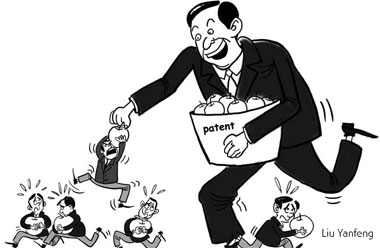
A relatively small manufacturer of precision instruments, for instance, has many stories to tell about its original technologies being imitated by Japanese giants.
While pursuing patent rights on its technology to manufacture reticular parts used in next-generation flat-panel TV displays, the company explained it to a large Japanese electric appliance maker, based on a confidentiality agreement. The smaller company was then surprised to see its partner apply for a patent for that very technology as if it had developed it. The subsequent patent dispute was submitted to the Patent Office.
The lightweight company has had similar unpleasant experiences with other manufacturing heavyweights over components for medical equipment and semiconductor testing equipment. The president of this relatively small company is angry about the way these major manufacturers tried to steal its technologies.
"Foreign companies are more seriously committed to complying with intellectual property contracts and related legislation. Large Japanese companies appear to regard technologies of smaller firms as something they can obtain for free," the president said.
In many cases a formal agreement is useless because smaller companies usually cannot afford to fight costly and time-consuming court battles with corporate giants. So they often have no choice but to suffer in silence when they get raw deals from big hitters.
Obviously, it is necessary to make the system for protecting intellectual property rights easier to use for light- and middleweight businesses. The Patent Office should take steps to make sure that the claims of smaller firms are fairly treated in patent disputes.
Many of the technologies owned by small and midsized firms have grown out of employees' efforts to improve the manufacturing process. Unlike in cases of innovations born in corporate laboratories, technological development on the shop floor is usually not documented in accurate records. It is, therefore, vital to ensure that insufficient documentation will not translate into a disadvantage for small companies in patent disputes.
The authorities also need to deliver swiftly a verdict when an intellectual property dispute arises. A prolonged legal battle inevitably costs money. Such disputes should not be allowed to become battles of financial power.
The government should also consider creating a new compensation system for small and medium-sized companies that win in intellectual property disputes. The system should allow the winners to receive, without fresh litigation, adequate compensation for the losses they have suffered from larger offenders.
The aim is to discourage large companies from running the risk of losing in patent litigation just to hamper a rival's operations.
Competitive small and medium-sized companies are a foundation for Japan's technological prowess. If large companies fail to appreciate this important source of innovations, they will end up using their own hands to strangle themselves.
The Asahi Shimbun
(China Daily 05/14/2008 page9)
|
||

|
|
|
|