OPINION> Commentary

|
OPINION> Commentary
|
|
Reality check on plastic bag ban
By Eric Sommer (China Daily)
Updated: 2008-06-05 07:56
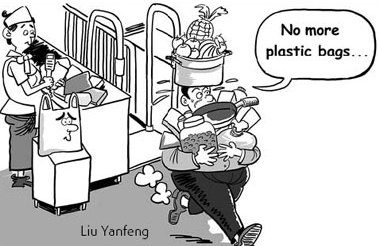
Chinese Premier Wen Jiabao recently declared that China should become an "ecological civilization". In recent years China has taken a series of measures to begin to reverse the sometimes terrible damage inflicted on the environment during the first phase of rapid economic development after its reform and opening-up began in 1978. Hundreds of polluting factories have recently been closed, heavily polluting industries are now actively discouraged, and ecological criteria are being built into calculation of the national GDP and the evaluation of performance of public servants. The new law banning free distribution of ultra-thin plastic bags for retail purchases is a further step along the path of ecological protection. But the allowance in the law for the continued sale of the bags to the public for 0.1 to 0.4 yuan may be inadvertently sending a double-message to retailers and the public. For it allows continued use of the bags for a pittance. Working to reduce consumption of plastic bags is undoubtedly an important step for China. China uses a staggeringly huge number of ultra-thin bags each day; and decomposition of these bags' material takes hundreds of years, with plastic particles from such bags and other plastic goods contaminating seawater, land, and air throughout the world.
In addition, the high-profile, and widely-publicized anti-bag law is symbolically important as a step toward China's "ecological awakening". The law is intended to enable both retailers and the public to participate actively in environmental protection, and has the potential to raise general ecological consciousness. But a quick canvassing at stores in our Beijing neighborhood shows that the anti-bag law's goal is, so far, being only partially achieved. In one QuickGuest grocery store a giant banner proclaims: "Use one less plastic bag and protect the earth we live on." At the same time, however, the store continues to sell the bags to anyone who asks for them. The local 7-11 actively promotes the continued use of the bags by placing them prominently on the checkout counter, and asking each individual customer if they want to buy one for 0.1 to 0.4 yuan. A local restaurant selling Taiwan-style pancakes from a window has eliminated the plastic bags in favor of paper ones. The local Walmart store has for several months shown its concern with the issue by selling cloth shopping bags for 3 yuan. Two checkout lines in the store are also devoted to non-bag users, but many lines continue to cater to those who buy the bags. All of the stores we checked have complied with the law by ceasing to distribute the bags free-of-charge. But all of them, with the exception of the pancake window, also continue to distribute the bags under the legal provision allowing their sale for the small sum of 0.1 or 0.2 yuan. Reactions of customers to the bag law were as mixed as those of the retailers. Eight or nine out of ten customers in each store we visited continued to use the bags by paying for them. In the 7-11, where customers were actively asked if they wanted to buy bags, nine out of ten agreed to do so. However, one customer at 7-11 commented: "It makes me sick to see the clerk encouraging the customers to use bags and to damage the environment." Several customers who chose not to buy the bags were forced to walk away with hands full of grocery items, due to the absence of any alternative provided by the store. Finally, in an online survey of Beijing residents around 50 percent of the people reported they would attempt to stop using plastic bags. But the same number - around 50 percent -said they are willing to pay for them. Clearly, some retailers are obeying the letter of the law but not following its spirit, and many consumers are still willing to use, and even pay for, the plastic bags. Promulgation of a law banning free distribution of ultra-thin bags underscores the government's firm determination to protect the environment. But allowing retailers to continue distributing the bags by charging a tiny sum for them can send a double message. To the public, it may say: "We'd like you to help protect the environment,, but if you don't want to bother, you can just pay 0.1 or 0.4 yuan - a trivial sum - and forget about it." To retailers, it may mean: "We'd like you to help protect the environment, but if you are afraid that your customers will find it inconvenient, and may go to another store where they can buy bags, you can just sell the bags for 0.1 or 0.4 yuan and forget about it." Two measures by the government could greatly strengthen the campaign against ultra-thin bags, and ensure that a double message is not sent. First, a government poster could be prepared and posted in stores. This poster would briefly describe the environmental damage inflicted by the plastic bags. It would also urge people to use other alternatives, such as cloth bags or recyclable plastic bags, to cart their goods home. Some people may be unaware of the environmental damage arising from the ultra-thin bags, and simply posting the information may sway them to stop their use. Second, legislating a complete end to distribution of ultra-thin bags with purchases - with a transition period for adjustment - may, in the end, prove the only effective way to ensure the dramatic reduction in the use of plastic bags which the government desires. The author is a Canadian teacher currently living in Beijing (China Daily 06/05/2008 page9) |