OPINION> Commentary

|
OPINION> Commentary
|
|
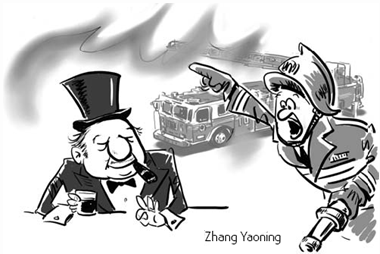
Hollywood is burning but history mustn't
By Jonathan Kuntz (China Daily)
Updated: 2008-06-10 08:08 The most famous back lot fire in Hollywood history was intentional. In 1938, David O. Selznick staged the burning of Atlanta in Gone With the Wind by torching the old King Kong Skull Island set on RKO's back lot and then filming the spectacular results. Another Kong, this one a 10-m, animatronic gorilla featured in the Universal City tour, went up in flames last week, along with various sets, film prints, audio recording and videotape storage vaults, as Universal Studios suffered its latest conflagration. The tour quickly reopened and now offers a view of the fire damage as part of the tram ride.
Most of the back lot acreage built up during Hollywood's classic studio era was long ago sold off for housing developments and commercial space (Century City lies on much of the old 20th Century Fox back lot), but Universal Studios has always held onto its 93-hectare lot, once a chicken ranch, supplementing profits from moviegoers with tickets to tourists eager for a behind-the-scene glimpse of Hollywood. Catastrophe has been too common from the start: in fact, Universal City's elaborate grand opening in March 1915 was cut short by disaster - a stunt flier was killed when his plane crashed near the horrified crowd. There have also been many studio fires in Hollywood's 95 years, including about a half-dozen at Universal: made of wood, sets catch fire easily. From the earliest days, film producers prided themselves on having well-trained, vigilant fire departments. Bragging rights went to the lot with the biggest water tower. Among the sets that burned this week were the courthouse square from To Kill a Mockingbird and Back to the Future, and a New York street from countless films and television shows. These sets themselves had been damaged and altered many times, and were mostly false fronts to begin with - so what has really been lost? The physical residue of great movie memories, no more, simulations of simulations. The studio can rebuild the sets, as they have before - now configured as much to the tour tram as to the camera - and they'll likely be better fakes than ever. More serious may be the loss of the circulating 35-mm theatrical prints. While not original masters, these are the copies made for screenings at repertory theaters, art museum retrospectives and in college classes. Universal has already canceled screenings of Rear Window and Howard Hawks' Scarface for the UCLA film history class I teach, along with all their other titles for the indefinite future. Universal controls a big chunk of Hollywood history. Their own prodigious output includes All Quiet on the Western Front, the third film to win the Oscar for best picture; classic monster series like Frankenstein, The Mummy and The Wolfman; the comedies of Abbott and Costello; the melodramas of Douglas Sirk; and hundreds more. In addition, through wise acquisitions in the Lew Wasserman era, Universal also owns the rights to many additional Paramount titles, including various Alfred Hitchcock classics, the Marx Brothers movies and Billy Wilder's film noir Double Indemnity. Prints of many of these seem to have been destroyed. This latest fire, I hope, will prompt Universal and its fellow majors to better preserve not just key titles like Duck Soup, Dracula or Vertigo - which will surely be reprinted and return to circulation - but also the other 90 percent of their inventories, the less famous and therefore more vulnerable titles that the studio may not feel justify spending thousands to save. These are exquisite samples of 20th-century American culture and deserve to always be seen in their extravagant, sensual, big-screen glory. Still, Hollywood can never be reduced to its physical remains, to false fronts or plastic film. This is an industry that delights in creating something memorable out of something fake, and creative destruction, rebuilding and reuse have always been part of the magic. After all, the burning of Atlanta in 1938 was actually a beginning. Selznick and his crew immediately cleared the Kong wreckage, and then used the space to build the dozens of structures, from the Atlanta rail yards to Tara, needed for Gone With the Wind. Those sets were used many more times: Atlanta was recycled into Mayberry for The Andy Griffith Show and then Gotham City in the television series Batman. The area is now an industrial park. The author is a professor of film at the University of California, Los Angeles The New York Times Syndicate (China Daily 06/10/2008 page9) |