OPINION> Commentary

|
OPINION> Commentary
|
|
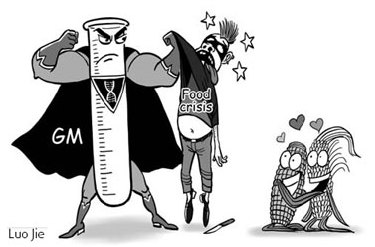
As starvation looms, it's time to take GM seriously
By Robin McKie (China Daily)
Updated: 2008-06-11 07:52 As front pages go, the cover of Nature is scarcely a stunner. It depicts two rows of trees facing each other across the page. Those trees, bearing papayas, are growing in a Hawaiian plantation and the difference between the two rows has critical importance to the world's mounting food crisis. It transpires that the stunted trees on the right, each bearing only a handful of fruit, are victims of papaya ringspot virus, a disease that devastates yields and is endemic in Hawaii. By contrast, the papaya trees in the other row, on the left, are healthy and disease-free, because they have been genetically modified (GM) to resist ringspot. As a demonstration of the potential of modern plant technology, the image speaks volumes. Transgenic crops may be disparaged and dug up every time scientists grow them as part of their trials in Britain, but as Nature's cover shows, the technology seems ripe to help feed a planet whose population will rise from 6.5 billion people, many of them already hungry, to around 9 billion by 2040. It is a point stressed by crop experts such as Professor Chris Pollack of the University of Wales.
"To stop widespread starvation, we will either have to plough up the planet's last wild places to grow more food or improve crop yields. GM technology allows farmers to do the latter - without digging up rainforests. "It is therefore perverse to rule out that technology for no good reason. Yet it still seems some people are willing to do so. That picture of transgenic papaya plants on Nature's cover shows how wrong they are." The trouble is that GM crops represent everything that the environment movement has come to hate, though it was not the technology itself that originally made greenies froth at the mouth. It was its promotion and marketing by international conglomerates such as Monsanto a decade ago that raised the hackles. As a result, GM crops have become a lightning rod for protests about globalization. "GM technology permits companies to ensure that everything we eat is owned by them," claimed campaigner George Monbiot. Perhaps he is right. However, it is questionable to go one step further and insist, as some campaigners do, that because GM technology has been misused by biotechnology conglomerates, it is therefore justifiable to ignore its usefulness completely. The science can still help feed the world, particularly through the introduction of drought and disease resistance to staple crops such as potatoes and rice. "Britain and Europe have isolated themselves from the rest of the world over transgenic crops," says Bill McKelvey, principal of the Scottish Agricultural College, in Edinburgh. "We have decided the technology, for no good reason, is dangerous. The rest of the world doesn't think so and has got on with using it. For example, GM soya is grown throughout America and Asia. It doesn't worry people there for the simple reason that no one has ever died of eating GM food. On the other hand, a lot of people could soon die because they have no food of any kind." Tough luck, you might say. That's not Europe's problem. It's the developing world that will get it in the neck. The world is warming and is destined to do so for decades to come as cars, factories and power plants continue to pump out carbon dioxide and other greenhouse gases. As a result, many grain-producing regions - in North America, Australia and parts of Africa - are expected to suffer significant changes in climate that will devastate crop production. By contrast, other regions -northern Europe and Canada, in particular - will find weather changes will boost crop growing. They will become the world's food stores, an issue highlighted by Professor Les Firbank of North Wyke Research Station in Devon. Britain and many other European countries have considerable expertise in plant and crop biology research, it should be stressed. But that work is constantly frustrated. Crop trials are dug up and funding is blocked by governments embarrassed to be seen backing such work. The effects are rarely beneficial. Consider the example of potato blight. Its prevalence rose rapidly last year, threatening a crop that is a staple foodstuff for many people round the world. Yet scientists insist it would be relatively easy to introduce a basic gene construct into potatoes that would make them resistant to blight. Europe has the expertise but is thwarted by gangs of men and women who trash GM crop fields. That is the crucial issue. Is society ready to change its attitude to GM crops? Major companies still announce GM bans, no doubt under pressure from protest groups. But given the science's growing role in helping world food shortages, such decisions should really be seen as acts of shame, not pronouncements of pride. And some scientists believe they can now detect shifts in public attitudes. I hope they are right, though I am not so confident.For example, environmental campaigners remain committed to the idea that nuclear energy has no role to play in helping to combat global warming. They react with equal scorn to GM crops. The latter is certainly not a panacea for the ills we will face. On other hand, it certainly has a role to play in helping to save people from starvation, a fact that is worth repeating now and again. The author is The Observer's science editor The Observer (China Daily 06/11/2008 page9) |