OPINION> Commentary

|
OPINION> Commentary
|
|
FDI in Vietnam easier but snags remain
By Kim Yuho
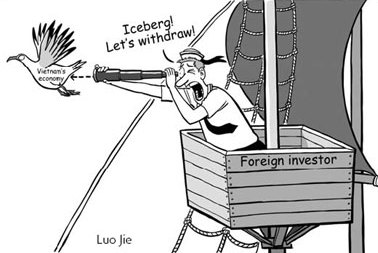
Updated: 2008-06-17 07:45 The current economic conditions in Vietnam are not as bright as they used to be. Some people even talk about the possibility of an IMF bailout. However, it is simply a matter of temporary growing pains that we have all experienced as we grow too quickly. We should take Vietnam's recent negative economic indicators as a natural step for a fast-growing country.
Furthermore, unlike private companies in other developed countries, Vietnamese firms are unlikely to collapse suddenly because the Vietnamese government owns some portion of most Vietnamese companies as a shareholder. Despite its current economic difficulties, Vietnam is still a very attractive location for new investments and it is one of the best long-term investment places in the world for many foreign investors. In January 2007, Vietnam has become the World Trade Organization's 150th member. Not only are the lists of Vietnam's commitments regarding goods and services broad, but the speed of opening Vietnam's door to foreigners seems to be favorable and quite rapid. This is of course an important breakthrough for Vietnam's economy because it can bring enormous opportunities. However, local businesses in Vietnam face quite a few challenges. In recent years, foreigners have become aware of the economic value of Vietnam and have rushed into the country as if they have found a gold mine. In the initial period, it was not easy for foreigners to invest or do business in Vietnam because of the uncertainties due to the lack of relevant Vietnamese laws, along with the different standards for foreigners. The Vietnamese government has recognized these difficulties, and Vietnamese laws have changed to reflect the needs of foreign investors. Foreign investors may have heard of the Law on Investment and the Law on Enterprises. These are the two laws most likely to affect foreign investors. Foreign and domestic investments used to be governed by two separate laws - the Law on Enterprises and the Law on Foreign Investment in Vietnam. Effective on July 1, 2006, the Law on Enterprises has unified those two laws, thereby significantly reducing the different treatment of foreigners and the Vietnamese, with a few exceptions. Moreover, foreigners can now freely invest in the stock market - up to 49 percent of a listed company's shares in Vietnam. There are taxes, accounting and land incentives for certain investment sectors and geographical areas under Articles 33-37 of the investment law.
In recent years, most foreign investors have invested in the construction and manufacturing industries. However, in the long run, they may want to take a look at service industries such as banking, insurance, and telecommunications because many restrictions on the service industry in Vietnam are likely to be eliminated or reduced soon. However, there are still difficulties for foreigners seeking to invest in Vietnam. One of these involves the ambiguities in the current law. For instance, the investment law does not provide clear guidance as to what level of control of the relevant company constitutes "participating directly in the management of the investment activity". Investors should be aware that some foreign companies claim that they are huge investors, but they do not even have an investment certificate. It sometimes takes a long time to get such a certificate. Also, some of them attract investors to advertise their plan, but some of their plans are not legally permitted. For instance, some may attract foreign investors by publicizing their plan to build a 100 percent foreign-invested international school in Vietnam, along with a residential and office complex. However, in general, 100 percent foreign-invested education entities are not yet permitted in Vietnam, although some types of educational services are currently permitted. Vietnam will permit 100 percent foreign-invested education entities in January 2009, in accord with the WTO agreement. Thus, foreign investors may soon face trouble when they learn that they do not even have an investment certificate, or that some of their plans cannot be achieved due to incorrect legal information. Some of them may not have a bona-fide interest in investing in Vietnam, but merely want to sell their investment permission - for example, investment certificate. However, they should be aware that it may require going through complicated processes to achieve it, and, in some cases, it may not be possible. Some foreign companies have had problems, particularly in dealing with their Vietnamese employees. Such problems are mostly because of the lack of understanding of Vietnamese customs and culture. Foreign investors should try to understand cultural differences, and respect the customs and culture of Vietnam. Vietnam has a very long history, and it is not advisable to push for radical changes in their customs, just for the convenience of foreign investors. Also, Vietnam's labor law favors the rights of employees, and, in recent years, these statutes have been strictly enforced. The author a US-certified attorney The Korea Herald/Asia News Network (China Daily 06/17/2008 page9) |