OPINION> Commentary

|
OPINION> Commentary
|
|
Yes,we'll have no bananas some day soon
By Dan Koeppel (China Daily)
Updated: 2008-06-20 07:43 Once you become accustomed to gas at $4 a gallon, brace yourself for the next shocking retail threshold: bananas reaching $1 a pound. At that price, Americans may stop thinking of bananas as a cheap staple, and then a strategy that has served the big banana companies for more than a century - enabling them to turn an exotic, tropical fruit into an everyday favorite - will begin to unravel. The immediate reasons for the price increase are the rising cost of oil and reduced supply caused by floods in Ecuador, the world's biggest banana exporter. But something larger is going on that will affect prices for years to come.
That bananas have long been the cheapest fruit at the grocery store is astonishing. They are grown thousands of miles away, they must be transported in cooled containers and even then they survive no more than two weeks after they are cut off the tree. Apples, in contrast, are typically grown within a few hundred miles of the store and kept for months in a basket out in the garage. Yet apples traditionally have cost at least twice as much per pound as bananas. Americans eat as many bananas as apples and oranges combined, which is especially amazing when you consider that not so long ago, bananas were virtually unknown in the US. They became a staple only after the men who in the late 19th century founded the United Fruit Company-today's Chiquitais, a Cincinnati, Ohio-based producer and distributor of bananas and other produce - figured out how to get bananas to American tables quickly - by clearing rainforest in Latin America, building railroads and communication networks and inventing refrigeration techniques to control ripening. The banana barons also marketed their product in ways that had never occurred to farmers or grocers before, by offering discount coupons, writing jingles and placing bananas in schoolbooks and on picture postcards. They even hired doctors to convince mothers that bananas were good for children. Once bananas had become widely popular, the companies kept costs low by exercising iron-fisted control over the Latin American countries where the fruit was grown. Workers could not be allowed such basic rights as health care, decent wages or the right to congregate. Over and over, banana companies, aided by the American military, intervened whenever there was a chance that any "banana republic" might end its cooperation. For example, in 1954, United Fruit helped arrange the overthrow of the democratically elected government of Guatemala. Labor is still cheap in these countries, and growers still resort to heavy-handed tactics. The final piece of the banana pricing equation is genetics. Unlike apple and orange growers, banana importers sell only a single variety of their fruit, the Cavendish. There are more than 1,000 varieties of bananas - most of them in Africa and Asia - but except for an occasional exotic, the Cavendish is the only banana we see in our markets. It is the only kind that is shipped and eaten everywhere from Beijing to Berlin, Moscow to Minneapolis. By sticking to this single variety, the banana industry ensures that all the bananas in a shipment ripen at the same rate, creating huge economies of scale. The Cavendish is the fruit equivalent of a fast-food hamburger: efficient to produce, uniform in quality and universally affordable. But there's a difference between a banana and a Big Mac: The banana is a living organism. It can get sick, and since bananas all come from the same gene pool, a virulent enough malady could wipe out the world's commercial banana crop in a matter of years.
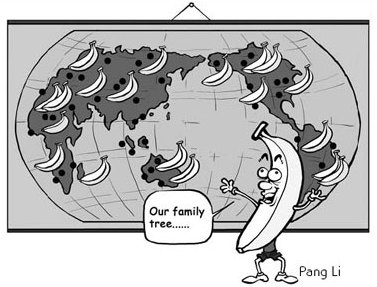
This has happened before. Our great-grandparents grew up eating not the Cavendish but the Gros Michel banana, a variety that everyone agreed was tastier. But starting in the early 1900s, banana plantations were invaded by a fungus called Panama disease and vanished one by one. Forest would be cleared for new banana fields, and healthy fruit would grow there for a while, but eventually succumb. By 1960, the Gros Michel was essentially extinct and the banana industry nearly bankrupt. It was saved at the last minute by the Cavendish, a Chinese variety, and it did resist the blight. Over the past decade, however, a new, more virulent strain of Panama disease has begun to spread across the world, and this time the Cavendish is not immune. The fungus is expected to reach Latin America in 5 to 10 years, maybe 20. The big banana companies have been slow to finance efforts to find either a cure for the fungus or a banana that resists it. Nor has enough been done to aid efforts to diversify the world's banana crop by preserving little-known varieties of the fruit that grow in Africa and Asia. In recent years, American consumers have begun seeing the benefits - to health, to the economy and to the environment - of buying foods that are grown close to our homes. Getting used to life without bananas will take some adjustment. What other fruit can you slice onto your breakfast cereal? But bananas have always been an emblem of a long-distance food chain. Perhaps it's time we recognize bananas for what they are: an exotic fruit that, some day soon, may slip beyond our reach. The author is a writer The New York Times Syndicate (China Daily 06/20/2008 page9) |