OPINION> Commentary

|
OPINION> Commentary
|
|
People's roles key to rebuilding
By Xin Zhiming (China Daily)
Updated: 2008-06-25 07:20 More than a month after the devastating earthquake hit Sichuan and its neighboring areas, the affected regions are busy mapping out their reconstruction plans. But the World Bank experts warn that such plans must be made very carefully to avoid missing the target and incur frustration in the future. They also suggested that a catastrophe risk insurance fund should be established to cater to future needs and community consultation must be thoroughly conducted to get the relocation process smooth.
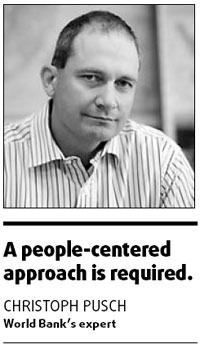
China has done a good job in the rescue and relief phase, said Christoph Pusch, the World Bank's South Asia regional coordinator for disaster risk management. "What we've seen is outstanding" in terms of responsiveness, political leadership and public support, said Pusch, who was attending a World Bank workshop last Thursday brainstorming experiences on how to rebuild China's quake-affected areas. "At the same time, having such great achievements also bears the risk of raising expectation that the next phase would be as smooth as the relief work," he said. It is, therefore, very important to draft the reconstruction plan carefully and avoid major revisions at a later stage, said Pusch, citing a country where the political leader vowed after a major disaster to have everything reconstructed within one year, but where the reconstruction actually had taken five years. "Of course this created a lot of frustration." The reconstruction process usually takes a long time. In Tangshan, Hebei province, which was hit by a 7.8-magnitude earthquake in 1976 that killed 240,000 people, it took 10 years for the reconstruction and resettlement to be completed. More recent earthquake reconstruction programs in Turkey and India have been completed within four to eight years. Given the prolonged process, Pusch suggested the expectation of the public be properly managed through planning the time framework in a realistic way and making the process transparent to the people. Based on experiences in other disaster-affected countries, "it's a good practice to have communities to get fully engaged in planning and implementing of the reconstruction programs," said Saroj Kumar Jha, the bank's program manager for the Global Facility for Disaster Reduction and Recovery (GFDRR). Smooth and thorough communication between policymakers and the local disaster-affected public will have a long-term effect on the rebuilding process. "In the long term, what has really worked in any country is how much the community is involved in planning and designing and implementing the operations," said Jha. "The community will have to make a choice if it will move elsewhere. It works in the long term." Agreed Pusch. In this way, "there is a greater chance of success in terms of achieving a harmonious and balanced construction program ... A people-centered approach is required." The World Bank experts also suggested that a partnership model be introduced in managing the funding of different sources in the reconstruction process. The government is in charge of preparing the reconstruction master plan. But for implementing the plans, the participation of the private sector, non-government organizations and other partners should be invited to make the process more efficient, said Pusch. In Pakistan, for example, the government had established a financing system where all the funding was tracked and accounted for, so that everybody can put money into the system and got assured their inputs would be accounted for, said Pusch. Special partnership arrangements are an integral part of the Pakistan earthquake reconstruction program. The country suffered an earthquake that killed more than 70,000 people in 2005. Catastrophe risk financing has become a focus of the World Bank workshop discussions. Over the last few decades direct property losses in China have averaged 3 to 5 percent of gross domestic product (GDP) and substantially higher proportions of government fiscal resources. Aside from flood mitigation China continues to rely largely on a standard ex-and-post relief approach. The Wenchuan quake has underscored the financial vulnerability of Chinese people to natural disasters in the absence of a catastrophe insurance scheme, the experts said. Since no commercial insurance has covered the houses in the quake zone, a major source of funding must be ferreted out. China is still discussing how to pool the funding for reconstruction, although fiscal resources are expected to play a major role. In the long term, however, experts suggested that a catastrophe risk insurance regime be put in place so that when a disaster hits, money can become readily available for rescue and reconstruction programs. "The idea of insurance is that house owners pay a relatively small premium to protect the property against economic losses caused by natural disasters. Through the establishment of an insurance pool, risks will be diversified and transferred to the capital market; it's like car insurance," said Pusch. "In many Western societies, insurance is an instrumental part of financing natural disaster risks," he said. For example, California, the US, suffered a major earthquake in the 1990s. There was no need for the government or the public to finance private houses leveled in the quakes, because they had been insured. The Bank experts have joined hands with the Turkish government and local authorities to establish the first ever catastrophe insurance pool, which was supported by the country's central government, the World Bank and the private sector reinsurance company Milli Re, according to David Dollar, the World Bank's country chief for China, and Jha. "This is a very good example of public-private partnership in providing catastrophe risk transfer and financing," they wrote in a note. The World Bank has been working with China to explore the models and options for catastrophe risk financing, according to Ede Ijjasz, sector manager for China and Mongolia sustainable development unit of the World Bank. Ijjasz also emphasized the importance of prevention inputs. Turkey, for example, is exposed to many natural disasters. The country has shifted its focus to prevention investment. In early 1980s, most of the earthquake-related investment was for reconstruction of the quake-affected areas while only 10 percent was for prevention, Ijjasz said. But now most of the money has been used for prevention. "They (the country) know that there is a high possibility of a very substantial earthquake hitting Istanbul in the next 20 years. They are getting ready for disasters that we know are going to happen; although we don't know when and where but we do know they are going to happen." (China Daily 06/25/2008 page9) |