OPINION> Commentary

|
OPINION> Commentary
|
|
Vietnam's new risks from FDI
By Liu Junhong (China Daily)
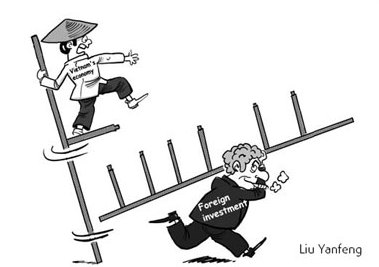
Updated: 2008-07-01 07:56 The recent slump of Vietnam's stock, property and currency markets has caused tension among investors across Asia who still have a fresh memory of the 1997-98 financial crisis. Though Hanoi moved quickly and "granted" its foreign exchange center a three-day holiday, it hasn't calmed market fears which actually are spreading to neighbors. And clearly, measures that Vietnam has taken may not work since it ignores deviations in its own economic structure. On July, 2, 1997, the depreciation of Thai baht triggered a regional financial crisis that swept most of Southeast Asian markets and caused serious economic damage to countries in this area. From then on, Southeast Asia's financial market has been very sensitive, worrying if the crisis may recur. To recall the crisis, it was indeed a crisis of credit and macro-economy that was caused by cheaper currencies rather than a simple money crisis. The crisis itself was a product of Southeast Asia's fragile economic structure that was caused by foreign investment-biased structures in both the systems of investment and in export, finance and banks' credit assets. In the context of globalization, foreign investment and export it generated are the main driving forces for Southeast Asia's economic boom and may be taken as the pivot of "East Asia Miracle".
As a newly rising economy, Southeast Asia didn't absorb production factors like techs and management and combine them with local elements, and as a result, it didn't take the opportunities provided by foreign capital to form their own backbones of industry and productive forces as well as sustainable economic growth. Every time the economy of this area takes a great leap, there looms a deep recession. The 1997-98 crisis epitomized such structural fragility. Foreign capital-led growth of investment and exports brought this area great trade surplus and foreign exchange reserves, pushed forward internal consumption and economic growth. However, in the meantime when Southeast Asia had not formed its own industrial structure, the local consumption frenzy paved the way for those foreign capital to enter local financial systems and real estate that were immature. Therefore, the local economy started to form a bubble and governments were forced to raise rates and appreciate their currencies which inevitably attracted more credit fund from western banks. So the structures of local banks' assets were all foreign capital-oriented. When the macroeconomic foundation is good, foreign money flows consistently and helps the local economy move forward. But once it engaged in adjustment, a rapid withdrawal of foreign capital caused sharp shortage of market liquidity. And the slump in all markets of stock, property and currency exacerbated the recession into a foreign capital-led financial crisis. Obviously, foreign capital and the performance and policies of local macro-economics involved mutual affects along with this process. On the one hand, foreign capital injects the main force to drive the economy; on the other hand, it adds an incremental as it depends too much on performance and policy-adjustment of the latter. However, it is an incremental ignored by local governments. For example, Southeast Asian countries raised their rates continuously, rather than resort to financial retrenchment, to curb their overheated markets. But results were just the opposite because every cut on rates would appreciate the local currency and attract more money from speculators. It cannot be overlooked that before the 1997-98 crisis broke out, regional trade deficits had occurred because of the decline in competitiveness that was caused by currency appreciation. Meanwhile, consumption and real estate remained hot, bringing serious imbalance to the economic growth structure and high risk to macro-economics. In fact, it was then that Thailand chose exchange liberalization, first in the region, that offered the best time for hedge funds to pull their trigger. Undeniably, the same foreign capital-led and high-risk structure exists in Vietnam's economy right now. But its banking system is not yet developed to attract enough credit fund and foreign money usually concentrates in stock and real estate markets. Since 1997 in particular when the ASEAN established bilateral currency swap agreements with China, Japan and the Republic of Korea, attacking the Vietnamese dong can no longer be that easy. Therefore, even if Vietnam's markets fell in the short term, it will not trigger a 1997-kind currency devaluation crisis. But it is worrying that the Vietnamese economy at present has serious deviations in industrial consumption structures. It could trigger new risks through market turbulence. The first aspect is trade deficit. Vietnam mainly exports oil and iron ore, while its domestic consumption concentrates on petroleum, iron and steel products and consumer-oriented goods. Though price rises increase export earnings, it remains difficult for the country to reverse its trade deficit since goods it consumes show greater price-increases. This trade deficit contrasts sharply with huge capital inflows, and once the latter retrace or transfer elsewhere, an economic crisis might be inevitable due to the lack of capital. Second, capitalizing trend of consumption exhausts foreign investment in vain and rapidly expands the risk of external debt crisis. In recent years, consumption by the Vietnamese has increasingly shown an assets-consuming tendency of not only real estate or gold, but also of superior grade motors as assets to accumulate. For example, Honda and Yamaha's high-end motorcycles have become Vietnamese's assets after the country lifted the "one person, one motor" ban in the seven largest cities, and it's estimated its market size will triple that of Japan by the end of this year. In 2003, Vietnam signed with Japan the Japan-Vietnam Joint Initiative to strengthen Japan's investment to the country. And in December of 2005 the two sides unified respective regulations on seven major fields such as investment, labor, industries and tariff. Vietnam's foreign capital has increasingly become Japan-biased, but it can hardly avoid the risks of foreign capital-biased policies once Japan changes its investment strategy. The author is a researcher with China Institute of Contemporary International Relations (China Daily 07/01/2008 page9) |