OPINION> Commentary

|
OPINION> Commentary
|
|
How they pay doctors to ignore patients
By Peter B. Bach (China Daily)
Updated: 2008-07-29 07:29 The longstanding push-pull between Medicare and Congress in the US has erupted again. Recently, Congress, overriding a presidential veto, canceled Medicare's scheduled 10.6 percent cut in payment rates for doctors, and instead raised the rates 1.1 percent. But this action fails to address the problem with the Medicare payment system, which is not the amounts doctors are paid but the way their payments are calculated. Medicare pays doctors for specific services. If a patient has a checkup that includes an X-ray, a urine analysis and a physical, Medicare pays the doctor three separate fees. Each fee is meant to reimburse the doctor for the time and skill he or she devotes to the patient. But it is also supposed to pay for overhead, and this is where the problem begins. To Medicare, a doctor's overhead (or "practice expense") includes such items as rent, staff salaries and the cost of high-tech medical equipment. When the agency pays a fee to a doctor who has performed a CT scan, it is meant to cover some of the cost of buying or leasing the scanner itself. Services using more expensive equipment generate higher fees. Any first-year business school student can see the profit opportunity here. The cost of a CT scanner is fixed, but a doctor earns fees each time it is used. This means that a scanner becomes highly profitable as soon as it's paid for. 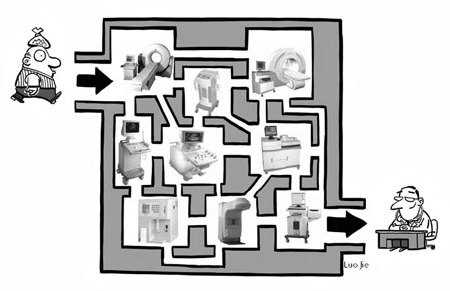 In contrast, the doctor-patient visit, which involves no expensive equipment, offers no significant profit opportunity. So the best way for a doctor to make money in his practice is not to spend time with patients but to use equipment as much as possible. That means moving the maximum number of patients through the practice, and spending the minimum amount of time with each one. From 2000 to 2005, the number of Medicare patients seen by doctors increased by 8.5 percent, while the number of services each one received was up 14 percent, according to the Government Accountability Office. It's not only Medicare that pays doctors on a fee-for-service basis; most private insurers do also. This is part of the reason that spending on physician services nationwide has risen every year since 2000 by about $25 billion. This year the tab will exceed $500 billion. Doctors who do their own CT scanning and other imaging order roughly two to eight times as many imaging tests as those who do not have their own equipment, a 2002 study by researchers at the University of North Carolina found. Altogether, doctors are ordering roughly $40 billion worth of unnecessary imaging each year - which adds up to nearly 2 percent of the total Americans pay for health care. No wonder the Government Accountability Office last month urged Medicare to find a way to constrain doctors' use of imaging tests. Over the years, Congress and Medicare have made various attempts to stamp out some of the most egregious excesses in Medicare payments. Sometimes they have succeeded. In 2004 and 2005, when Congress lowered the fees associated with anti-testosterone drugs used to treat prostate cancer, urologists and other doctors prescribed them less. Around the same time, though, urologists started buying multimillion-dollar radiation therapy machines for treating prostate cancer. Reimbursement for radiation treatment remains very generous. Clearly, scattershot strategies aimed at individual fees are unlikely to reduce health care costs. More fundamental changes are needed in the way doctors are paid. For their time, doctors should be given a stipend for each of their patients. It should be larger for patients with complicated medical conditions and smaller for those who are healthy, and it should not be influenced by the number of services or tests a doctor orders. For overhead, doctors should be paid an amount that covers the typical cost of tests and treatments needed to address a patient's condition. This strategy - known as "case rate" or "prospective" payment - is standard in American hospitals. The hospital receives a payment for dealing with a patient's underlying condition rather than individual payments for each test and treatment. This approach offers no incentive to run unneeded tests, and it has been credited with substantially slowing the growth in Medicare payments to hospitals. Without changes to the way Medicare pays doctors, the fights in Congress over raising or lowering payment rates will continue. And doctors will still have no financial incentive to do what is most important: spend more time with their patients. The author is a doctor at Memorial Sloan-Kettering Cancer Center The New York Times Syndicate (China Daily 07/29/2008 page9) |
