OPINION> Commentary

|
OPINION> Commentary
|
|
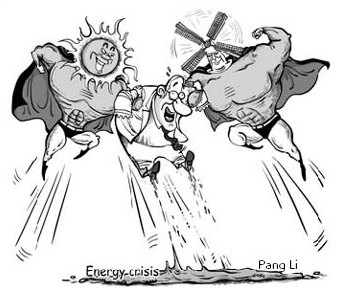
Answer is blowin' in the wind - and sun
By James Tisch (China Daily)
Updated: 2008-07-30 07:32 Bob Dylan said it best: "The answer is blowin' in the wind." While politicians and environmentalists have been busy arguing about how best to ensure that greenhouse gases are curtailed, the world around them has changed. The precipitous rise in oil and gas prices over the past year has made the debate on greenhouse gas emissions a moot question. The reduction in the output of those gases will move forward at warp speed, not because of rules, regulations and cap-and-trade decrees but because of free markets and economics. Two factors are driving this sea change. First, the prices of our traditional fuels - oil, gas and coal- have risen dramatically. Second, the silent and inexorable march of technology has dramatically reduced the costs of clean alternative energy sources such as wind turbines and photovoltaics, which converts sunlight into electricity. The result will be a dramatic reduction in the emission of greenhouse gases - without politicians passing a single additional piece of legislation. How have we come to this point? Blame it on oil prices and technology. The extraordinary increase in the price of hydrocarbons and coal has created a price umbrella under which competing technologies can flourish. Already, clean wind energy is increasing by leaps and bounds. In the past five years, more than 5 gigawatts of wind turbine capacity has been built in Texas alone; on days when the winds whistle along the plains, wind energy represents just under 10 percent of the electrical supply in the Lone Star State. Today, wind energy is economical at about 7 cents per kilowatt hour, and that is without factoring in production tax credits. A few years ago, that cost was 15 to 20 cents. Compare the 7 cents for wind energy with the 12 cents per kilowatt hour required to build a gas-fired power plant, and you can see why there is a veritable land rush to harness wind energy.
Texas is not the only state where the gravitational pull of economics and markets is working. Across the country, the price of electricity has skyrocketed for homeowners and businesses. This steep increase is creating a wide opening for technologies such as photovoltaics. The cost of this technology has fallen over the past few decades and is about ready for prime time. That retail electricity prices are increasing by as much as 30 percent this year will only accelerate the arrival of the "liftoff" phase of photovoltaics. Also, retail electricity prices in New York may soon be headed to 30 cents per kilowatt hour. At those prices, an investment in a photovoltaic array on the rooftop of a house will pay for itself in fewer than 10 years, resulting in a greater than 10 percent return on one's capital cost. Compared to the sub-5 percent yield on municipal bonds, this return represents an extraordinary investment. So, without a gavel coming down in a single additional legislative session, wind and the sun will become much bigger contributors to our national electricity mix. And an added benefit is that they generate absolutely no greenhouse gases. One more fast-approaching major change will all but guarantee that curtailment of greenhouse gases becomes an issue of the past: the advent of the electric car. Improvements in battery technology mean that in the next five to 10 years, plug-in hybrid electric vehicles will finally be on our roads. Within the next two to three decades, the gasoline-fired internal combustion engine automobile will no longer be sold. Since gasoline accounts for more than a third of worldwide oil demand, the rise of plug-in hybrids represents a mega-change in terms of emissions. Plug-in hybrids are dramatically cheaper to operate than today's cars. They will consume about 2 cents' worth of electricity to travel one mile, compared with the current 20- to 25-cent cost of driving a mile using gasoline. If consumers flock to them because of their lower operating costs, and they will, the resulting reduction in greenhouse gases will be a benefit of extraordinary proportion - one that the Kyoto crowd thought could be achieved only through draconian regulation. These changes will take place not only in the United States but worldwide. These technologies will be adopted simply because they are cheaper than their hydrocarbon-burning cousins. The old world of burning hydrocarbons to generate energy and power automobiles is on the way out because it is being priced out of the market. In the next few decades, it is possible that the only thing oil products will be used for is to power airplanes, heavy vehicles and ships. All that is required on the part of those wanting to reduce greenhouse gases is a little patience so these new technologies can be adopted by the market. So there is a silver lining in the run-up of hydrocarbon prices. These elevated costs are causing a dramatic change in our energy and automobile mix that will result in significantly less greenhouse gas emissions in the next few decades. The change is already on the way based on today's technology, and it will only quicken with the technological advances that are sure to come. Without a doubt, the answer is blowin' in the wind. The author is chief executive of Loews Corp in the US The Korea Herald/Asia News Network (China Daily 07/30/2008 page9) |