OPINION> Commentary

|
OPINION> Commentary
|
|
East Asia and Pacific: Navigating the perfect storm
By Jim Adams (China Daily)
Updated: 2008-12-23 07:45 Today's global financial crisis is not of East Asia's making. Yet the region, like the rest of the world, will not escape its effects. Fortunately, East Asian countries are better prepared to face today's financial turmoil than they were in the 1990s. But it is important to learn the lessons of what happened in the last decade and avoid the policies that can bring even greater hardships to the poor and vulnerable. First, some positive facts. So far, the economies of developing countries in East Asia have remained stable during this crisis. This is thanks to robust buffers built since the 1997 financial crisis: strengthened public finances and external balances; improved corporate governance; and stricter bank supervision. A sharp boost in foreign exchange reserves has also helped. But these buffers are now being tested. The sudden withdrawal of investments by nonresident investors has pushed East Asian economies into difficult terrain. The cost of capital has skyrocketed, threatening development programs in the region. The World Bank's East Asia and Pacific (EAP) economic update forecasts that real gross domestic product (GDP) growth in developing East Asia is likely to slow to 6.7 percent in 2009 - a slow down from 8.5 percent in 2008 and a record 10.5 percent in 2007. This slow down will be similar to what we have seen in Europe and Latin America. But coming off such a high base, developing East Asia will continue to outpace other developing regions. Much of that is driven by China's projected 7.5 percent growth (off levels of 11.9 percent in 2007 and 9.4 percent this year). In 2009, we expect that countries such as Indonesia, Malaysia, the Philippines, and Thailand, will grow by less than the average for developing countries. Slowing growth is not abstract - real people suffer. What these figures mean is that 5.6 million people in East Asia will remain trapped in poverty who might otherwise have escaped. As the demand for low-skilled labor falls, remittances from abroad decrease. Tighter capital reduces access to finance for small enterprises. Families will be squeezed.
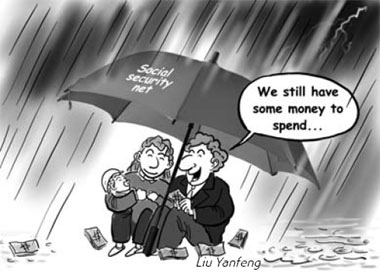
This crisis began as a financial crisis, quickly became an economic crisis, and now is rapidly becoming an employment crisis. The emphasis is therefore increasingly on economic stimulus packages. So far, we have seen packages from China, the Republic of Korea, Thailand, and Malaysia. Indonesia and Vietnam are also considering such plans. But unless the projects are already underway, the impact of new infrastructure spending often lags. The speed and effectiveness of fiscal stimulus packages are key to boosting economic activity. It is important, therefore, not to repeat the mistakes of the 1990s. Back then, governments were squeezed for cash and they cut into social programs. This hurt the poor most. We saw the result in social unrest and violence. The 1997 crisis highlighted the need for social safety nets. Social transfers, typically, have been most effective in stimulating spending, and serve the dual purpose of protecting the poor from the worst effects of the crisis. While safety net coverage varies across the region, many East Asian countries recognize their importance in an overall crisis response. The World Bank's research shows that these initiatives - such as conditional cash transfer or school feeding programs - can be run at a relatively low cost, typically at less than one percent of a country's GDP. The World Bank Group stands ready to help. We'll be looking for ways to speed up grants and the long-term interest-free loans that come from the $42 billion available to the International Development Association (IDA), which is our fund for the 78 poorest countries. Our lending arm, the International Bank for Reconstruction and Development, could make new commitments of up to $100 billion over the next three years. This year, lending could almost triple to more than $35 billion. Much of this increased support will help countries help the poor and the vulnerable. We are working to mobilize additional resources and coordinating actively with others, such as Australia, China, the European Commission, Japan, and the Asian Development Bank. International Finance Corporation, our private sector arm, is launching or expanding three facilities to help the private sector, expected to total around $30 billion over the next three years. They will address priority problems that have emerged in recent months: expanding trade finance; recapitalizing banks in poorer countries; and helping viable projects that are now facing liquidity crises. Countries that continue to pursue sound and coordinated policies are likely to weather the storm. This won't be easy. Keeping economies stable, shifting exports to faster growing regions in the world, substituting external with domestic demand, and continuing with reforms to strengthen competitiveness will be vital. This is a tall order given the turmoil in international markets, but it is one that countries in the region must strive together to achieve. The author is World Bank vice-president for the East Asia & Pacific region (China Daily 12/23/2008 page9) |