OPINION> Commentary

|
OPINION> Commentary
|
|
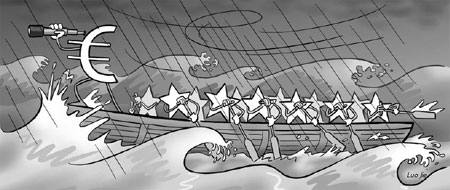
The Euro Ark has proved doomsdayers wrong
By Joaquin Almunia (China Daily)
Updated: 2009-01-13 07:36
The euro celebrated its 10th anniversary against the background of the most difficult economic climate since its birth. The financial storm that swept in from the United States, and the onset of a severe economic downturn, confront Europe with unprecedented challenges. Faced with the biggest test in its history, the euro is far from steering into disaster, as the Nobel laureate economist Milton Friedman predicted 10 years ago. On the contrary, Europe's Economic and Monetary Union (EMU) is proving a major asset in these tumultuous times. Doubters should remember that the euro was itself born out of crisis. The single currency was conceived as an answer to the upheavals of the postwar period - double-digit inflation, high unemployment, and speculative attacks on the pound, the lira, and the French franc. It was the crisis of the European Monetary System that drove the euro's launch on Jan 1, 1999. In 10 short years, the euro revolutionized the global economic environment, rising to the status of the world's second currency and rivaling the dollar as a medium for international trade and finance. The EMU is now the world's largest market, and continues to grow. With Slovakia's entry on Jan 1 this year, the euro spans 16 countries and 329 million citizens. The benefits of a monetary union based on a stable macroeconomic framework and governed by an independent central bank are manifest: the euro area has enjoyed low inflation and low interest rates for much of the last decade, a boost in trade and investment, and rapid integration of financial markets. Moreover, 16 million jobs have been created over the last 10 years - a record more successful than even the US. Today's financial turmoil and economic downturn are highlighting the EMU's advantages in several important ways. First, the euro has eliminated the possibility of exchange-rate turbulence and speculative currency attacks that more vulnerable economies could have expected in the current turmoil. As a stable and strong world currency, the euro is also limiting exchange-rate instability globally. Second, the euro area benefits from an independent European Central Bank whose swift actions to ease liquidity constraints and coordinate monetary policy have recently helped to avert a financial meltdown. Such rapid, coordinated steps by 16 national central banks would have been unthinkable. Third, the EMU's stability-oriented macroeconomic framework has better prepared euro-area countries for economic storms. Thanks to the fiscal rules of the Stability and Growth Pact, the euro area achieved its soundest budgetary position in 2007, bringing deficits to their lowest levels in 25 years. This allowed many European Union countries to approach the crisis with room for maneuver. Such are the EMU's benefits that the visible costs of remaining a non-member are beginning to recast the political debate surrounding euro adoption in several countries. Of course, the euro is no panacea, nor has it functioned perfectly over the last decade. Divergences between euro-area economies in terms of growth and inflation have been a persistent challenge. Though differences are no bigger than those found within larger economies such as the US or Germany, they risk being amplified by the crisis. This is why it is even more important that we continue to improve the EMU's functioning. This requires not just reinforcing resilience in the face of crisis, but also equipping euro-area economies for the longer-term challenges of globalization, aging, resource scarcity, and climate change. In a potentially more volatile 21st century global economy, we must reap the maximum benefits of economic integration in terms of growth and jobs.
 The key to a better functioning EMU is closer surveillance and deeper coordination of economic policies. Leaders must start living up to the responsibilities that come with sharing a single currency. They must recognize the impact that national economic policies have on the euro area as a whole, and thus discuss and coordinate economic programs at the euro-area level. Here, the launch of the European Economic Recovery Plan - the initiative for an EU-wide fiscal stimulus equivalent to 1.5 percent of GDP, endorsed by the European Heads of Government in December - constitutes a major step forward. This must now be followed by closer budgetary monitoring, particularly given that fiscal stimulus measures, the economic downturn, and bank rescue plans will take a toll on public finances. The Stability and Growth Pact must remain the cornerstone of the EU's budgetary framework, and effective surveillance and peer support will be vital to help member states work towards balanced budgets once the economy rebounds. Deeper fiscal surveillance should be matched by broader economic surveillance, especially since current-account imbalances have become more acute during the crisis. The European Commission is now working on extending the focus of surveillance beyond fiscal policy so that we can identify risks stemming from macroeconomic imbalances or changes in competitiveness and address them before they become entrenched. Finally, euro-area nations must strive harder to find common positions on international issues and to speak with a single voice in the global arena. This is the only way to promote and defend the EMU's economic interests in a world where the challenges are global and overcoming them will increasingly depend on multilateral cooperation. Consider November's international summit on the financial crisis. Agreeing on a common position ahead of the meeting gave Europe a greater role. When the euro area manages to agree swiftly on a coordinated position, this can be instrumental to finding agreement in the EU as a whole and internationally. It is vital we now build on this success and develop a genuine international strategy for the euro. The European single currency has been a major success, but it remains a work in progress. A decade after the euro's introduction, we must follow the example of its founders and turn crisis into opportunity by uniting in a spirit of cooperation and ambition - and thereby reinforce the EMU's foundations. The author is the European Union's Commissioner for Economic and Monetary Affairs Project Syndicate (China Daily 01/13/2009 page9) |