OPINION> Commentary

|
OPINION> Commentary
|
|
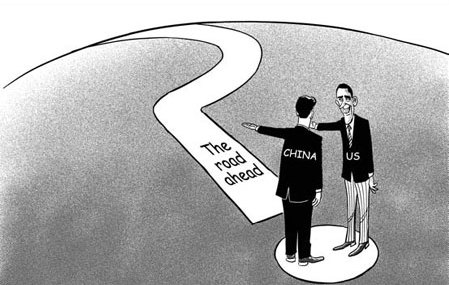
Will Obama's China policy be a step forward?
By Cai Hong (China Daily)
Updated: 2009-01-20 07:46 China is not at the peak of US President Barack Obama's game now. When the time comes, will he deliver "change", as he promised, to the United States' policy toward China? In the remarks to the US Senate Committee on Foreign Relations during her testimony as secretary of state-designate on Jan 13, Hillary Clinton called China "a critically important actor" in a changing global landscape. "We want a positive and cooperative relationship with China, one where we deepen and strengthen our ties on a number of issues, and candidly address differences where they persist," she said. She listed security and economic issues as the areas for cooperation between the two countries, including terrorism, proliferation, climate change and reforming financial markets. For the first time, China was being exploited so little at the hearings for secretary of state-designate at US Senate Committee on Foreign Relations. This should be a sign for a more mature relationship between China and the US. The Bush administration has left a favorable China legacy. In his foreign policy remarks on Jan 15, outgoing President George W. Bush highlighted his "strengthened ties with China". One week before the Bush administration was to leave office, the US sealed a milestone pact with China clearing the way for full implementation of a trade program for dual-use technology goods. The US Department of Commerce implemented a new export control policy toward China designed to tighten restrictions on dual-use technology exports. Among the technology covered under the new export policy are depleted uranium, lasers, certain types of avionics and aircraft equipment. At the same time, the department implemented the "validated End-User", or VEU, program in China. The US government has approved five Chinese companies for participation in the VEU program. Being designated by the US government as a VEU means individual export licensing requirements will be removed on shipments of controlled items to the five companies.
 In return, the companies agreed to on-site audits by US officials and strict record-keeping requirements. This program is expected to reduce the time, expense, and "uncertainty" in the licensing process and sharpen US exporters' competitive edge in China. US Under Secretary of Commerce Mario Mancuso said in a statement last week that the latest deal "will maximize the security and trade-enhancing benefits of the VEU program and continue a promising chapter in civilian US-China high technology trade". US trade deficit with China will greatly reduce if the US lifts restrictions on hi-tech export to China. So far, Obama has not commented on the last deal his predecessor struck with China. The number of areas where bilateral cooperation has improved in recent years, ranging from combating terrorism, preventing disease pandemics to reversing environmental degradation, is quite striking. Scholars Niall Ferguson and Moritz Schularick went as far as christening such a relationship as "Chimerica." For them, the most important thing to understand about the world economy over the past decade has been the relationship between China and US. They think of the relationship as one economy called Chimerica. It accounts for around 13 percent of the world's land surface, a quarter of its population, about a third of its gross domestic product, and somewhere over half of the global economic growth of the past six years. It is still a big guess whether the Obama administration would continue the strengthened ties with China. Fred Bergsten, director of Washington's Peterson Institute for International Economics, said Obama should initiate annual bilateral meetings with Chinese President Hu Jintao. Speaking at a Brookings Institution conference, Bergsten said only the United States and China can exert global economic leadership, particularly in critical new areas like combating climate change. He applauded moves to expand the Group of Eight into a more inclusive Group of 20, which includes China and India. "As we go forward in this whole process, we need to increasingly see at the center of the world's economic steering process an informal G2 between the US and China," he said. G2, G8, G20, or Gwhatever as we may call it, the presidents of the two countries have communicated frequently and met five to six times per year at international meetings. The intergovernmental relationship has never been broader or more deeply institutionalized. There are more than 60 bilateral dialogues and working groups in existence. The most important of these are the Strategic Economic dialogue and the Senior Dialogue on Global Issues. The communication in these dialogues is professional and cooperative. John Thornton of the Brookings Institution emphasized China's growing economic power. He called the US to lift the remaining barriers restricting Chinese ownership of US companies. Yet commentators should hesitate before prophesying a rosy picture for a Sino-US relationship under the Obama presidency. At its start treating the sick economy will top his agenda, followed by an array of priorities including billions of dollars for renewable energy, education and health care innovations. China won't become an issue for Obama's first 100 days as president, and beyond. The secretary of state-designate has left a note of toughness in her remarks during Senate Committee on Foreign Relations hearings. A positive and cooperative relationship between the two countries is not "one-way effort - much of what we will do depends on the choices China makes about its future at home and abroad." Traditionally, the Democratic Party endows trade protectionism compared to the Republicans. Yet trade war or conflict seems a less likely scenario than a continuation of cooperation between the two countries. The strategy of engagement initiated by former US president Richard Nixon and sustained by all his successors to date has left the new US administration no choice but to keep the momentum, if not moving it forward. (China Daily 01/20/2009 page9) |
