OPINION> Commentary

|
OPINION> Commentary
|
|
Only united efforts can tackle global challenges
By Fu Mengzi (China Daily)
Updated: 2009-01-23 07:37
With the demise of what was once called the bi-polar world, the global power structure has grown more complex, not simpler. Evidence of this new reality may be seen in the jostling for dominance among the world's sole remaining superpower and a legion of emerging second-tier powers. Twenty years of globalization has reshaped the global perspective as major powers moved to reposition. Briefly, the United States enjoyed a period of virtually unrivaled dominance in global affairs at the turn of the century. Nonetheless, my assessment of the global political picture today reveals a world in transition toward an international power structure that is multi-polar and multi-faceted. The likelihood of the world coming under the domination of a single political entity grows increasingly remote as the challenges facing the world grow increasingly complex. A multi-polar world augurs the rise of more global and regional powers capable of asserting an influence in the global arena, in the traditional sense of economic and military might. A multi-faceted world, however, creates a new set of rules and opportunities for countries to influence the geopolitical climate in non-traditional ways by demonstrating their "soft powers". Nations in a multi-faceted world are able to gain influence through their capability of mobilizing national resources, through the ability to execute policy effectively, by improving the "happiness index" among citizens, by promoting unique or distinctive cultural values" and so on. The interaction of such elements ultimately appears to be reshaping the world political scene and redefining concepts of international standing of nations. The influence of non-governmental organizations (NGOs), business, the media and interest groups becomes much greater than ever before. Rising powers no longer find them restricted to following the roadmap drawn at the behest of Western industrialized countries. Today, a nation's evolution tends to proceed along pathways best adapted to its domestic circumstances, its culture and its national traditions. The experience of China, Russia, India, South Africa and Brazil offer clear demonstration of how strong nationhood can be achieved, independent of conventions established by the prevailing world order. Information technology and resources are contributing factors to the rise of nations. Western countries may become wary of emerging countries that choose their own paths. Even countries that choose to adhere to the Western model may continue their economic development while retaining their intrinsic, native values and their ethnic and national identities. On matters of global security. Russia, the former superpower, complains bitterly at US presumptions to act unilaterally. International tensions may arise from regional tensions. The Russia-Georgia conflict is one example. Dispute and confrontation, however, no longer dominate relations between nations as they once did. Regardless of the individual paths nations choose, the rising tide of globalization establishes a natural environment strongly favoring cooperation. In the Russia-Georgia conflict, concerned parties including Russia, the United States and Europe had plenty of room to maneuver within the environment of negotiation and cooperation. As the world's only superpower, the United States failed to chart a course for international security acceptable to the rest of the world in the post-Cold War era. The US' determined pursuit of unilateralism and double standards contributed to the spread of disorder and threats to global security. While confronting the specter of terrorism, the US has maintained a wary vigilance toward other leading powers. Although efforts to curb terrorism will remain a top priority for the new US president, US foreign policy strategy is likely to diversify as the new administration sets out to achieve better coordination with principal allies and to secure support for US policies that has wavered in recent years. The pressing issue at the moment is to avert any deepening of the global economic recession. The endeavor will test the new US administration's ability to lead in multi-lateral efforts.
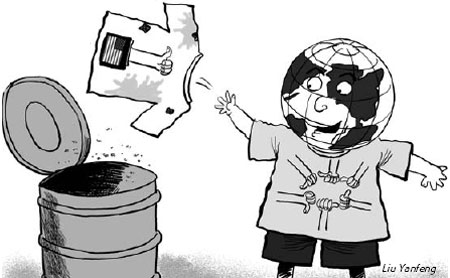 The challenges posed by climate change, environmental protection, energy conservation, terrorism and proliferation of weapons of mass destruction are far greater than the immediate threat of conflict among nations. In a multi-faceted, multi-polar world, unilateralism would work to the detriment of achieving an international solution. The rest of the world waits to see whether the new US administration possesses the ability to make good use of diverse forces and to tolerate different developmental paths. In an increasingly interdependent world, the US should look at things from a brand new perspective and come up with a global strategy free of the old school Cold War mentality. Such a move will help to build trust among the world's leading powers and serve as a stimulus for unified efforts to tackle the common challenges we all face. In a multi-faceted, multi-polar world, collective management of international affairs makes far greater sense than the hegemony of a solitary superpower. Collective management does not spell the decline of the US. Collective management however is a necessity, driven by the complexity and urgency of today's problems. Although developed nations such as the US must shoulder greater responsibility, global solutions demand global effort. Globalization has created fresh opportunities for global development. It has side effects that cause some developed nations to balk and reconsider the their positions on the trend. Once a synonym for Americanization, globalization is a force that many in the US see as careering out of US control. Industrial outsourcing, an exodus of jobs and the climate presenting higher financial risks are combining to cast doubt. Globalization is getting a second and more wary look in the US. On trade matters, the US is more focused today on bilateral agreements than multi-lateral accords. With its enthusiasm waning, the US is likely to play a diminishing role in the globalization process. The European Union faces its own difficulties. The EU also is likely to be less proactive in promoting globalization. The external economic ties of developed nations are also undergoing changes. Industrial outsourcing and the shrinkage of manufacturing sectors are lowering these countries' dependence on raw materials and half-finished products from developing nations. The Wall Street financial crisis raised new questions about laissez-faire capitalism and the US-style free-market economy. The merits of the high-consumption US lifestyle with its associated low savings record are becoming widely questioned. The diminished ability of developed nations, the US in particular, to drive global economic growth does not portend the end to globalization. With the existing world trade system still functioning, international commerce will not soon fall apart. From a mid- and long-term point of view, the future of globalization lies in concerted efforts by the existing superpower, the US, China and other rising powers. The progress of globalization has not impaired cooperation at the regional level. Apart from Asia, where progress remains slow, regional cooperative arrangements are gaining importance in Africa and Latin America. The days are gone when big nations vied for influence to lead or control international and regional organizations. The challenges posed by global warming, environmental protection and regionalization are too daunting for any nation to desire to shoulder on its own. Therefore, the jostling for dominance gives way to a set of conditions better suited to a new spirit of increased cooperation. The author is assistant president of the China Institute of Contemporary International Relations (China Daily 01/23/2009 page9) |