OPINION> Commentary

|
OPINION> Commentary
|
|
Economic makeover the only hope
(China Daily)
Updated: 2009-02-13 07:42 Never has China's economic growth attracted so much global attention. The shock waves from the financial crisis that started in the United States have spread across the entire world, sending developed nations, including Japan and those of Europe, into serious recession. The world is now holding out hope that China, with its massive potential, will serve as the engine to stoke global economic growth. But China's real economic growth slowed sharply to 6.8 percent in the October-December quarter. For China, this rate of economic expansion must be as disappointing as negative growth is for Japan. Beijing has set an official goal of achieving a minimum annual growth rate of 8 percent - a pace it regards as vital to ensuring job security.
The Chinese government is apparently confident the nation will achieve the minimum growth target of 8 percent in 2009. At the World Economic Forum's annual meeting of political and business leaders in Davos, Switzerland, Chinese Premier Wen Jiabao stressed the Chinese economy began to show signs of recovery late last year. Last week, however, the International Monetary Fund predicted that China's economic growth in 2009 will be 6.7 percent. China's economic outlook is likely to keep arousing both hope and anxiety for the time being. China's spectacular economic growth has been fueled by swelling exports and massive investment in plant and equipment to produce goods for overseas. But the US, Japanese and European economies, which have absorbed the bulk of China's exports, are expected to shrink simultaneously in 2009, for the first time since the end of World War II. For the first time since it started serious efforts to turn itself into a market economy in the 1990s, China is facing the challenge of maintaining healthy economic growth without depending on external demand. Expansion of domestic demand holds a key to China's success in tackling this challenge. Consumer spending accounts for only 35 percent of China's gross domestic product. The ratio is considerably lower than the 70 percent for the United States and the nearly 60 percent for Japan. That is because the middle class - the group that should lead consumer spending - is still relatively small in China, where the benefits of the nation's strong economic growth in recent years have mostly eluded rural villages and low-income earners.
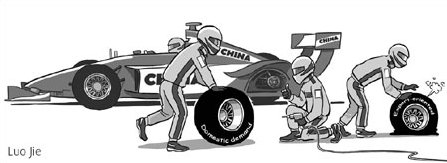 When it announced a fiscal stimulus package worth 4 trillion yuan (some 52 trillion yen) last autumn, Beijing cited 10 policy priorities. They included measures to support the lower rungs of the economy, such as building housing for middle- and low-income earners and developing infrastructure in farming villages. The Chinese government has also started taking steps to stimulate consumption, for example, by providing state subsidies so inhabitants of rural areas can purchase electronic home appliances. With the world economy facing the prospect of a prolonged downturn, however, China needs to push through more radical structural economic reforms.It should focus on transforming the country's export-driven economy to one led by domestic demand. A delay in the necessary economic policy shift could lead to an even sharper slowdown and a further widening of the economic gap. A long list of policy challenges is confronting China. In order to narrow the income gap between cities and rural areas, it needs to establish a system that allows people to move freely to find jobs. The country also must find a way to redistribute fiscal resources to support underdeveloped areas similar to Japan's allocation of part of the central government's tax revenues to local governments. Because of food, energy and environmental limitations, China, with a population of 1.3 billion, definitely must pursue energy-efficient growth. The yen's sharp appreciation in the mid-1980s put strong pressure on Japan to undertake a structural shift toward an economy driven by domestic demand. In response, the Japanese government offered a blueprint for the economic makeover in the so-called Maekawa Report, a document drafted by an advisory panel headed by former Bank of Japan Governor Haruo Maekawa. We hope that China will lay out a new vision for its economic future in a Chinese-version of the Maekawa Report. The Asahi Shimbun (China Daily 02/13/2009 page9) |