OPINION> Commentary

|
OPINION> Commentary
|
|
Obama should flex more diplomatic muscle
By Morton Abramowitz (China Daily)
Updated: 2009-02-26 07:45 Recently, the United States marked the 30th anniversary of a historic diplomatic success in East Asia - the restoration of Sino-American relations. The current world economic crisis merits an attempt at diplomacy of even greater magnitude. President Barack Obama should start flexing his "aggressive" diplomacy early on by inviting the leaders of China and Japan to join him in Hawaii - or any other mutually agreed place - for what would hopefully be the first in an ongoing series of trilateral summits to work out how the three countries will cooperate, both to get out of recession and enhance the stability and security of East Asia. Such a meeting could be a game-changing event. International coordination of strong national efforts will be essential to surmounting the global economic crisis. Not only must the whole of our national stimulus efforts be greater than the sum of their parts, we also need to avoid sliding into protective trade and industrial policies that could make the crisis far worse. The Group of Eight and the G-20 forums are useful vehicles for coordination. However, there are two countries with which the United States must work especially closely - China and Japan. Japan is still the world's second-largest economy and China is probably the third-largest and certainly the fastest growing. Politically and economically the three countries dominate East Asia, the most dynamic area of the world; they are all key to preserving peace in the region. Encouragingly, China and Japan have already begun to work together - a December summit meeting with South Korea focused on expanding central-bank cooperation. Obama has a unique opportunity to both strengthen economic cooperation and enhance prospects for security in East Asia. The inextricable interdependence of our three economies is now crystal clear. The three are major trading partners with each other. All are suffering substantial declines in growth and will need to stimulate their economies for some time. What has been done or is contemplated thus far is almost certainly not going to be sufficient. China and Japan hold huge amounts of American debt, and the United States needs them to add to those holdings as it embarks on a huge stimulus package.
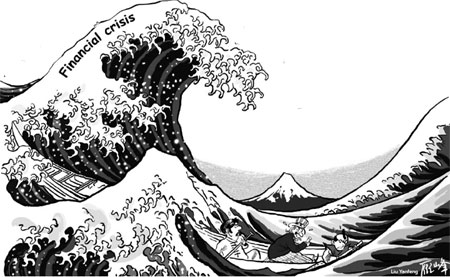 China needs to expand domestic consumption. Both Japan and China need to reduce their reliance on exports. In the longer term, America clearly has to save more and changes to the international financial structure must be made. Without serious coordination and reinforcement of each other's national measures, we will glissade down an icy slope of increasingly nationalist and protectionist economic policies. Such moves would threaten our economic recovery efforts. They could also exacerbate nationalist tensions and, if unchecked, jeopardize our security interests. A "trilateral" meeting among the leaders of the United States, China and Japan would be unprecedented. For several reasons including history, this kind of meeting has yet to occur, even at lower official levels. The United States has preferred to deal with both Japan and China on a bilateral plane believing - wrongly - that this somehow maximizes the US influence. And yet, American relations with both Japan and China have never been as simultaneously good as they are now. This is an enormous opportunity for American leadership to lay the foundation for trilateral cooperation. In this period of common economic disaster, there's never been more at stake in terms of trilateral cooperation. Granted, US-Japanese-Chinese cooperation can be only one part of a broader multilateral effort. The G-20 is scheduled to meet in April and policies need to be coordinated on a global scale. Analysts have been acknowledging the rise of East Asia and its burgeoning weight on the global economy. It is hard to say now what the current global crisis will do for this forecast. But clearly, the global balance of influence will continue to shift and power will continue to diffuse. Change is happening - whether it's Obama's version or someone else's will depend in part on how effective he is in engaging the other principal actors who are driving change. The author is a senior fellow at The Century Foundation, has served as US ambassador to Thailand and president of the Carnegie Endowment for International Peace. The Asahi Shimbun (China Daily 02/26/2009 page9) |
