OPINION> Commentary

|
OPINION> Commentary
|
|
Russia equipped to ride out economic tempest
By Yu Sui (China Daily)
Updated: 2009-03-19 07:22 Until the latter half of 2008, the Russian economy was developing rapidly. Annual GDP rose more than 7 percent throughout Vladimir Putin's presidency. The boom however came to a shuddering halt as the economic crisis broke, triggering a downward spiral in oil prices. As economic pain became political, and internal problems affected external relations, how Russia would weather the economic crisis is an increasing concern. But it's more a case of setback than ruin for the former Soviet Union. In an interview with French newspaper Le Figaro in September, Prime Minister Putin said: "We have had no liquidity crisis and no mortgage loan crisis of a kind that some European and American markets have experienced we have a double surplus, the budget surplus and the foreign trade surplus. Our gold and currency reserves are constantly growing and have reached $500-odd billion, Russia is third on that count after China and Japan." This obviously underestimated the threat posed by the economic crisis. Since last July, the rouble has lost more than 30 percent of its value against the dollar and the stock market has plummeted 70 percent. Gold reserves shrank by one fifth and capital outflow in 2008 amounted to US$130 billion. Industrial output has fallen since November, recording a 12.8 percent drop in December. Housing prices, which had been going up until October, plunged by 25 percent. More than 300,000 have joined the ranks of the unemployed in the past few months, bringing the total to a staggering 5 million. Vice Prime Minister and Finance Minister Alexei Kudrin said Russia is facing the most difficult year since World War II. After predicting GDP will drop to zero, the economy ministry has admitted it might shrink by 2.2 percent. The budget deficit could exceed 8 percent, while the inflation rate may soar to 14 percent. But Russia should be able to ride out the storm. Firstly, oil prices may bounce back due to the long-term global energy supply shortage and OPEC's production-cutting measures. Secondly, the Russian government has taken a series of policies in shoring up the rouble, reining in inflation, monitoring fiscal spending and ensuring money supply to the real economy. Thirdly, arms sales are in good shape, totaling $8.35 billion last year and setting a record since the disintegration of the USSR. The gloom pervading recent media reports on Russia is a correction of the former euphoria. The political disturbance has also been exaggerated. Anti-government rallies have broken out in cities including Moscow, St Petersburg and Sochi since late last year. The protest in the far-eastern port of Vladivostok, in particular, drew much media attention. Thousands took to the streets to protest the 80 percent import tariffs on imported cars. The measure, effective since December 10, aims to protect the domestic car industry. But to Vladivostok, where the economy relies on refitting and selling second-hand Japanese and South Korean cars, it means more than 100,000 may lose their jobs.
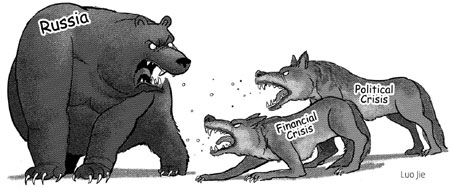 But protests caused by economic crises are hardly surprising. They have been held in Europe, Africa and Latin America. To interpret Russian demonstrations into seething public discontent would be an overstatement. In and outside Russia, some commentators have been linking the rallies WTO political instability. This has much to do with the fact that President Dmitry Medvedev twice rebuked the cabinet for being too slow in taking measures to tackle the economic crisis. This raises questions about the alliance between Medvedev and Putin, who leads the cabinet. Putin gained a platform to wield power, he assumed the inherent risks of taking on thorny economic problems. At this juncture, Putin and his cabinet are under unprecedented pressure. Still, Medvedev and Putin have been working together in apparent harmony. Opinion polls show Putin, chairman of the country's biggest party United Russia, still ranking as Russia's No 1 leader with a 70 percent approval rating. To suggest Putin's position had been undermined is unfounded. If someday heads do have to roll, there's always the option of finding a scapegoat. The harsh economic situation has made the Russian government more careful with external relations. Underneath the hard-line stance, Russia is becoming more flexible. In its key diplomatic relations with the US, Russia enjoys two advantages: Firstly, it came out on top in the August war with the US-backed Georgia and has effectively slowed down the eastern expansion of NATO. Secondly, the new diplomacy of US President Barack Obama has offered more possibilities for maneuvering. While resisting pressure from the US, Russia has displayed signs that it wants to be on better terms with the US. Such intentions are evident in Russia's allowing the US to transport non-lethal supplies to Afghanistan by rail through its territory, though it has been pushing for Kyrgyzstan to cancel the lease of Manas Air Base. Other signs include bargaining over nuclear disarmament and a US missile shield in Eastern Europe, closer cooperation with other Commonwealth of Independent States, efforts to warm up ties with US allies such as the EU and Japan and the campaign to cement links with Latin America. Like always, Russia-US relations will oscillate between temporary warmth and inevitable coldness. The author is a researcher with the Research Center of Contemporary World. (China Daily 03/19/2009 page9) |
