OPINION> OP-ED CONTRIBUTORS

|
OPINION> OP-ED CONTRIBUTORS
|
|
Climate change: EU, China have work to do
By Serge Abou (China Daily)
Updated: 2009-04-28 07:55 One of the many mutual interests of China and the European Union (EU) is to reduce, if not eliminate, the threat of climate change. Tackling climate change can help unlock investment that will accelerate global recovery from the deepening recession and ease our dependence on fossil fuel imports. Battling the problem requires more or less the same kind of measures needed to cut our dependence on energy and improve the environment. We need to save energy and become energy efficient. The EU agrees that developed countries have a huge responsibility on their shoulders, which is why it has committed to cut greenhouse gas emissions by at least 20 percent from the levels in 1990 by 2020. The EU is prepared to move to a 30-percent reduction as its contribution to a new global agreement, provided other developed countries commit to similar emission reductions and developing countries contribute adequately in line with their sustainable development needs. The global community will continue to follow the principle of common but differentiated responsibilities, under which all countries contribute to tackling climate change as per their capabilities. Chinese leaders recently stressed that China, being a responsible member of the global community, will contribute its fair share in battling climate change. So there is clearly ground for optimism. The EU welcomes the measures China is already taking to improve energy efficiency across its economy, increase renewable energy and forest coverage. Not only has China fixed a number of key short to medium-term targets but also put in place policies, including mandatory regulations and economic instruments, that have proven effective. We also look forward to seeing substantial focus on these goals during the implementation of the economic stimulus package launched last November. If China is successful in steering its economy onto the path of low carbon development, it will enable the country to become a leading player in markets for low-carbon technology, lead to new trade opportunities and create a better standard of living for its citizens. While there is tremendous potential to cut energy use and emissions by using technology that already exists in China or can be transferred from developed countries, it is clear that we also need concerted efforts on research, development and demonstration (RD&D).
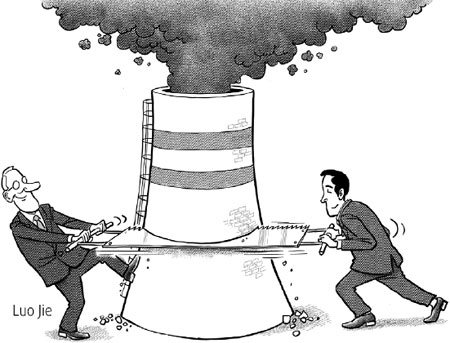 It would be desirable to at least double global energy-related RD&D by 2012 and increase it to four times its current level by 2020, with emphasis on low-carbon technologies, especially renewable energy sources. It will involve global research coordination, science and technology cooperation and reduction in barriers for environmental goods and services in the market. The EU and China have already embarked on a strategic energy and climate technology cooperation. Last January, we agreed to establish a center for clean energy technologies in China, while later this year we will conclude the joint research that has been going on for three years to prepare the ground for a carbon capture and storage demonstration project and move to site-specific design and feasibility studies with a view to having large-scale demonstration in China around 2015 (alongside up to a dozen plants in Europe). In order to meet the needs of skilled staff operating clean and renewable energy installations, we recently agreed to establish a vocational training institute in China as well. In the current economic situation, it is particularly important that climate change goals are delivered cost-effectively. In this context, the EU firmly believes that a global carbon market is the most effective approach. China and the EU have both benefited from the Clean Development Mechanism (CDM). Indeed the two sides have been the most important protagonists of this mechanism since the Kyoto Protocol came into force. The sale of emission credits by China has allowed a great number of investments to take place in the country in energy saving and diversification. However, CDM projects are not delivering emission cuts at the scale that is required. The EU is aware that developing countries will need additional financial and technological assistance to complement the carbon market. We believe financial support for mitigation should be based on "low carbon development strategies" produced by developing countries themselves. In the context of China, this strategy should be fully integrated into the overarching Five-Year Plans and cover all key emitting sectors. A recent report by the Chinese Academy of Sciences (CAS) is very encouraging in this respect. It argues that a low carbon development path with Chinese characteristics shall be built containing clearly defined targets and a roadmap of priority actions, to be implemented as pilots in representative regions/cities and key sectors, as part of the national strategy for economic and social development. CAS proposes that China's low carbon economic development target for 2020 be set at 40-60 percent reduction of energy consumption per unit of GDP over the 2005 level and that carbon dioxide emissions per unit of GDP be reduced by about 50 percent. It foresees a peak in national greenhouse gas emissions between 2030 and 2040. Furthermore, it advocates participation in international sectoral energy efficiency benchmarking and Chinese leadership in "clean coal" technology with carbon capture and storage. Both China and the EU want a successful conclusion at the Copenhagen Summit, scheduled for the end of this year. The EU appreciates China's constructive approach to the negotiations. Dialogues between China and the EU on climate change, and the general upgrading of our Strategic Partnership, with two EU-China Summits planned this year, will be very helpful in fostering mutual understanding and a more common vision in the run up to Copenhagen. Last month, US President Barack Obama wrote in a letter to the EU President Jose Manuel Barroso that the future of our children and our planet depends on what we do to address this challenge in the months and years ahead. I couldn't agree more. The author is Ambassador and Head of the Delegation of the European Commission to China. (China Daily 04/28/2009 page9) |
