OPINION> OP-ED CONTRIBUTORS

|
OPINION> OP-ED CONTRIBUTORS
|
|
Task ahead for China, US: Maximum cooperation
By David Shambaugh (China Daily)
Updated: 2009-05-06 07:45 Despite the broadening of the strategic agenda, the Barack Obama administration will continue to work with Beijing on three important "holdover" issues from the Bush administration: Taiwan, the Democratic People's Republic of Korea (DPRK) and Iran. On Taiwan, Washington is pleased with the trajectory of the question since Ma Ying-jeou's election as "president" in May 2008. Cross-Straits relations have substantially stabilized in all spheres. Washington is encouraged by these trends and takes heart from the Bush administration's successful navigation and management of the dangerous Chen Shui-bian period. Chinese President Hu Jintao's important speech on New Year's Eve (December 31, 2008) opened the possibility of adding military confidence and security building measures to the other ongoing areas of exchange. This is to be welcomed. More broadly, there is growing discussion in Washington of the need to undertake a thorough policy review over Taiwan given the dramatic and positive changes in cross-Straits relations. On the DPRK, the Obama administration has signaled its intent to remain actively engaged in the Six-Party Talks and to pursue the "complete and verifiable" denuclearization of the Korean Peninsula. If Pyongyang were to do so, US Secretary of State Hillary Clinton for the first time stated in unambiguous terms in her Asia Society speech, the US would be prepared to "normalize bilateral relations, replace the peninsula's longstanding armistice agreements with a permanent peace treaty, and assist in meeting the energy and other economic needs of the Korean people". The recent launch of a long-range Taepodong-2 ballistic missile by the DPRK was opposed by Beijing and Washington both. Finally, with respect to Iran's nascent nuclear program, the Obama administration has signaled a dual policy. The first track is to continue the UN Security Council permanent 5+1 (Germany) "sextet" to try and negotiate with Teheran to abandon its secret program and come under the International Atomic Energy Agency regime. This track will continue to involve China. The second track is to possibly initiate direct contact with the government in Teheran to begin the long process of normalization of relations. Obama indicated during the presidential election campaign that his administration would pursue such direct contacts. He has reiterated that since assuming office. The appointment of seasoned Middle East troubleshooter Dennis Ross as Special Envoy with responsibility of Israel and Palestine, the Persian Gulf, and "Southwest Asia" (codeword for Iran) is a step in this direction. While Teheran has not yet signaled a positive willingness to hold such formal direct contacts with Washington, interestingly Iranian diplomats abroad have been privately contacting their Chinese counterparts to ask how China "prepared" for the rapprochement with the US in the early 1970s. Modalities Before and during her visit to China, Clinton signaled an alteration in the modalities of strategic dialogue. She had been somewhat critical of the Strategic Economic Dialogue launched by former Treasury secretary Henry Paulson during the Bush administration. Clinton's position seemed to have more to do with her desire to elevate the State Department's role in these dialogues. As a result, it was announced at the Obama-Hu meeting in London that a bilateral "Strategic and Economic Dialogue" would commence, with the first round scheduled to take place in Washington sometime this summer. On the US side, the new dialogue mechanism will be jointly headed by Clinton and Treasury Secretary Tim Geithner.
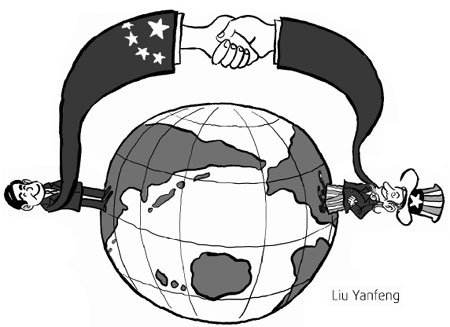 In pursuing this broader strategic agenda with China, Clinton roiled the human rights community by claiming that human rights concerns "cannot interfere" with the broader strategic agenda. She said in Beijing: "We have to continue to press them but our pressing on these issues (Taiwan, Tibet, human rights) can't interfere with the global financial crisis, the global climate change crisis, and the security crises - we have to have a dialogue that leads to an understanding and cooperation on each of these." Clinton later backpedaled somewhat to indicate that human rights remained on the agenda and an important issue in the relationship. In order to push forward the military-to-military exchange ties, the Obama administration should seriously consider asking Congress to repeal a number of the more restrictive aspects of the 2000 Defense Authorization Act, which prohibits a wide range of contacts between the US military and People's Liberation Army. These provisions may have made sense at that time, but they no longer do so, and they are an impediment to building communication, trust and confidence between the two military establishments. Prospects and outlook This seems to be the broad outlines of the Obama administration's strategic and security agenda with China. To be sure, there are many more issues on the US agenda (China has its own agenda) - including the valuation of China's currency, the trade deficit, nonproliferation, intellectual property rights, human rights, Tibet, Darfur and Myanmar. It is a crowded agenda. One challenge for the new administration will be to prioritize the issues on the agenda, although all of them must be pursued simultaneously. In addition to the question of prioritization, there is also the issue of institutionalization. That is, these multiple issues on the bilateral agenda may be better pursued through a combination of (1) establishing institutionalized working groups that communicate regularly and meet periodically, and (2) high-level meetings at the ministerial, vice-presidential and presidential levels. The latter will energize the former. Too often in the past, the two sides have had high-level meetings without setting up institutionalized working groups. Both sides like to claim that there exist more than 60 bilateral dialogue mechanisms, but these are episodic and not regular. The relationship needs, I believe, a deeper degree of institutionalization through the establishment of bilateral ministerial working groups. On some issues, when warranted, such working groups can involve other nations and regions (Japan, Russia or the European Union, for example), but the core would be Sino-US. This will perhaps give the appearance of a "G-2," but in reality China already has such working group mechanisms with the EU and a number of countries. The virtue of this approach is that it would institutionalize cooperation and infuse the bureaucracies of the countries with positive missions. Sino-US ties have a great opportunity. The Obama administration inherits not only from the Bush administration a basically well-functioning, positive and cooperative relationship, but also a considerable bipartisan consensus in Congress and the public. Moreover, the chronic problem of the Taiwan question is at low ebb and East Asia is at peace (notwithstanding the DPRK nuclear problem), thus clearing the path for both sides to focus on regional and global cooperation. To be sure, the Taiwan question remains potent and as long as the arms sales issue hangs over the relationship (thus suspending military exchanges) bilateral ties will not be fully normalized. Japan also harbors concerns (that will have to be assuaged) about the emerging Sino-US global partnership, of which it is not a part. There remains a good deal of residual strategic suspicion in the US and China's militaries and national security establishments, including the intelligence and counterintelligence communities. But this strategic suspicion can be ameliorated by resuming military exchanges and forging cooperation in other realms. Cooperation can be contagious. Cooperation forged in the diplomatic and economic realms can positively "spill over" into the national security domain. By signaling to Beijing that Washington seeks just such a global, cooperative, and comprehensive partnership, Clinton has started off in the right way and has set an appropriate tone for the relationship. Her broadening of the strategic agenda is also appropriate, although the Chinese side will be pressed to formulate detailed policy positions in these new areas. In sum, there is perhaps no more important relationship for the Obama administration to manage simply because China is now a global player in so many areas, and as such Washington's and Beijing's interests and equities coincide. The task at hand will be to cooperate to a maximum extent, minimize competition, and avoid conflict. The author is professor of Political Science and International Affairs and director of the China Policy Program at George Washington University. He is also a non-resident senior fellow in the Foreign Policy Studies Program of the Center for Northeast Asian Policy Studies, the Brookings Institution in Washington DC. (China Daily 05/06/2009 page9) |

