OPINION> OP-ED CONTRIBUTORS

|
OPINION> OP-ED CONTRIBUTORS
|
|
Japan uses DPRK as excuse for space plan
By Li Daguang (China Daily)
Updated: 2009-05-13 07:47 On April 5, the Democratic People's Republic of Korea (DPRK) stunned the world by launching an experimental communication satellite into space. The international community has focused its gaze on the DPRK since then, but seems to have ignored Japan's efforts to use the event as an excuse to develop its space program for military purposes. Japan has the most vociferous reaction in the region to the satellite launch. It even threatened to intercept the DPRK's rocket. To cope with the so-called "missile threat" from the DPRK, Japan deployed three "Aegis" destroyers to form a barrier on sea, and its Ground Self-Defense Force set up anti-aircraft missiles around Tokyo and in northern Japan to form a shield on land. Japan's "hard" reaction to the DPRK's satellite launch shows its intention to take advantage of the situation. Many experts say Japan may use the DPRK satellite launch as a pretext to further build up its conventional arms. But I believe it will use it as an excuse to develop its military space program because its conventional military machinery, especially its navy, is already in the top tier in Asia. In fact, no Asian country poses a real threat to Japan. Before 2008, Japan had always advocated prohibition in the use of outer space for military purposes. In May 2008, however, the Japanese parliament passed the Basic Law of Space, which scrapped the principle of non-military use of space, and made military satellite launches by Tokyo possible. Though the Basic Law of Space opened up the prospects of Japan's space plan, Tokyo did not reveal its intention of leaning toward a military program. The DPRK's satellite launch, however, offered it a superb excuse. On April 3, two days before the satellite launch, Japan's Strategic Headquarters for Space Development released a 5-year plan for space development aimed at landing a robot on the moon before 2020. It emphasized that its space program would focus on defense and serve military and diplomatic purposes.
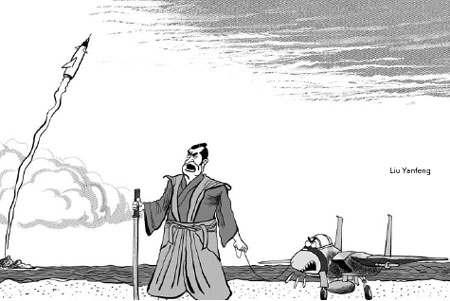 The embarrassment Japan suffered before and after the DPRK satellite launch stirred it into declaring that it would develop its own military space program. The DPRK informed China, the US and Russia beforehand of the time of its satellite launch, and the US passed on the information to the Republic of Korea. Japan was "forgotten" by everyone. That indirectly led to Japan's embarrassment of misreporting that the DPRK would "launch a satellite" on April 4. Smarting from the experience, Japan is now considering adding "launching and maintaining of independent early warning satellites" to its National Defense Program Outline when it is modified in December. On April 9, Japan's Minister of Defense Yasukazu Hamada told the Security Committee of the House of Representatives that in order to counter the "DPRK threat", "Japan must consider equipping itself with early warning satellites. (If they are deployed), there will be more preparatory time to take immediate countermeasures after the launch. Hence, I think they are vital". The Japanese government has included "the stimulation research of a united anti-aircraft system with satellites" into its 2009 defense budget, indicating that its Defense Ministry had already started conducting research on early warning satellites. Tokyo depends on the Pentagon for its early warning intelligence. If Japan develops its own early space warning system, its Missile Defense System (MDS) will cease to depend on US intelligence. A glance at history shows that as a regional power, Japan has always taken advantage of a crisis on the Korean Peninsula to gradually fulfil its own interests. Japan has yearned for an MDS for decades, and joined the Theater Missile Defense (TMD) of the US in the mid-1980s. With efforts of more than 20 years, it has acquired the most powerful anti-aircraft and anti-missile systems in Asia. For years, Tokyo has been preparing to develop and deploy a specialized military space-flight system. When the DPRK launched an intermediate-range ballistic missile, "Taepodong-1", over Japanese territory on August 31, 1998, Japan had no knowledge beforehand about it. Three months later, Tokyo decided to develop an independent reconnaissance satellite system, and began formulating a satellite launch plan to "monitor the Korean Peninsula". The Japanese government spent 505 billion yen ($5.16 billion) over the next eight and half years to build its reconnaissance satellite system, citing the so-called threat from the DPRK's Taepodong missile as an excuse. It set up a reconnaissance satellite office in April 2001 to promote the plan, and later shot four successive reconnaissance satellites into space. The current Japanese space reconnaissance system comprises two optical and two radar satellites that have been weaved into a monitoring network in space. Tokyo plans to launch a more advanced optical satellite later this year, too, and send a new radar satellite into space in 2011. It's high time the international community reach a consensus on "space militarization", because without it Japan's military activities in space will continue to advance under the banner of "civilian" or "defense" technology. The author is a researcher with the National Defense University. (China Daily 05/13/2009 page9) |
