OPINION> OP-ED CONTRIBUTORS

|
OPINION> OP-ED CONTRIBUTORS
|
|
Let Rio deal be a lesson in M&A strategy
By Shujie Yao (China Daily)
Updated: 2009-06-17 07:46 The scrapping of a deal by Rio Tinto with Chinalco is a poignant reminder that China's long march for overseas acquisitions will be slow and tortuous. Four years have passed since China National Offshore Oil Co (CNOOC) hit a political brick wall in its bid to buy California-based oil company Unocal. The US Congress opposed the deal, nervous over the extent of China's geopolitical influence on its own doorstep. There is a key difference between the Unocal and Rio Tinto cases. Whereas the rejection of CNOOC's advances in 2005 was overtly political, the rupture of the Chinalco-Rio Tinto deal was attributed to commercial factors. When Rio Tinto decided on a rights issue and a joint venture with BHP Billiton, the commercial advantages to non-Chinese shareholders were obvious. But the unilateral action by Rio Tinto, an Anglo-Australian company, to destroy the Chinalco deal was also subject to weighty media and political pressures. Many in Australia feared China - the world's largest steel producer - would manipulate the price of iron ore and bauxite to its advantage, and Western stakeholders felt uneasy about two Chinese non-executive directors sitting on the board. In this sense the Rio Tinto affair emphasizes how little has changed since the Unocal saga. The gulf of misunderstanding between China and the West is still yawning. The emergence of China has been so swift that many in the West have been slow to recognize that it is a much-reformed society today. They are reluctant to accept that in the sphere of international relations China seeks harmony not confrontation. Economic concerns abound. The world economy benefits from cheap Chinese imports but nations fear China's rise will threaten their markets and jobs. These anxieties may be justified, but this is the inevitable process of competition and globalization - every country should adjust its strategies to cope with it. There are cultural barriers, too. In its dealings with Rio Tinto, Chinalco committed the mistake of applying traditional Chinese culture to cutthroat business. It expected a degree of respect for what it considered a generous offer. But it failed to realize that Western businesses are attuned to using any trick in the negotiating book to get the best deal at any cost. There was a patent need to seal off the escape route Rio Tinto had dug. Failing to do so exposed the dearth of international experience among China's senior business leaders. Unfamiliarity with the West's legal language is a problem. Loopholes are often hidden in heaps of documents, and Chinese companies not alert to these hidden dangers are likely to find their weaknesses exploited. The Chinalco-Rio strategic partnership was documented in a 600-page file in which the Anglo-Australian company cleverly built two escape routes in just a couple of nondescript lines. It will take time for China to learn how to reconcile its differences with the West. The errors of Chinalco will not be repeated easily, but that is not to say more mistakes will not be committed. Chinese companies need to swot quickly. The opportunities created by the financial crisis to make far-reaching global acquisitions only come once in a lifetime. Despite the blow to China's self-esteem caused by the Rio Tinto deal, China has shown it is in no mood to relent. Western companies can dodge China today, but cannot do so tomorrow. Overseas expansion is strategically ingrained in two key national development objectives: to secure long-term, stable and cost-effective supply of energy resources and to raise the country's international status.
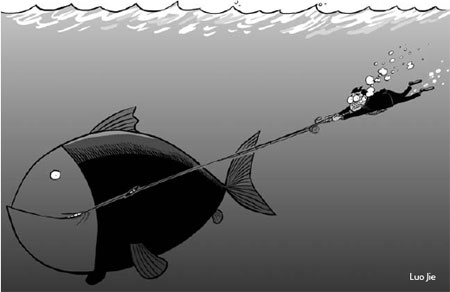 So there is plenty of encouragement for Chinese companies with pretensions of being global players. State-owned Minmetals succeeded only a week after Chinalco failed by snapping up struggling Oz Minerals. It was a small victory for China after the big disappointment of Chinalco. At $1.38 billion, the deal represented just a fraction of the Chinalco deal, and Oz Minerals had no better way of surviving. But it was an important psychological boost for China's overall acquisition ambitions. Minmetals was quick to learn lessons from its brother, upping its offer for Oz Minerals by 15 percent the night before a make-or-break vote by shareholders. That made it absolutely sure that China would not lose face twice in one month. It was a reminder to the West that Chinese business champions are not isolated commercial entities; they represent their country and people. It bodes well for future forays, among which Beijing Auto's reported interest in Volvo and Opel appeals most. China's auto industry has been unable to produce any of the big brand names that can define a nation and raise its international profile. It would take many years for China to build a brand like Volvo. The solution is to establish joint venture partnerships with the world's leading brands. Now is the time to act - when the global financial crisis has reduced the likes of GM and Chrysler to bankruptcy. With these ambitions, though, come pitfalls. China's automakers lack R&D and managerial expertise to turn these brands into profitable, mass-produced cars. Opportunities may be lost unless they consider employing strong teams of overseas specialists to bolster their research and development capabilities, but this option presents uncertainty and unforeseen costs. Such difficulties were demonstrated in Nanjing Auto's purchase of Britain's Rover in 2005. It had had a low profile, largely because Rover's reputation had been damaged years before it was sold. While Volvo is exactly the kind of brand China needs, the surprise move by the privately owned Sichuan Tengzhong Heavy Industrial Machinery Co for GM's Hummer contradicts the momentum of China's auto industry. The Hummer's is a niche market that does not represent the future. It is a symbol of environmental unfriendliness and inequality - it does not fit in with China's desired political and social image. In little doubt is the phenomenal firepower that underpins China's overseas investment drive. The kind of lending activity that saw China's banks stumping up the funds for Chinalco's $19.5-billion offer for Rio Tinto is possible only in China, where State-owned banks and businesses are treated as the left and right arms of the State. But it is important for China not to flaunt its wealth so publicly. To avoid attracting the type of opposition that sunk the Unocal and Rio Tinto deals, they need to ensure future acquisitions have a lower profile in the media. Rather than huge $19.5-billion offers, as was the case with Chinalco, a more piecemeal, calculated approach is more effective. Chinese companies should seek out more covert ways of gaining power through joint ventures with savvier Western private equity businesses. Finally, regulatory authorities should consider forming a panel of experts from across China's political and business circles to advise on where to look next. A more gradual acquisition policy will help dissipate fears and misunderstandings in the West. The author is professor of Economics and head of the School of Contemporary Chinese Studies in the University of Nottingham. (China Daily 06/17/2009 page9) |
