OPINION> OP-ED CONTRIBUTORS

|
OPINION> OP-ED CONTRIBUTORS
|
|
Running from the financial crisis to a debt crisis
By Kenneth Rogoff (China Daily)
Updated: 2009-09-15 07:54
Everyone from the Queen of England to laid-off Detroit autoworkers wants to know why more experts did not see the financial crisis coming. It is an awkward question. How can policymakers be so certain that a financial catastrophe will not recur soon when they seemed to have no idea that such a crisis would happen in the first place? The answer is not very reassuring. First, economics tells us much more about a country's vulnerability to financial crises than it does about the timing. Second, there is every reason to worry that the banking crisis has simply morphed into a long-term government debt crisis.
But if the governments have shown they will spare no expenses to backstop the financial system, who will backstop the governments, particularly with so many running out-sized deficits at the same time? As the governments pile up war-level debt burdens, when will the problem explode? Again we don't know. Our theoretical models tell us that even a massively leveraged economy can plod along for years, if not decades, before crashing and burning. It all boils down to confidence. It is precisely when investors are most sure that the governments will eventually dig their way out of huge debt holes that politicians dig their way deeper and deeper into debt. Economics theory tells us a lot about which countries are most vulnerable, but specifying exactly where and when crises will erupt is far more difficult. Unfortunately it is a bit like predicting heart attacks. A person who is obese and has high blood pressure and high level of cholesterol is statistically far more likely to have a serious heart attack or stroke than a person who exhibits none of these vulnerabilities. Yet high-risk individuals can often go decades without suffering a problem. At the same time, individuals who appear to be "low risk" are vulnerable to heart attacks.
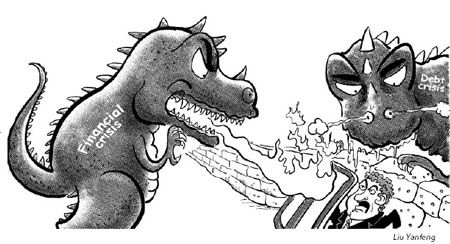 Of course, careful monitoring yields potentially very useful information for preventing heart attacks. Ultimately, however, it is helpful only if the individual is treated, and perhaps undertakes a significant change in lifestyle. The same is true of financial systems. Good monitoring yields information that is helpful only if there is a response. Unfortunately, we live in a world where the political and regulatory systems are often very weak and shortsighted. Indeed, no economy is immune to financial crises, no matter how much investors and leaders try to convince themselves otherwise, as Carmen Reinhart and I have shown in our new book, ironically entitled This Time is Different: Eight Centuries of Financial Folly. Right now, the latest "this time is different" folly is that, because the governments are taking all the debt on their shoulders, the rest of us don't have to worry. Unless we are taxpayers, that is. We are constantly reassured that governments will not default on their debts. In fact, governments all over the world default with startling regularity, either outright or through inflation. Even the US, for example, significantly inflated down its debt in the 1970s, and debased the gold value of the dollar from $21 per ounce to $35 in the 1930s. For now, the good news is that the crisis will be contained as long as government credit holds up. The bad news is that the rate at which government debt is piling up could easily lead to a second wave of financial crisis within a few years. Most worrisome is America's huge dependence on foreign borrowing, particularly from China -- an imbalance that is likely to have planted the seeds of the current crisis. Asians recognize that if they continue to accumulate paper debt, they risk the same fate that Europeans suffered three decades ago, when they piled up US debt that was dramatically melted down through inflation. The question today is not why nobody is warning about the next crisis. They are. The question is whether political leaders are listening. The unwinding of unsustainable government deficit trajectories is a key question that G20 leaders must ask themselves when they meet in Pittsburgh later this month. Otherwise, Queen Elizabeth II and Detroit autoworkers will be asking again, all too soon, why no one saw it coming. Kenneth Rogoff is professor of economics and public policy at Harvard University, and was formerly chief economist at the IMF. Project Syndicate. (China Daily 09/15/2009 page9) |
|||||||