OPINION> Raymond Zhou

|
OPINION> Raymond Zhou
|
|
The story of China Incorporated
By Raymond Zhou (China Daily)
Updated: 2009-10-23 08:44
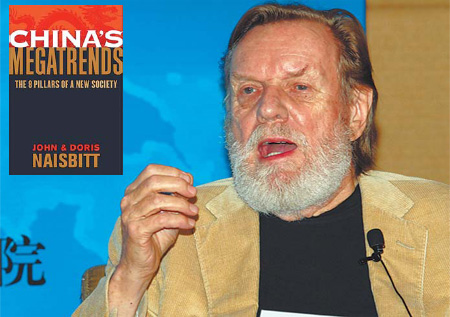
Twenty-five years ago, Megatrends was a must-read for any Chinese who was keen to know about the world - not just the world as it was, but the world that would be. And that included higher officials who were unaccustomed to foreign theorizing other than that by Marx and Lenin. By some estimate, the book sold some 20 million copies in China. The original English version was published two years earlier, in 1982, and stayed on the New York Times bestseller list for two years. Last month, John Naisbitt, the author of Megatrends, came out with China's Megatrends. This time, the Chinese edition debuted before the English original. The American author's foray into China study does not come as a surprise. He has been traveling around the country for many years, and has set up a China Institute in Tianjin - in his name. The book is the product of three years of intensive research and the collaboration of a sizable team. In the book, Naisbitt details "Eight Pillars" that support China's reform. They are "emancipation of the mind", "balancing top-down and bottom-up", "framing the forest and letting the trees grow", "crossing the river by feeling the stones", "artistic and intellectual ferment", "joining the world", "freedom and fairness" and "from Olympic gold medals to Nobel prizes". Some of the terms are borrowed from Chinese metaphors that reflect the Chinese penchant for imagery in lieu of abstract thinking. The futurist does not make specific predictions of what will happen to China. Rather, he reviews the past three decades when China transformed itself beyond anyone's anticipation.
John and Doris Naisbitt (the book is co-authored by his wife) make a deliberate attempt to unchain themselves from the orthodoxy of political dichotomy. Instead of applying the democratic-vs-autocratic yardsticks, they see China as a corporation. As such, the multitude of issues that confound foreign analysts suddenly begin to make sense. The authors explain why Chinese are results-oriented and reluctant to imitate Western ways of doing things: "Enterprises are judged not against other enterprises by evaluating company cultures, management styles and leadership skills but by their own economic performance." The Naisbitts' interpretation of Deng Xiaoping follows a similar line: "A visionary, decisive, assertive CEO takes over a very large, moribund company that is on the verge of collapse. "The workforce is demoralized, patronized and poorly educated. The CEO is determined to turn the rundown enterprise into a healthy, profitable, sustainable company and to bring modest wealth to the people. And he has a clear strategy for achieving this goal." That's closer in meaning to what the Chinese refer to as "the architect of China's reform" and much more accurate than "paramount leader", which the Western press usually uses. The authors and their team have conducted meticulous examination of the decision-making process of China's leadership. What fascinates them includes the top-down and then bottom-up bilateral approach and the pilot programs that epitomize the phrase "crossing the river by feeling the stones". They understand why Chinese leaders do not pay much attention to outside carping. "The CEO of a healthy, profitable company is not very vulnerable. Results dampen criticism. The more the new Chinese system evolves and the stronger its outlines become, the less vulnerable the political leadership will feel." At this level, China does not divert much from a typical Western democracy. But the authors regret that the Western press, which "criticizes China so self-righteously and condescendingly", are oblivious to the "cosmopolitanism and savoir-vivre of some top-ranking Chinese politicians". Not only do they scrutinize the current situation through a corporate lens, but they also evaluate its history and why it acted in certain ways: "For some time China acted no differently from an enterprise in crisis. When a company is rundown and on the brink of collapse, it cannot afford to vote on how to get out of the mess. "Decisions have to be made quickly and with the long term in view. Survival of the company has to take priority over individuals' interests and benefits." The Naisbitts do not build their arguments on the foundation of Chinese ideology. They do not subvert values held dear in the West. What they do is move closer to the Chinese perspective, the "Chinese context" as they name it. They make an extra effort to see Chinese society and its conundrums the Chinese way. Some of the findings have been documented before by other researchers, such as the Chinese self-perception as "more as part of a network than as individuals". But they show insight in noticing how people are not bitter about their experience in the "cultural revolution" (1966-76), but rather, made the best of it. They also understand why the Chinese keep silent on certain issues with which the West is obsessed. Their optimism about China is based on a willingness and objectivity that allow them to see the silver lining broadening and shrinking the cloud. As they see it, this is what a "fair appraisal" needs. The Nasbitts have not dramatically reinterpreted Chinese events of the past 30 years. They have provided a bridge between the standard Chinese version and the conventional wisdom of the West. They have proved that the mainstream interpretations of the East and the West are actually not that far apart. By confronting the biases and prejudices of the West, they are bringing the two sides a little closer. To a Chinese reader, this book, if the translation is complete and retains all the "sensitive" passages, offers a friendly Western take that ostensibly parallels our own, yet is subtly goading us on. Yes, we've made big strides, but we still have a long way to go. (China Daily 10/23/2009 page18) |